Hall of Fame Translation Policy: Accurate, Accessible Multilingual Recognition
- Home /
- Digital Wall of Fame Blog - Recognition Display Insights & Resources /
- Hall of Fame Translation Policy: Accurate, Accessible Multilingual Recognition
The Easiest Touchscreen Solution




Live Example: Rocket Alumni Solutions Touchscreen Display
Interact with a live example (16:9 scaled 1920x1080 display). All content is automatically responsive to all screen sizes and orientations.
A school’s hall of fame is only as inclusive as the language it speaks. When inductee names are misspelled in transliteration, biographical narratives are machine-translated without review, or award titles appear only in English on a display visited daily by students and families who speak other languages at home, the recognition program sends an unintended message. A written hall of fame translation policy defines exactly how the program handles multilingual content: which languages are supported, how translations are produced and verified, who holds final approval, and how updates are managed across every display and platform. Done well, a translation policy extends the reach and dignity of recognition rather than adding bureaucratic complexity.
Schools that serve linguistically diverse communities—and that number is growing across nearly every region—owe their honorees the same standard of accuracy in every supported language. This guide walks athletic directors, archive teams, hall-of-fame committees, and booster leaders through the purpose, structure, and practical steps for building a hall of fame translation policy that works.

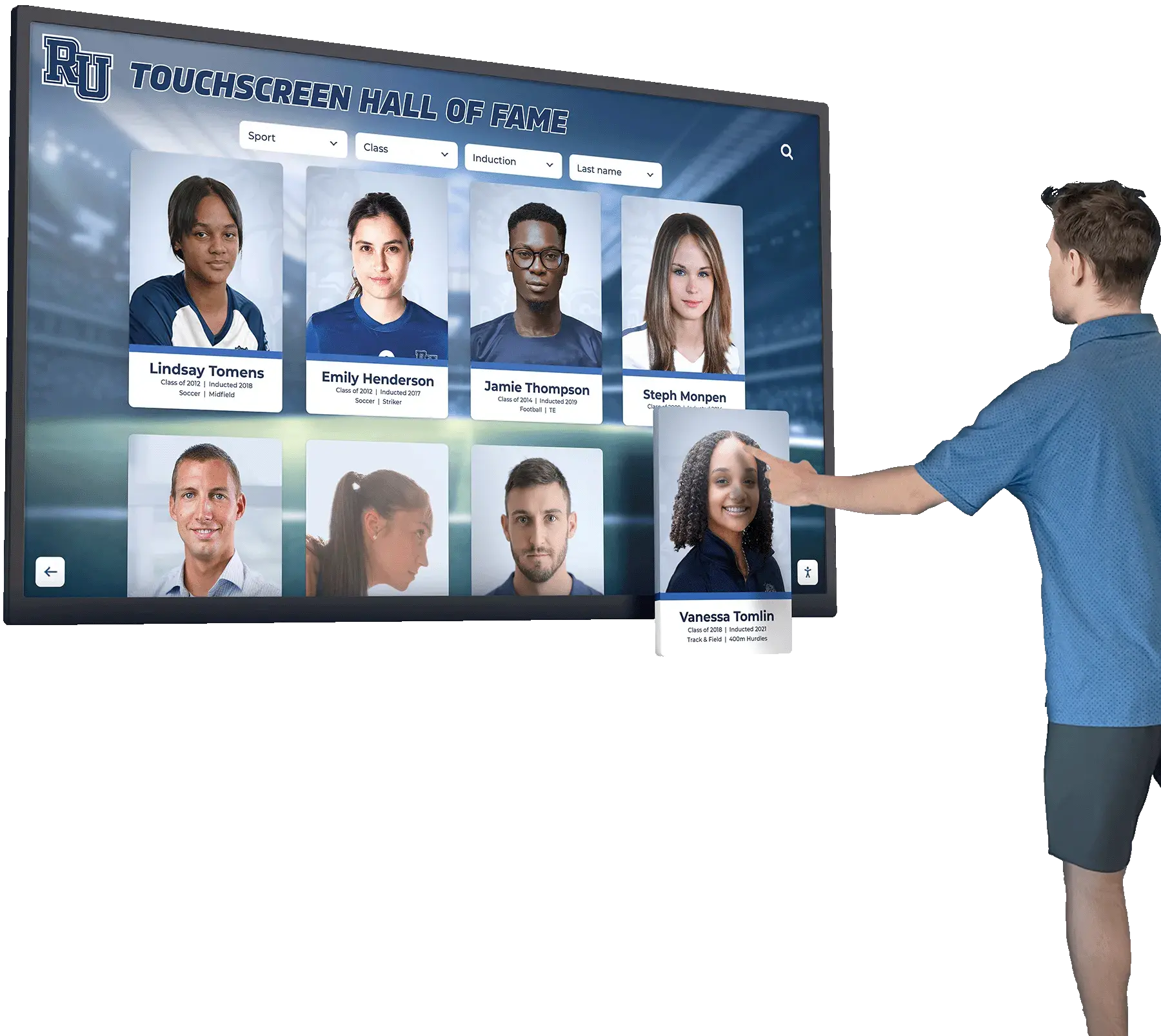
A modern hall of fame serves audiences who speak many languages; a formal translation policy keeps every inductee's recognition accurate and dignified across all of them
Why a Hall of Fame Translation Policy Matters
Most schools adopt a hall of fame translation policy reactively: a family points out that a name is mangled on a touchscreen display, or a bilingual staff member notices that a machine-translated biography has reversed the meaning of a sentence. By that point, the error has already been seen by everyone who walked through the lobby.
A proactive policy prevents those moments by building translation standards into the recognition workflow before content is ever published. It also signals institutional respect. When a school commits to publishing inductee content accurately in multiple languages, it communicates that recognition belongs to everyone in the community, not just those most comfortable reading English.
There is also a governance dimension. Digital recognition platforms increasingly support multilingual interfaces, QR-code-linked mobile profiles, and cloud-based content management systems that can publish the same inductee biography in several languages simultaneously. Without a policy governing which languages are supported, who verifies translations, and how corrections are processed, each language version becomes a separate maintenance burden with no clear owner.
Building a virtual hall of fame that serves your full community requires thinking through content governance from the start—including the language layers that make a program genuinely accessible.
The Four Content Categories a Translation Policy Must Address
A hall of fame translation policy should not treat all content as a single category. Different content types carry different risks of error and different standards for accuracy. A sound policy addresses each of the following four categories explicitly.
1. Inductee Names
Names are the most consequential content category and the one where errors cause the most harm. A misspelled or mistransliterated name on a lobby display is a public slight to the person being honored and their family.
The policy should establish:
- Transliteration standard: When a name uses a non-Latin script (Cyrillic, Arabic, Chinese characters, Korean Hangul, etc.), which transliteration system does the school follow? ISO standards, national romanization systems, and phonetic approximations can produce significantly different results. The policy should name the system used for each script and acknowledge that the inductee’s own preferred romanization takes precedence.
- Name authority: Who holds final authority over the displayed form of an inductee’s name? The inductee themselves (or their family, for deceased honorees) should have the right to specify how their name appears in any language version. This right should be documented as part of the nomination and onboarding process.
- Prohibited practices: The policy should explicitly prohibit using automated transliteration tools as the sole source for displayed names without human verification. Many automated systems produce outdated or regionally inconsistent romanizations.
2. Biographical Narratives
Inductee biographies describe career highlights, academic achievements, community impact, and personal background. Translation errors in biographical content can misattribute records, distort timelines, or introduce unintended meanings that alter how an inductee’s legacy is understood.
The policy should require:
- Human review of all translated biographies, even when a translation service or AI-assisted tool is used to produce a first draft. A bilingual community member, staff member, or professional reviewer should read the translated biography in context before it is published.
- Review by the inductee or a trusted family member, when possible. The person whose story is being told is often the best judge of whether the translation captures what they meant.
- A defined revision process: If an inductee or their family identifies an error in a translated biography after publication, how is the correction submitted, reviewed, and implemented? The policy should connect this to any existing content correction or takedown request process.
3. Award Titles and Category Labels
Award names—Most Valuable Player, All-Conference Honoree, Academic Excellence Award—carry specific meaning that may not translate directly. Some awards have official translated names; many do not. When a school invents a translation for an award title without institutional consensus, the result is often inconsistent across displays, programs, and digital profiles.
The policy should establish:
- An approved translation glossary for recurring award titles, category labels, position names, and program terminology. Once agreed upon, every translated display and profile uses the terms from this glossary consistently.
- A process for adding new terms to the glossary as new awards are created or as the recognition program expands.
4. Interface and Navigation Content
Hall of fame kiosks, touchscreen displays, and web-based recognition platforms include interface elements—navigation labels, search prompts, section headers, filter categories—that are separate from inductee-specific content but equally important for accessibility.
Interface translation is typically handled at the platform level rather than by individual schools, but the policy should specify whether the school expects the display vendor to provide interface translations, which languages are requested, and who verifies the interface translation quality before the display goes live.
For schools using digital yearbooks and modern memory preservation platforms, the interface language question often arises alongside inductee profile content—both need to be addressed in the same governance framework.
Step-by-Step: Building Your Hall of Fame Translation Policy
The following eight steps provide a practical framework for developing a translation policy that is proportionate to your school’s size, language diversity, and recognition program complexity.
Step 1: Audit Current Language Needs
Before writing the policy, understand the actual language landscape of your community. How many families in your school district speak a primary language other than English at home? Which languages are represented among current and historical inductees? Which language groups are most likely to engage with hall of fame content? Your district’s enrollment data and community surveys can help answer these questions. Focus the policy on the languages where translation provides genuine value to real members of your community.
Step 2: Define the Supported Languages
The policy should name the languages the school commits to supporting in hall of fame content. “All languages” is not a practical commitment. Naming specific languages—Spanish, Mandarin, Vietnamese, Arabic, or whatever reflects your community—makes the commitment enforceable and the translation workflow manageable. Start with two or three languages if resources are limited. The policy can be expanded as capacity grows.
Step 3: Identify Translation Resources
Determine who will produce translations for each content category. Options include:
| Resource Type | Best For | Limitations |
|---|---|---|
| Professional translation service | Biographical narratives, formal award descriptions | Cost, turnaround time |
| Bilingual staff or faculty | First-pass review, terminology verification | Availability, not always available for all languages |
| Community volunteers with verified fluency | Inductee name verification, community review | Must have a formal verification step; cannot be sole source |
| AI-assisted translation with human review | First drafts for high-volume content | Requires mandatory human review before publication |
| Inductee or family | Name preferences, biographical accuracy | Should be consulted, not solely responsible for translation |
The policy should specify, for each content category, which translation resources are acceptable and whether human review is mandatory. For inductee names and biographical narratives, human review should always be required.
Step 4: Establish the Name Authority Process
During nomination and induction intake, add a step that explicitly asks: how would you like your name to appear in non-English display versions? Provide the inductee or their family with a preview of any transliterated or translated form before it is published. Document the response in the nomination file and carry it forward into the recognition platform.
For deceased inductees being added to a historical program, contact the family with the same question before publishing.
Step 5: Build the Translation Glossary
Convene a small working group—at minimum the athletic director and one bilingual community member for each supported language—to agree on translated terms for the most frequently appearing award titles, category labels, and program terminology. Document the agreed terms in a simple reference table. Store the glossary in the same location as other hall of fame governance documents and link to it from the translation policy.
Step 6: Define the Publication Approval Workflow
Before any translated content is published to a display, the policy should specify who reviews and approves it. A practical workflow for most schools looks like this:
- Translation is produced by the designated resource
- A bilingual reviewer reads the translation in context and confirms accuracy
- The inductee or family is given the opportunity to review (with a defined response window)
- The athletic director or designated hall of fame administrator approves publication
- Content is published through the platform’s CMS and confirmed accurate on the live display
Step 7: Document the Correction Process
Errors in translated content will occur. The policy should specify a direct path for inductees, families, and community members to submit a correction: a named contact, an email address or form, and a defined response timeline. Corrections to inductee names should be treated as urgent and implemented within five business days.
Connect the translation correction process to any broader content correction or takedown request policy the school maintains, so requests are handled by the same workflow regardless of whether they involve language accuracy or other content concerns.
Step 8: Set a Policy Review Schedule
Translation standards, available tools, and community demographics all change over time. The policy should commit to a review on a defined schedule—annually for programs with active multilingual communities, every two to three years for programs with more stable language landscapes. The review should assess whether the list of supported languages is still appropriate, whether the translation glossary needs updating, and whether new tools or resources have changed best practices.
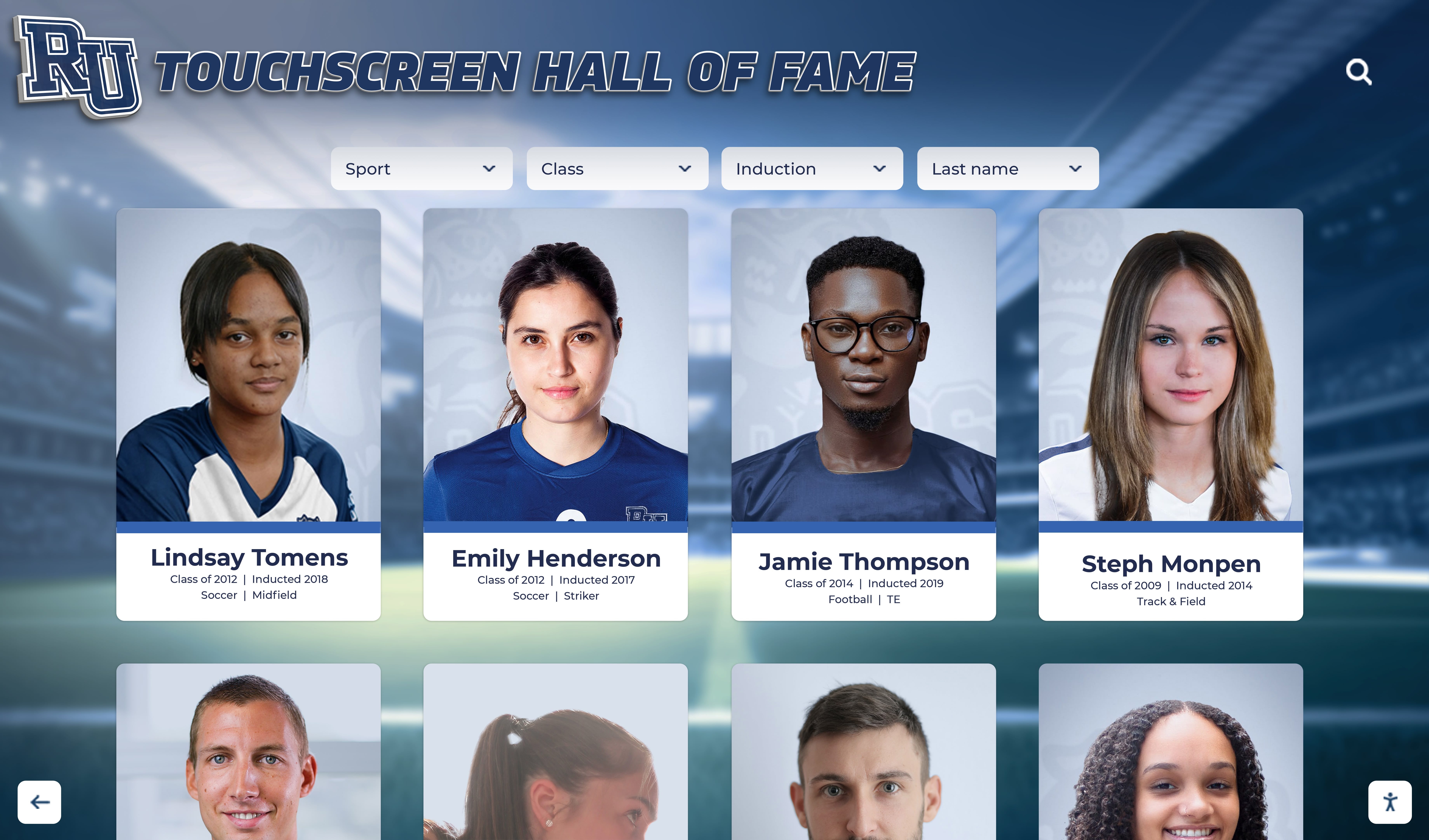
Cloud-based touchscreen recognition platforms allow schools to update inductee content across all display languages from a single CMS, making multilingual maintenance practical at any program size
Special Governance Situations
Inductees with Names in Multiple Scripts
Some honorees have names that are meaningful in their original script and become something different when romanized. A school serving communities with Chinese, Korean, Japanese, Arabic, or other non-Latin-script backgrounds may choose to display names in both the original script and a romanized form. The policy should specify whether dual-script display is supported, how it is formatted on the physical and digital display, and who is responsible for verifying the original-script form.
Historical Inductees Added Retroactively
When a school expands its hall of fame to include historical inductees from earlier eras, translated names and biographical content may need to be produced without the inductee available to confirm preferences. The policy should specify that for deceased historical inductees:
- Family members are contacted first for name verification
- Recognized historical sources (school archives, local newspaper records, published sports histories) are used for biographical content
- All historical translations are noted as produced without direct inductee confirmation, so future corrections can be made if family contact is later established
Awards with Official Translated Names
Some awards—academic honors, statewide athletic recognitions, and national honors—have official translated names established by the granting organization. When an award has an official translated name, the policy should require using that name rather than producing an independent translation. Examples include state scholar-athlete programs and national volunteer service recognition programs. When those official translated names are available, they take precedence over locally produced translations in the school’s glossary.
For context on how awards with multilingual recognition histories are documented, understanding what an MVP award means across different programs illustrates why award terminology consistency matters as halls of fame expand their language coverage.
Managing Translation Across Physical and Digital Displays
One of the practical challenges in multilingual hall of fame programs is that the same inductee content often appears in multiple locations: a physical plaque, a lobby digital kiosk, a web-based archive, and printed program materials. A translation policy that does not address each display format creates gaps.
| Display Type | Translation Approach | Update Speed |
|---|---|---|
| Physical plaques and banners | Translation approved before fabrication; errors require re-fabrication | Slow; corrections are expensive |
| Touchscreen digital kiosks with cloud CMS | Translation managed in CMS; updates publish across all displays remotely | Fast; single update applies everywhere |
| Web-based hall of fame profiles | Managed alongside digital display content in same CMS | Fast |
| Printed programs and media guides | Translation finalized before print run; corrections apply to future editions | Cannot be retroactively corrected |
The asymmetry in update speed between physical and digital formats is one of the strongest arguments for investing in a digital recognition platform before expanding a multilingual program. Schools that rely primarily on physical plaques face a situation where every translation error requires expensive re-fabrication, and where adding a new supported language means reprinting the entire collection. Cloud-based touchscreen platforms allow schools to add a language, update a name, or correct a biography across every display in the building from a single content management interface.
For programs that include recognition beyond athletics—academic honor rolls, coach appreciation programs, and community service awards—the same translation governance framework applies. How schools honor coaches and the leaders behind the team is a context where multilingual recognition is equally important, particularly for coaches whose families may be more comfortable reading in a language other than English.
Connecting Translation Policy to Broader Recognition Governance
A hall of fame translation policy does not stand alone. It connects to and should be coordinated with several related governance documents:
- Nomination and induction policy: Add the name-preference inquiry and inductee review step as explicit parts of the induction workflow.
- Content correction and takedown request policy: Route translation error corrections through the same process as other content corrections, with faster timelines for name errors.
- Deaccession policy: When physical plaques are deaccessioned, the translated content associated with those plaques should be preserved in the digital archive under the same standard as English content.
- Accessibility policy: Multilingual support and accessibility are overlapping commitments. ADA-compliant touchscreen displays and WCAG 2.1 AA-compliant web profiles serve users with disabilities and users whose primary language is not English through the same underlying infrastructure.
School spirit and recognition programs that build community benefit from the same governance rigor that makes a hall of fame program credible—consistency, accuracy, and documented standards that apply to everyone equally.
How schools create meaningful athletic sponsorship relationships is another context where translation governance matters: sponsor recognition panels may appear alongside inductee displays, and the same standards for accuracy and multilingual consistency should apply.
Frequently Asked Questions
Q: Does a hall of fame translation policy require the school to translate into every language spoken in the community?
A: No. The policy should define a specific list of supported languages based on the languages most prevalent in the community and available translation resources. Supporting two or three languages well is far better than attempting to support many languages without the resources to maintain accuracy. The policy can expand as resources grow.
Q: Who should have final approval authority over translated inductee names?
A: The inductee themselves, or their family for deceased honorees, should have the right to specify how their name appears in any language version. The athletic director or designated hall of fame administrator holds final institutional approval, but the inductee’s documented preference takes precedence over any other source.
Q: Is machine translation (AI-assisted) acceptable for hall of fame content?
A: AI-assisted translation is acceptable as a first-pass tool to produce draft translations quickly, but it must not be the sole source for any published content involving inductee names or biographical narratives. Human review by a fluent speaker is mandatory before publication. Machine translation errors in names and biographical content can cause significant harm to inductees and their families.
Q: How should the school handle a situation where two family members disagree about the correct form of a deceased inductee’s name?
A: Document both preferences, explain the school’s intent to display the name in a single canonical form, and ask the family to reach consensus with a defined timeline. If consensus cannot be reached, the policy should specify a default—typically the form documented in the most authoritative historical source available (original enrollment records, official award documentation, published obituaries). Document the decision and the basis for it.
Q: Should the policy apply to donor and sponsor recognition panels as well as athletic inductee profiles?
A: Yes, if those panels appear on the same display platforms as inductee content. Consistency across the display environment—using the same translation standards for everyone whose name appears on a school recognition display—is both practical and equitable. Coordinate with the development office for donor recognition content.
Q: How should a school prioritize translation requests when resources are limited?
A: Prioritize in this order: (1) inductee names in any supported language where the current display is known to contain an error; (2) new inductee biographical content being published for the first time; (3) existing biographical content for the most-visited or highest-profile inductees; (4) interface and navigation content for touchscreen displays; (5) historical inductee content being added to a digital archive. This order reflects the harm-reduction principle: errors in published content that visitors are already seeing warrant faster attention than content not yet live.
Q: What resources are available to help schools develop their translation glossary?
A: Start with the state athletic association’s published glossary if one exists. Review how other schools in your district or conference have translated recurring award titles. For terminology without an established precedent, consult bilingual staff, community members, or a professional translation service. Document the agreed terms and the rationale for each choice so future committees understand why specific translations were selected.
Q: Does a multilingual hall of fame require special hardware or software?
A: Modern touchscreen recognition platforms include cloud-based content management systems designed to support multiple language versions of the same inductee profile, with remote update capability that publishes changes across every display simultaneously. No special hardware is required. The key is choosing a platform whose CMS is designed for multilingual content management, so adding a language version does not require duplicating the entire database manually.
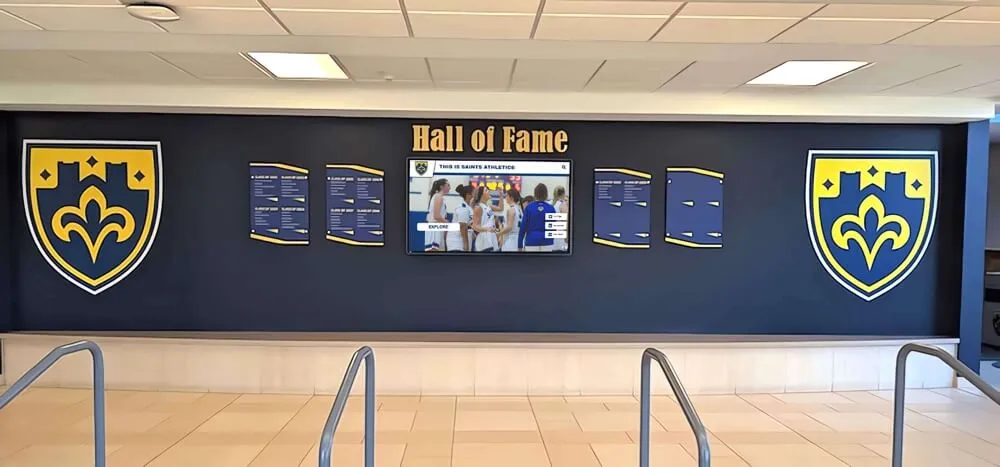
A formal translation policy ensures that every name and story displayed on a recognition wall is as accurate and meaningful in any supported language as it is in English
Building the Policy Document: Eight Required Sections
A written hall of fame translation policy should address each of the following sections. Administrators who inherit a hall of fame program without existing documentation can use this list as a checklist for what still needs to be written.
1. Purpose and scope — State the policy’s purpose and identify which displays, platforms, and content types it covers. Be explicit about whether the policy covers only athletic inductees or also donor recognition, academic honor programs, and other recognition content that appears on the same platforms.
2. Supported languages — List the specific languages the school commits to supporting, with a note that the list may be expanded by policy amendment. Include the effective date for each language’s inclusion, so future administrators know when translation coverage was added.
3. Content category standards — Define the translation requirements and review standards for each of the four content categories: inductee names, biographical narratives, award titles and glossary terms, and interface content.
4. Name authority process — Specify the steps for obtaining and documenting inductee name preferences, including the process for historical inductees whose families must be contacted retroactively.
5. Translation resources and approval workflow — Identify acceptable translation resources for each content category and describe the approval workflow that must be completed before translated content is published.
6. Translation glossary — Reference the location of the approved glossary and establish the process for adding or updating terms.
7. Correction process — Define how translation errors are reported, reviewed, and corrected. Include timelines and the responsible staff role.
8. Policy review schedule — Commit to a review on a defined cycle and name the position responsible for initiating that review.
Honoring the full scope of student athletic achievement through recognition programs requires the same consistency and documentation discipline that makes a translation policy effective—standards that apply equally to every honoree, regardless of which award they received or which language their family speaks at home.
For programs building multilingual recognition alongside athletic displays, creative recognition ideas that build team and school community benefit from the same attention to inclusive communication that a translation policy formalizes.
How Digital Recognition Infrastructure Supports Multilingual Programs
The practical feasibility of a multilingual hall of fame depends heavily on the technology platform used to manage and display recognition content. Schools relying on static physical plaques face a fundamentally different (and more expensive) translation challenge than schools using cloud-based touchscreen recognition systems.
On a cloud-based platform, adding a translated version of an inductee biography means entering the text in the CMS—no fabrication, no reprinting, no technician visit to the display. A correction to a transliterated name updates instantly across every touchscreen in the building. New language versions can be added to existing profiles without rebuilding the entire display.
The accessibility advantages extend beyond language. ADA-compliant touchscreen displays with adjustable text size and contrast settings serve visitors who need those accommodations alongside visitors using the multilingual interface. Celebrating swimming programs and athletes in recognition displays is one example of how program-specific recognition content benefits from the same accessible, updatable platform that makes multilingual governance practical.
Football trophies and awards that tell the story of a program’s history are another example where digital preservation and multilingual accessibility extend the reach of recognition—families who attend games and visit the lobby speak many languages, and the display should honor all of them equally.
For athletic directors evaluating recognition infrastructure with an eye toward multilingual support, Learn more about Rocket Alumni Solutions’ Digital Wall of Fame platform to see how cloud-based content management, unlimited inductee storage, and remote update capabilities support multilingual recognition programs at scale.
A hall of fame translation policy is a commitment to the same accuracy and dignity for every honoree, regardless of the language their family reads. It does not require unlimited resources or a full-time translation staff. What it requires is a written framework that defines standards, assigns responsibility, documents decisions, and builds review into the publication workflow before errors reach the display. Schools that invest in that framework—and pair it with a digital recognition platform that makes multilingual updates fast and manageable—build recognition programs that truly reflect the communities they serve.
Make Multilingual Recognition Manageable with a Modern Display Platform
Rocket Alumni Solutions' interactive touchscreen wall of fame gives your school a cloud-based content management system that supports multilingual inductee profiles, remote updates, and consistent recognition across every display—so your translation policy is easy to implement and maintain over time.
Request Your Custom DemoLive Example: Rocket Alumni Solutions Touchscreen Display
Interact with a live example (16:9 scaled 1920x1080 display). All content is automatically responsive to all screen sizes and orientations.