



Latin honors GPA designations—cum laude, magna cum laude, and summa cum laude—represent the pinnacle of academic achievement recognized at graduation ceremonies across thousands of colleges, universities, and increasingly, high schools. These distinctions tell a student’s entire academic story in two or three Latin words, signaling to future employers and graduate schools that the graduate not only completed their degree but excelled at the highest levels.
Yet the GPA thresholds behind these honors vary more than many people realize. One university may award summa cum laude to students with a 3.9 GPA, while another reserves it for the top 2% of graduates regardless of their GPA. Understanding exactly how these distinctions work—and how institutions decide who earns them—matters for students working toward them, families celebrating them, and schools designing the recognition programs that honor them permanently.
This guide explains the GPA thresholds behind each Latin honor, explores how institutions set their own standards, and details how schools create lasting recognition displays that make these academic achievements visible and celebrated long after graduation day.
Latin honors transform a grade point average into a permanent designation of excellence. Whether printed on a diploma, announced at commencement, or displayed on a touchscreen wall of honor in a school lobby, these recognitions carry weight that extends far beyond the ceremony itself.

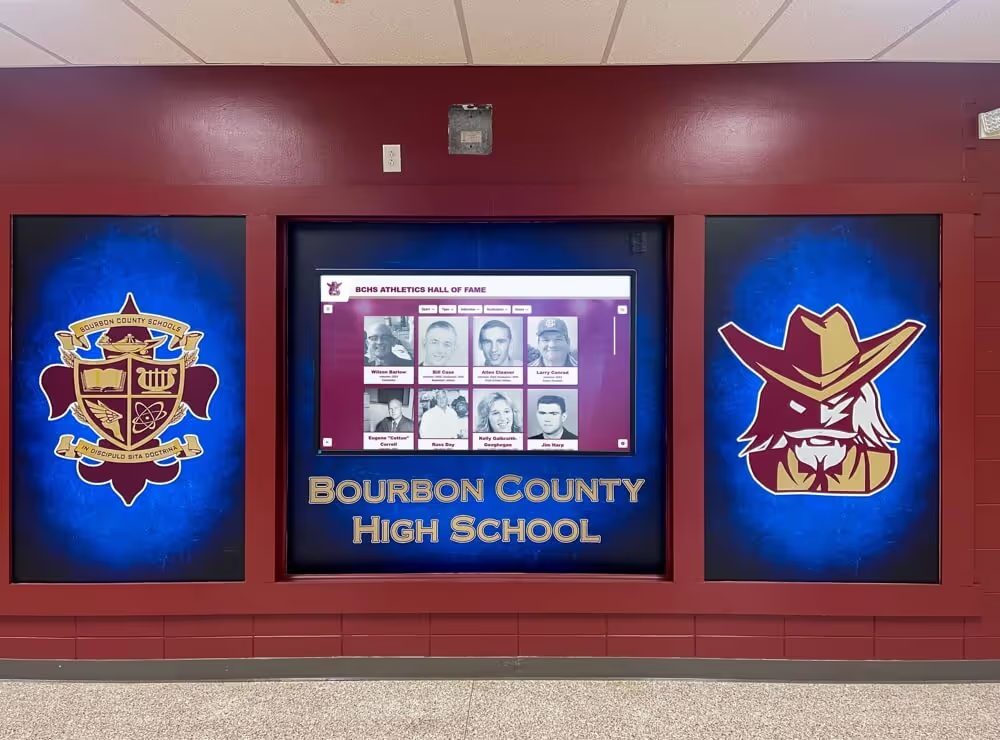
Permanent recognition displays in school hallways keep academic honors visible and celebrated throughout the year, not just at graduation
What Is Latin Honors GPA and Why It Matters
Latin honors originate from European university traditions dating back centuries, with American institutions adopting the system during the 19th century. Today, nearly all four-year colleges and universities in the United States use some form of this tiered honor system at commencement, and the practice has expanded to high schools, community colleges, and professional programs.
The three standard Latin honors, from highest to lowest, are:
- Summa cum laude — “with highest praise”
- Magna cum laude — “with great praise”
- Cum laude — “with praise”
Some institutions add a fourth tier—laude alone—for students who narrowly miss cum laude requirements, though this is less common.
Why Latin Honors Appear on Transcripts, Diplomas, and Displays
The practical value of Latin honors extends through a graduate’s entire career. Graduate school admissions committees use these designations as objective comparisons across institutions. Employers note them on resumes as evidence of sustained academic commitment. And within the academic community, they represent a shared shorthand for achievement that crosses institutional boundaries.
For schools, Latin honors create natural recognition touchpoints: graduation ceremonies, diplomas, transcripts, commencement programs, and increasingly, permanent digital displays that honor each class’s highest achievers.
Explore academic awards categories by grade level to understand how Latin honors fit within broader academic recognition frameworks.
Standard Latin Honors GPA Thresholds
No single universal GPA standard governs Latin honors—each institution sets its own thresholds. That said, several benchmark ranges appear across the majority of American colleges and universities.
Cum Laude GPA Requirements
Cum laude typically requires a cumulative GPA between 3.5 and 3.7 on a 4.0 scale. This level recognizes students who consistently performed above average throughout their academic career, maintaining strong grades across general education requirements, major coursework, and electives.
At institutions using class rank percentile systems rather than fixed GPA cutoffs, cum laude often corresponds to the top 30–35% of graduating students.
Common cum laude thresholds by institution type:
- Large public universities: frequently 3.5–3.6 GPA
- Private liberal arts colleges: often 3.5 or top 30% of class
- Community colleges (where applicable): typically 3.5 GPA
- High schools adopting Latin honors: commonly 3.5 GPA
Magna Cum Laude GPA Requirements
Magna cum laude occupies the middle tier, typically requiring a cumulative GPA between 3.7 and 3.85. Students earning this designation demonstrate sustained excellence that goes beyond good grades into the territory of consistent high performance across all coursework.
At percentile-based institutions, magna cum laude often represents the top 10–15% of graduates.
Typical magna cum laude GPA ranges:
- Research universities: commonly 3.7–3.8 GPA
- Liberal arts colleges: often top 10–12% of class
- Professional programs (business, nursing, education): typically 3.75+
- High schools: generally 3.7–3.8 GPA
Summa Cum Laude GPA Requirements
Summa cum laude represents the highest academic honor, typically requiring a cumulative GPA of 3.9 or higher on a 4.0 scale. Some highly selective institutions set the bar at 3.95, while others define summa cum laude as the top 1–5% of graduates regardless of absolute GPA.
Earning summa cum laude often requires near-perfect academic performance maintained over four years, including performance in demanding upper-division coursework where grade distributions tend to be more rigorous.
Summa cum laude thresholds across institution types:
- Highly selective universities: often top 1–3% of class or 3.9+ GPA
- Mid-size universities: typically 3.9–3.95 GPA
- Liberal arts colleges: frequently top 5% or 3.9+ GPA
- High schools: generally 3.9+ GPA, sometimes 4.0 unweighted only
Fixed GPA vs. Percentile-Based Systems
Institutions choose between two primary approaches to setting Latin honors thresholds, and understanding the difference helps students plan their academic goals.
Fixed GPA thresholds establish absolute cutoffs: achieve a 3.5, 3.7, or 3.9 GPA and you qualify regardless of how many other students also meet that standard. In strong academic years, a higher percentage of graduates earn honors; in weaker years, fewer do. This approach rewards individual achievement without penalizing students for being in a high-achieving cohort.
Percentile-based systems award Latin honors to fixed proportions of each graduating class: perhaps the top 30%, top 15%, and top 5%. This ensures consistent distribution across years but means the actual GPA required fluctuates with each cohort’s performance.

University recognition spaces celebrate academic and athletic achievement side by side, creating comprehensive displays of institutional excellence
Some institutions combine both approaches, requiring a minimum GPA (e.g., 3.5) to qualify for any Latin honor consideration while also imposing percentile caps to limit each tier’s size.
How Different Institutions Approach Latin Honors
Understanding variation across institutional types helps schools designing their own recognition programs benchmark against peers and set appropriate thresholds.
Four-Year College and University Latin Honors
Most four-year institutions publish their Latin honors thresholds in academic catalogs and on registrar websites. According to institutional data and academic policy publications, threshold ranges typically look like:
| Honor | Typical GPA Range | Typical Percentile |
|---|---|---|
| Cum Laude | 3.50–3.69 | Top 25–35% |
| Magna Cum Laude | 3.70–3.89 | Top 10–15% |
| Summa Cum Laude | 3.90–4.00 | Top 3–5% |
Highly selective research universities sometimes use different criteria, including factors beyond GPA such as thesis completion, departmental recommendations, or minimum credit hour requirements. Students at these institutions may need to complete additional requirements to qualify even if their GPA meets the threshold.
Community College Latin Honors
An increasing number of community colleges award Latin honors at graduation, typically using fixed GPA thresholds similar to four-year institutions. The practice recognizes that associate degree programs involve rigorous academic work deserving formal distinction. Most community colleges using Latin honors set cum laude at 3.5, magna cum laude at 3.7, and summa cum laude at 3.9.
High School Latin Honors Programs
High schools adopt Latin honors for several reasons: they provide meaningful recognition beyond standard honor roll designations, align graduating seniors with the collegiate recognition system they’ll enter, and create natural content for graduation ceremonies and permanent recognition displays.
High school implementations typically use unweighted GPA thresholds to maintain consistency across students in different course loads, though some schools use weighted GPA to account for AP and honors course rigor.
Check out high school awards ceremony ideas for inspiration on incorporating Latin honors into graduation and recognition events.
What Latin Honors Look Like at Graduation
The visibility of Latin honors at commencement ceremonies creates memorable moments that families photograph and students carry in memory for decades. Understanding how these honors appear physically helps schools design recognition that matches their ceremony traditions.
Graduation Cords and Regalia
The most visible display of Latin honors at graduation comes through academic regalia—specifically graduation cords worn around the neck or stoles worn over graduation gowns. Standard color conventions vary by institution, but common approaches include:
Gold cords: Most commonly used for cum laude designations across institutions. Gold symbolizes academic achievement and appears prominently against dark graduation gowns.
Gold and white cords: Often used for magna cum laude, distinguishing this tier from basic cum laude.
Gold and white braided cords or medallions: Frequently reserved for summa cum laude graduates, providing visual distinction for the highest honor at a glance.
Some institutions use single cord colors where cord thickness or braiding indicates honor level, while others use entirely different color schemes matching institutional color identities. Schools should publish their specific cord color conventions in commencement programs so graduates and families understand what each designation signifies.
Announcements and Diplomas
Latin honors appear in multiple places beyond graduation day regalia:
Commencement programs: Graduating students’ names appear listed under their respective honor designations in printed and digital programs.
Verbal announcements: Commencement speakers or faculty marshals announce each graduate’s honors designation as students cross the stage.
Diplomas: Most institutions print Latin honor designations directly on diplomas, creating permanent documentation of academic achievement that students carry throughout their careers.
Official transcripts: Latin honors appear on official academic transcripts as a permanent record, often stated both as a designation and as the GPA that earned it.

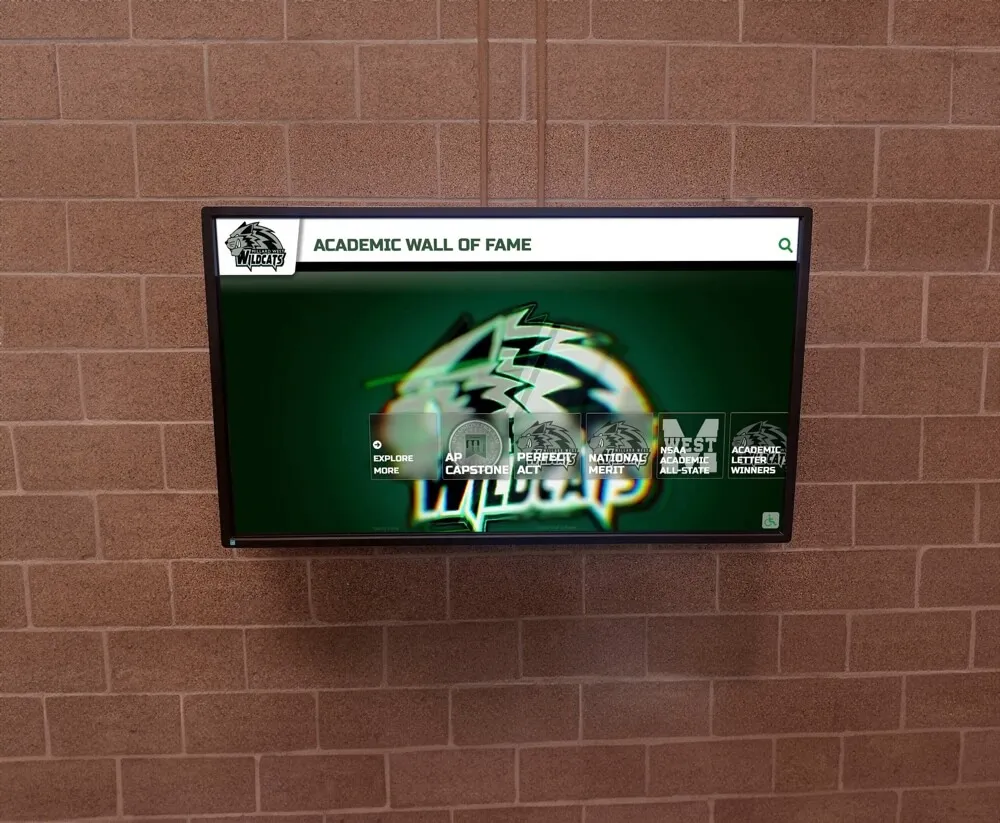
Digital recognition displays extend the visibility of academic honors beyond graduation day into permanent campus recognition spaces
Learn about the full range of awards high school students can win that complement Latin honors recognition.
Creating Permanent Latin Honors Displays
Graduation ceremonies create brief, powerful recognition moments—but the achievement deserves visibility beyond a single afternoon. Schools that create permanent recognition displays for Latin honors graduates build institutional culture around academic excellence while honoring student accomplishment in lasting ways.
The Case for Permanent Academic Honor Displays
Physical and digital recognition displays serve purposes that graduation ceremonies alone cannot fulfill:
Year-round visibility: A display in a school lobby or academic building makes academic excellence visible to current students throughout the year, not only at graduation. When students see their peers honored permanently, it reinforces the message that academic achievement matters institutionally.
Alumni connection: Graduates who return for reunions, sporting events, or campus visits can find their names recognized alongside their classmates. This connection to institutional history strengthens alumni relationships.
Prospective student recruitment: Families touring campuses notice recognition displays. A well-designed Latin honors gallery signals institutional commitment to academic distinction and celebrates the achievements that define your academic community.
Motivational impact: Current students who see predecessors recognized for cum laude and summa cum laude achievements have concrete evidence that the institution honors academic success publicly and permanently.
Explore how alumni recognition event planning creates natural opportunities to celebrate Latin honors graduates with the alumni community.
Traditional Latin Honors Display Approaches
Before digital solutions, schools recognized academic honorees through several traditional methods:
Honor plaques: Engraved plaques in academic buildings listed graduates achieving each honor tier. These created permanent, dignified recognition but required expensive re-fabrication each year and eventually ran out of wall space.
Dean’s list bulletin boards: Quarterly honor roll postings in hallways recognized current students but offered limited permanence and lacked the visual distinction of formal Latin honors.
Framed class lists: Many institutions display framed lists of each graduating class’s Latin honors recipients in libraries, administration buildings, or academic department offices. These maintain historical records but limit engagement to text-only formats.
Trophy and award cases: Some institutions display graduation cords, medals, or other regalia alongside class photos and honor designations in trophy cases near main building entrances.
Traditional approaches carry institutional tradition and gravitas, but they create limitations: fixed content that can’t be updated, space constraints that force difficult prioritization, no multimedia capability, and accessibility challenges for visitors with visual impairments.
Digital Recognition Displays for Academic Honors
Modern touchscreen recognition displays transform how schools celebrate Latin honors graduates. Platforms like Rocket Alumni Solutions enable institutions to create searchable, interactive galleries of academic honorees that provide capabilities traditional displays cannot match.
Unlimited recognition capacity: A single touchscreen display can feature every cumulative Latin honors recipient in an institution’s history—hundreds or thousands of graduates—without the space constraints that force traditional displays to limit visibility.
Rich graduate profiles: Each honoree’s entry can include their photo, graduation year, major, Latin honors designation, notable achievements, and post-graduation accomplishments, telling complete academic stories rather than simply listing names.
Searchable databases: Visitors can search by name, graduation year, honor tier, academic department, or other criteria to explore the institution’s full history of academic excellence.

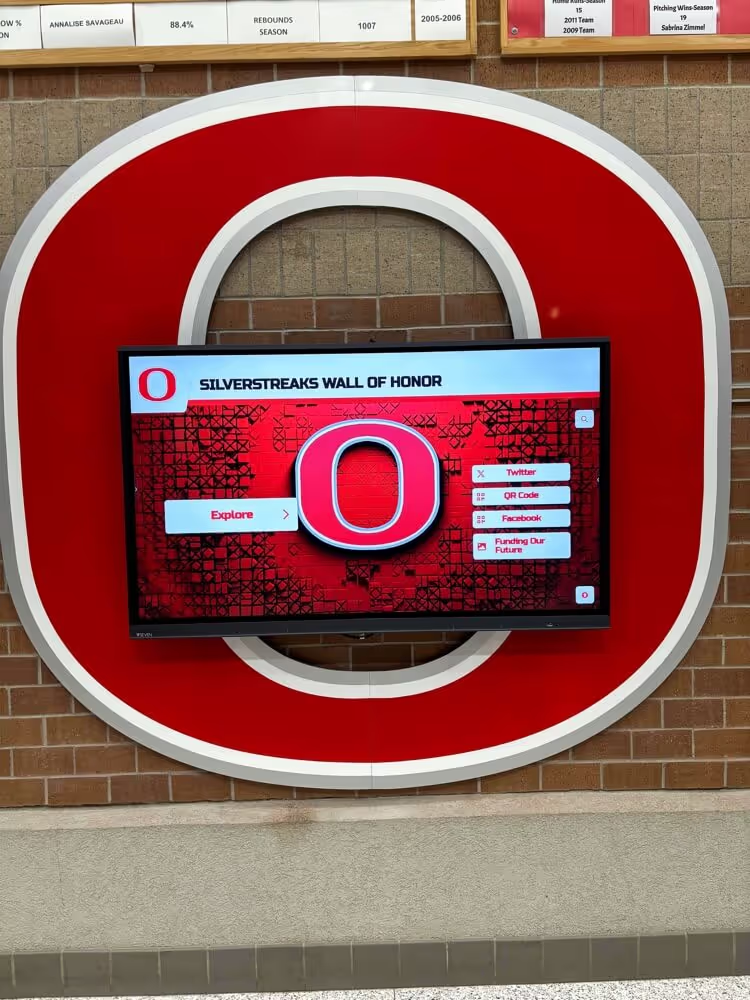
Interactive recognition displays invite engagement from students, families, and alumni throughout the year
Annual updates without replacement: Adding each new graduating class’s Latin honors recipients requires a simple content management update rather than new fabrication. Administrators can update displays remotely from any internet-connected device, publishing new honorees on graduation day itself.
ADA accessibility compliance: ADA-compliant touchscreen displays meeting WCAG 2.2 AA standards ensure Latin honors displays are accessible to all visitors, including those with visual, motor, or cognitive accessibility needs.
QR code mobile access: Digital recognition systems with QR code functionality allow visitors to access full honoree profiles on their personal devices, extending engagement beyond the physical display location.
Designing an Effective Latin Honors Recognition Display
Whether implementing a new digital system or updating traditional approaches, several design principles maximize the impact of Latin honors recognition.
Organizing Latin Honors Content
Tiered visual hierarchy: Design choices should clearly communicate the three honor levels visually. Color coding, typography sizing, layout positioning, and display order should all reinforce that summa cum laude represents the highest distinction.
Chronological organization: Displaying Latin honors by graduation year creates a historical narrative of academic achievement, allowing visitors to browse specific classes or explore trends across decades.
Departmental categorization: Institutions with strong departmental identities may benefit from organizing honorees by college, school, or academic department alongside class year, helping current students see Latin honors achievers within their own academic area.
Search functionality: For institutions with many years of honorees, robust search capabilities become essential. Graduates searching for themselves or family members should be able to find records quickly and reliably.
Content Elements for Honoree Profiles
Compelling Latin honors recognition displays go beyond listing names and GPAs. Consider including:
- Professional photo: A graduation photo or formal portrait connects recognition to the person
- Graduation year and degree: Provides academic context for each honoree
- Major and concentration: Shows the breadth of academic excellence across disciplines
- Honors designation in Latin: The formal designation shown prominently in recognition of what was earned
- Post-graduation path: Where noted honors graduates went after earning their degree reinforces that Latin honors recognition translates to real-world opportunity
- Thesis or research highlights: For graduate programs or undergraduate honors theses, brief descriptions of scholarly work add depth
Explore hall of fame induction criteria for digital displays to understand how to establish clear, consistent selection and display standards.
Placement Strategies for Maximum Visibility
Where a Latin honors display lives on campus significantly affects how many students and families engage with it:
Library entrances: Students using the library daily encounter academic recognition regularly, reinforcing the connection between scholarly effort and honored achievement.
Academic building lobbies: Placing Latin honors displays in buildings associated with academic work—classroom buildings, faculty offices, lab complexes—creates contextual connection between learning and recognition.
Admissions areas: Prospective students and families touring campus see Latin honors recognition during visits, signaling institutional commitment to academic excellence and setting aspirational expectations.
Alumni gathering spaces: In venues used for reunions, alumni events, and homecoming activities, Latin honors displays create natural connection points where graduates find their records and introduce the display to family members.

Multi-screen installations allow institutions to dedicate separate displays to different recognition categories, including academic honors
Latin Honors Recognition Beyond the Display
Physical and digital recognition displays work best as part of broader recognition ecosystems that celebrate academic achievement through multiple channels.
Integrating Latin Honors with Annual Awards Programs
Latin honors graduation recognition connects naturally with annual academic awards programs that recognize excellence throughout the year:
End-of-year banquets: Senior recognition events that present Latin honors cords in a ceremony before graduation create additional recognition moments and allow families to participate in honoring their students.
Department honors convocations: Many academic departments hold their own recognition ceremonies at which Latin honors recipients receive acknowledgment within their disciplinary community alongside department-specific awards.
Academic awards ceremonies: Schools hosting separate academic awards events create opportunities to recognize Latin honors recipients with particular attention to their academic journeys before they get swept into general commencement activities.
Digital signage rotation: Schools using digital signage software can rotate Latin honors recipient profiles across campus screens during graduation week, extending recognition visibility across the entire campus environment.
Learn more about building comprehensive annual programs in high school awards ceremony planning guides.
Social Media and Digital Communication
Latin honors recognition translates naturally to digital communication channels:
Graduate spotlight posts: Featuring each class’s summa cum laude graduates in individual social media spotlights creates personalized recognition that reaches family networks and drives engagement.
Class honor roll graphics: Visual announcements listing all Latin honors recipients by tier create shareable recognition content that families and graduates naturally distribute to their networks.
Alumni newsletter features: Regular features on Latin honors graduates and their post-graduation paths maintain alumni engagement while reinforcing the institution’s academic achievement culture.
Website recognition galleries: Online recognition galleries accessible from institutional websites extend Latin honors visibility to prospective students, donors, and the broader community.
For guidance on maintaining digital displays long-term, review digital wall of fame maintenance best practices.
Connecting Academic and Extracurricular Recognition
The most impactful recognition programs present Latin honors alongside complementary achievements rather than in isolation:
Academic-athletic honor walls: Many schools with strong athletic traditions display academic honors alongside athletic achievements in unified recognition spaces. Showing that student-athletes earn Latin honors reinforces holistic achievement values.
Leadership and service integration: Combining Latin honors recognition with student leadership, community service, and extracurricular achievement creates comprehensive profiles that honor the full student experience.
Club and organization connections: School club highlights and recognition integrated with academic honors displays show prospective students the full breadth of campus achievement.
Perfect attendance recognition: Academic achievement displays that include attendance recognition alongside Latin honors celebrate the consistency and commitment that often correlate with academic excellence.

Web-based recognition platforms extend Latin honors visibility to alumni, families, and prospective students regardless of geographic location
Frequently Asked Questions About Latin Honors GPA
What GPA do you need for cum laude at most schools? Most institutions require a cumulative GPA of 3.5 for cum laude designation, though requirements range from 3.4 to 3.7 depending on the institution. Percentile-based systems may award cum laude to the top 25–35% of graduates.
Is magna cum laude or summa cum laude higher? Summa cum laude is the highest Latin honor, followed by magna cum laude, then cum laude. Summa cum laude—meaning “with highest praise”—typically requires a 3.9 or higher GPA or placement in the top 3–5% of graduating students.
Do high schools use Latin honors? Yes, many high schools have adopted Latin honors programs, typically using GPA thresholds similar to those used by colleges: 3.5 for cum laude, 3.7 for magna cum laude, and 3.9 for summa cum laude. Some high schools use these designations for graduating seniors; others apply them across all grade levels.
Are Latin honors on a weighted or unweighted GPA? This varies by institution. Many colleges use cumulative GPA as calculated on their standard grading scale, which may or may not weight AP, honors, or other advanced coursework. High schools using Latin honors often specify whether they use weighted or unweighted GPA for threshold calculations. Students should consult their specific institution’s academic catalog or registrar for this information.
How do Latin honors appear on a diploma? Most institutions print the Latin honors designation directly on the diploma below the degree title. The exact format varies—some print the full Latin phrase, others print the English translation, and some include both. The designation also typically appears on official transcripts.
Can you lose Latin honors after they’re awarded? Once formally conferred at graduation, Latin honors designations are permanent academic credentials. However, institutions calculate Latin honors designations based on the cumulative GPA at time of graduation, so all coursework through the final semester counts toward the threshold calculation.
What’s the difference between Latin honors and honor roll? Honor roll designations typically recognize academic achievement within a specific semester or grading period, while Latin honors represent cumulative achievement across an entire degree program. Honor roll is an ongoing, per-semester recognition; Latin honors are conferred once at graduation based on four years of cumulative academic performance.
Building a Latin Honors Recognition Program That Lasts
Creating recognition for Latin honors graduates that endures beyond the graduation ceremony requires institutional commitment to systematic documentation, consistent display, and regular updating. Schools that build comprehensive academic honor recognition programs create assets that serve multiple constituencies—motivating current students, honoring alumni, engaging families, and demonstrating institutional values to prospective students.
The recognition infrastructure built for Latin honors naturally extends to other academic achievements: honor roll designations, departmental awards, national scholarship recognition, and academic competition achievements. A platform capable of displaying and managing Latin honors recognition can typically serve as the foundation for comprehensive academic achievement recognition.
Institutions ready to create lasting, engaging recognition for their Latin honors graduates have more options than ever—from traditional engraved plaques to interactive touchscreen displays that feature complete graduate profiles with searchable databases spanning decades of institutional academic excellence.
Celebrate Your Academic Honors Graduates Permanently
Discover how interactive digital recognition displays can transform how your institution honors cum laude, magna cum laude, and summa cum laude graduates—featuring unlimited inductees, searchable profiles, and ADA-compliant touchscreen access that keeps academic excellence visible year-round.
Request a Custom DemoWhether your school awards Latin honors to three graduates or three hundred, those students earned distinctions worth celebrating beyond a single ceremony morning. The institutions that honor academic achievement most effectively create recognition systems that keep these accomplishments visible, searchable, and celebrated for years after graduation—reminding current students that academic excellence receives the same institutional recognition as athletic achievement, and building a culture where the pursuit of cum laude, magna cum laude, and summa cum laude becomes a genuine community aspiration.