Recognition Wall Layout Guide: HOF Design Patterns for K-12 Schools
- Home /
- Digital Wall of Fame Blog - Recognition Display Insights & Resources /
- Recognition Wall Layout Guide: HOF Design Patterns for K-12 Schools
The Easiest Touchscreen Solution




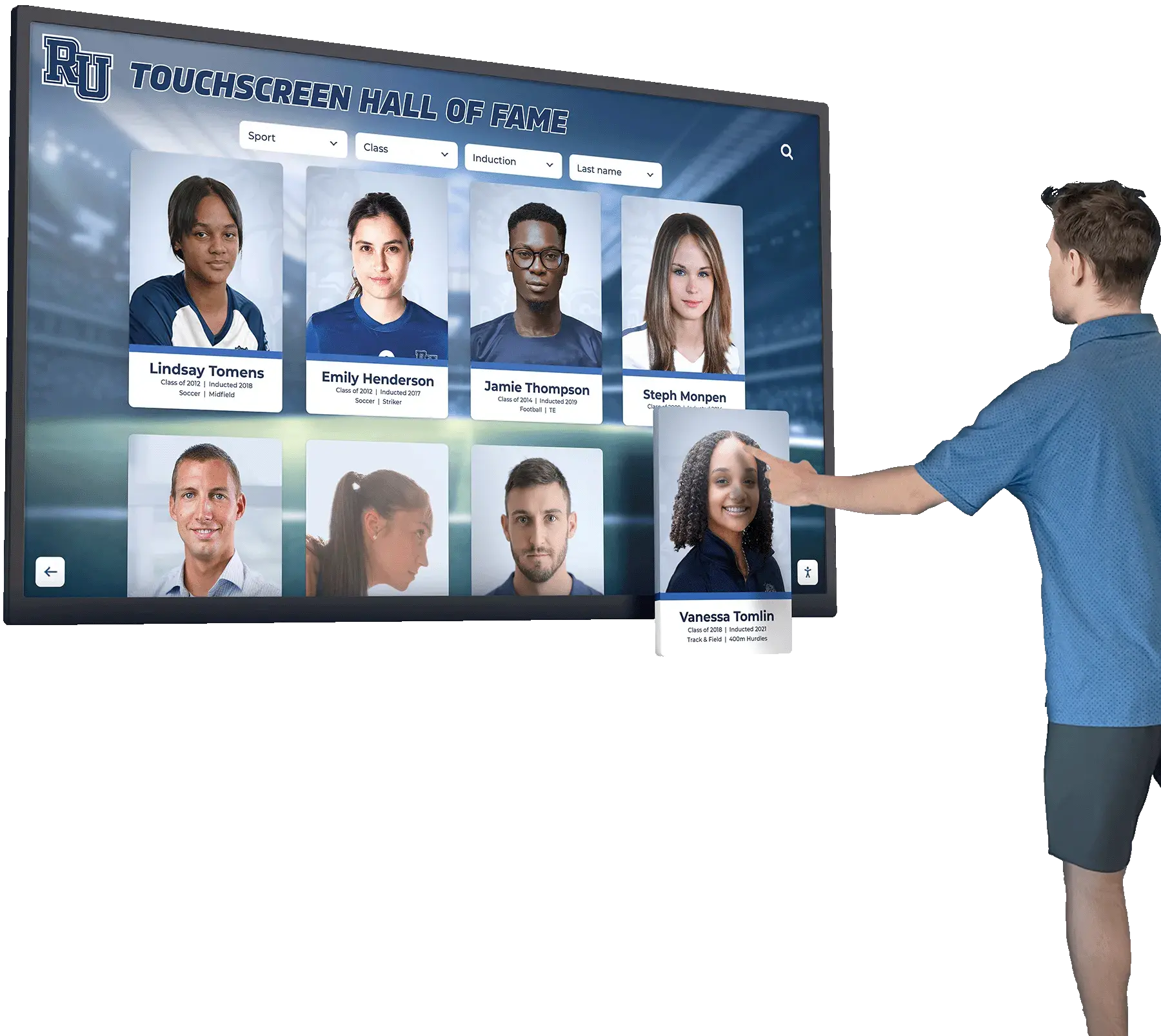
Live Example: Rocket Alumni Solutions Touchscreen Display
Interact with a live example (16:9 scaled 1920x1080 display). All content is automatically responsive to all screen sizes and orientations.
Every K-12 school eventually faces the same decision: how to organize decades of athletic championships, academic honors, alumni achievements, and donor contributions into a wall display that actually works. The recognition wall layout you choose determines whether visitors stop to engage, whether inductees feel genuinely honored, and whether the display remains practical five years from now when new names need to be added. Get it right and your lobby becomes a point of pride. Get it wrong and you’re staring at overcrowded plaques nobody reads and available wall space that’s already full.
This guide breaks down the most effective hall of fame design patterns for K-12 schools—grid, vertical, tiered, and interactive touchscreen layouts—across the four core recognition categories: athletic, academic, alumni, and donor. Whether you’re planning a first-time installation or rethinking an existing display that’s run out of room, these patterns give you a clear framework for making decisions that will hold up for decades.
Understanding how layout choices interact with content strategy is the foundation of any successful recognition wall. The physical arrangement of names, photos, and categories shapes how visitors move through the space, what they notice first, and how strongly they connect with the school’s legacy.

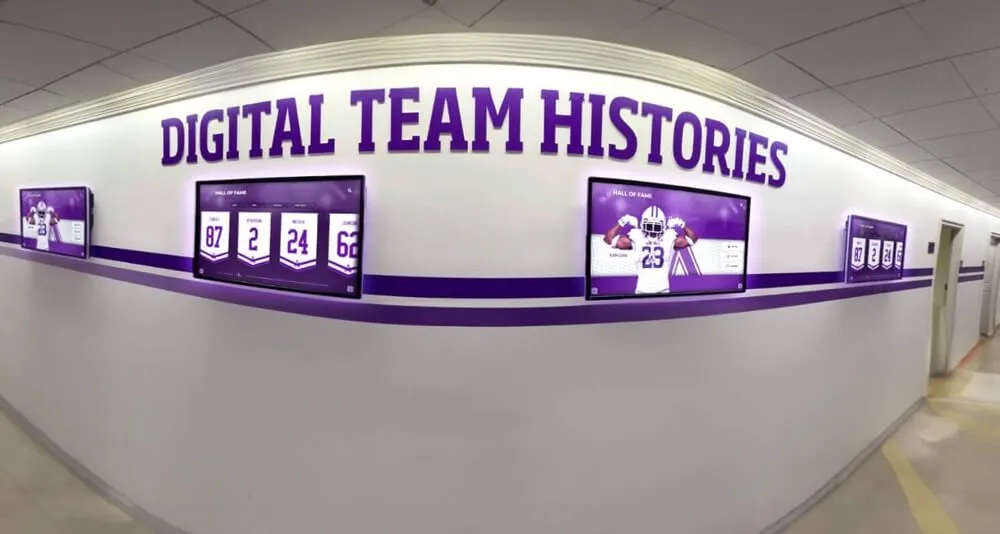
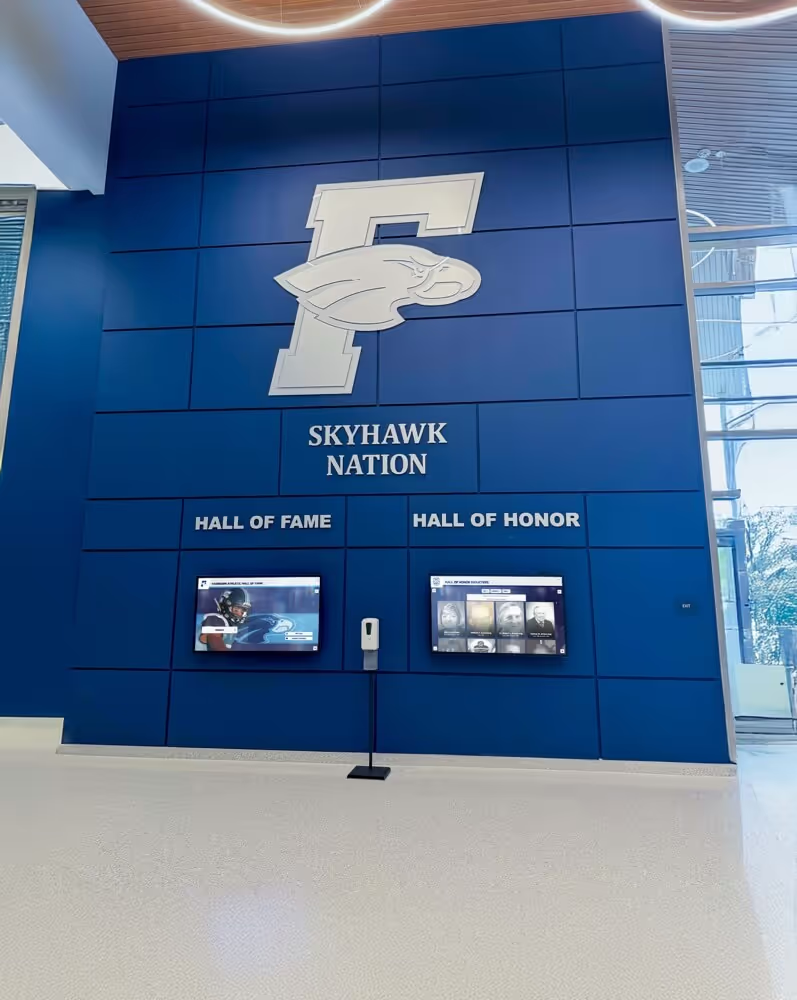
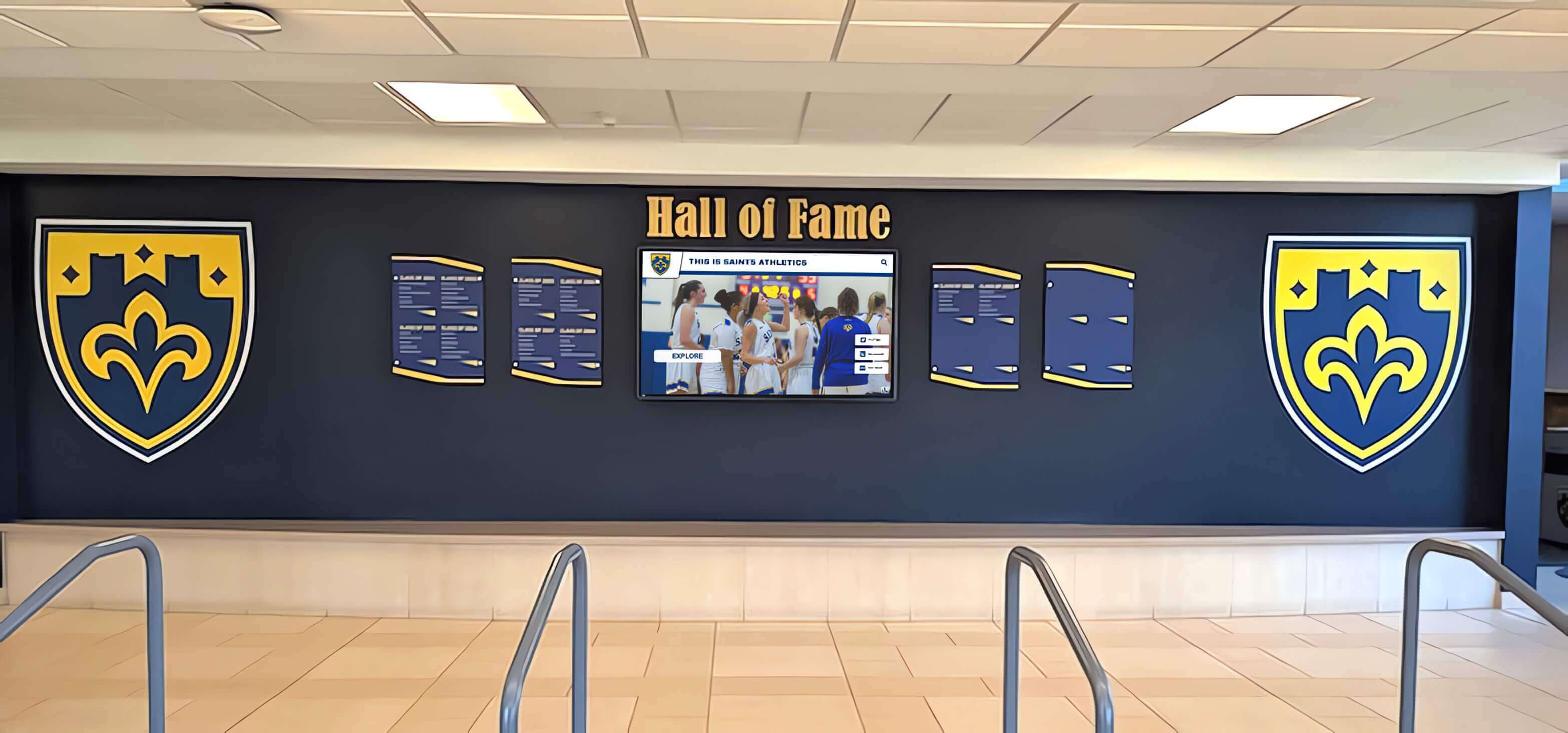
A well-designed hall of fame lobby combines structured visual hierarchy with digital technology to create lasting first impressions
Why Recognition Wall Layout Matters More Than You Think
A recognition wall isn’t simply a list of names. It’s an active communication tool that broadcasts school values, motivates current students, and deepens alumni connections every time someone walks by. Layout choices carry direct consequences:
Space efficiency determines how many inductees you can display before the wall becomes unmanageable. A poorly planned layout fills to capacity within five years; a well-planned one scales for decades.
Visual hierarchy guides the eye and communicates relative importance. Without it, a wall of 200 names reads as visual noise rather than meaningful recognition.
Category organization determines whether visitors can find relevant honorees or spend five minutes scanning without success.
Flexibility is what separates a display that serves the school in 2030 from one that requires expensive renovation by 2028.
Schools selecting a recognition wall layout should think long-term from the start. Decisions made for budget or aesthetic reasons during initial installation often create structural problems that cost far more to fix later.
The Four Core Recognition Categories
Before choosing a layout pattern, K-12 schools need clarity on what categories of recognition the wall will carry. Most comprehensive recognition walls combine some or all of these:
Athletic Recognition
Athletic halls of fame represent the most common type of school recognition wall. These typically honor:
- Individual sport champions and all-state athletes
- Team championship seasons with roster documentation
- Career statistical leaders and record holders
- Coaches who built successful programs
- Student-athletes who went on to collegiate or professional play
Athletic recognition walls benefit from visual energy—sport-specific imagery, dynamic action photos, and bold color schemes aligned with school identity. Hall of fame selection criteria and induction standards significantly affect how the display grows over time, so schools should establish clear criteria before designing the layout.
Academic Recognition
Academic recognition displays honor intellectual achievement alongside athletic accomplishment. Content categories include:
- Valedictorians and salutatorians by graduation year
- National Merit Scholars and AP Scholars
- National Honor Society inductees
- Academic team champions and competition winners
- Faculty members with distinguished service or awards
Academic walls often benefit from cleaner, more refined layouts that communicate gravitas and scholarly achievement rather than athletic energy. For a comprehensive view of high school recognition award categories and selection criteria, schools find that thoughtful category definition prevents scope creep and layout complications down the road.
Alumni Recognition
Alumni walls celebrate graduates who have achieved distinction in their careers, communities, or civic roles long after leaving school. This category often includes:
- Distinguished alumni by profession or industry
- Community leaders and public servants
- Philanthropists and school benefactors
- Military service veterans and decorated officers
- Alumni who have brought recognition to the school’s name
Alumni displays need regular updating as graduates’ careers develop, making content management flexibility a critical layout consideration. Understanding how schools recognize graduates across different life stages helps determine what content depth the layout needs to accommodate.
Donor Recognition
Donor walls recognize financial contributors to capital campaigns, endowments, scholarship funds, and facility improvements. Donor recognition typically organizes by giving tier:
- Major gifts (naming rights for facilities or programs)
- Leadership gifts
- Annual fund leadership donors
- Legacy donors and planned giving participants
Donor recognition carries specific design expectations—donors who contribute at naming-gift levels have reasonable expectations about the prominence of their recognition. For detailed guidance on donor wall display ideas for schools, schools can find approaches suited to every budget range and space constraint.
Grid Layout Patterns
The grid layout is the most common recognition wall pattern and the default choice for many schools. In a grid layout, honorees appear in uniform cells—typically equal-sized photo frames or plaques arranged in rows and columns.
When Grid Layouts Work Well
Uniform honoree pools: When all inductees share the same category (such as individual sport halls of fame), the grid provides visual equity where every honoree receives identical treatment.
Photo-forward recognition: Schools wanting to lead with athlete or honoree portraits find grids the most efficient way to display large photo collections.
Championship rosters: Team championship displays benefit from grid arrangements that can show full rosters without requiring different frame sizes for different athletes.
Grid Layout Limitations
The grid’s inherent weakness is its inflexibility. When you run out of wall space, the choices are removing old inductees (unacceptable), extending into an adjacent wall (requires planning), or abandoning the grid format entirely.
Grid layouts also struggle to communicate hierarchy. When a three-time state champion and a one-time varsity letter winner appear in identical frames, the display communicates nothing about the relative significance of different achievements.
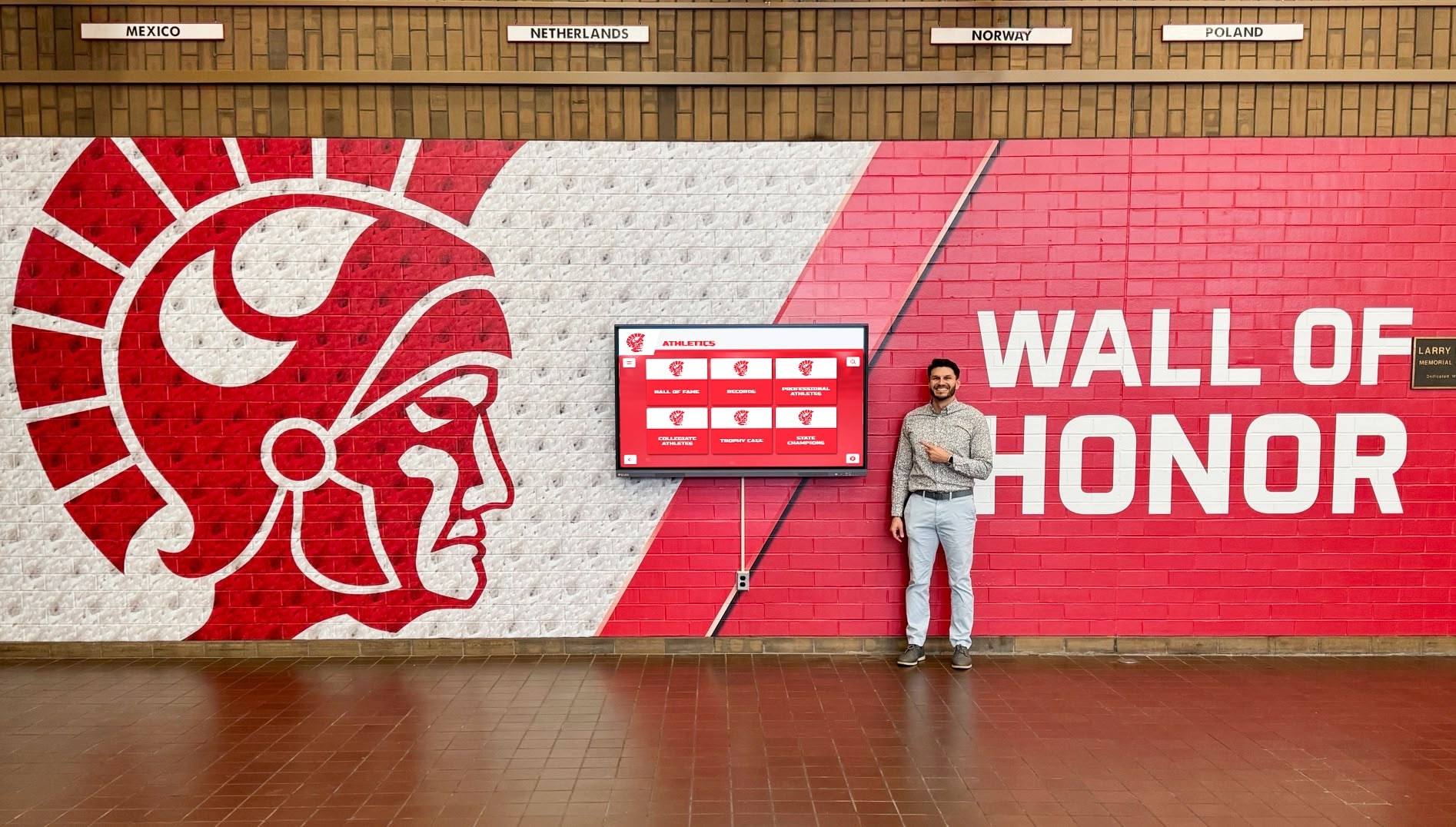
Grid-style layouts create visual consistency and work well for uniform honoree categories in dedicated hallway spaces
Optimizing a Grid Layout
Schools committed to grid layouts should:
Pre-plan expansion zones: Design the initial installation to cover only 60-70% of available wall space, preserving room for future inductees without requiring redesign.
Standardize photo dimensions: Uniform photo sizes enable additions that maintain visual consistency across years of different photography quality and style.
Use modular framing systems: Interlocking or track-mounted frame systems allow additions without drilling new holes or disrupting existing displays.
Add organizational headers: Year banners, sport category dividers, or decade markers give a large grid visual structure that helps visitors navigate.
Vertical and Linear Layout Patterns
Vertical layouts organize recognition content in tall columns rather than wide rows. This pattern works particularly well in corridor settings where wall width is limited but ceiling height provides display real estate.
Corridor Recognition Walls
Long school hallways present ideal opportunities for linear recognition displays that guide visitors through a journey of school history. Effective corridor layouts:
Chronological narrative: Organizing recognition chronologically along a hallway creates a historical timeline that visitors experience progressively as they walk. The 1960s championship wall at the hallway entrance transitions naturally into decades of subsequent achievement, giving context to each era’s inductees.
Sport or category zones: Dividing a hallway into sections for each sport or recognition category allows visitors to seek specific content while ensuring every program receives dedicated visibility.
Alternating visual rhythm: Varying between portrait photos, team images, and text-based recognition panels prevents visual monotony across long wall runs.
The “One Side” Layout Challenge
Many schools have recognition displays running along only one side of a hallway, creating a one-way experience. Schools with available walls on both sides of a corridor can create immersive recognition environments where athletic achievement lines one wall and academic recognition lines the other—a layout that communicates the school’s commitment to developing complete student-citizens.
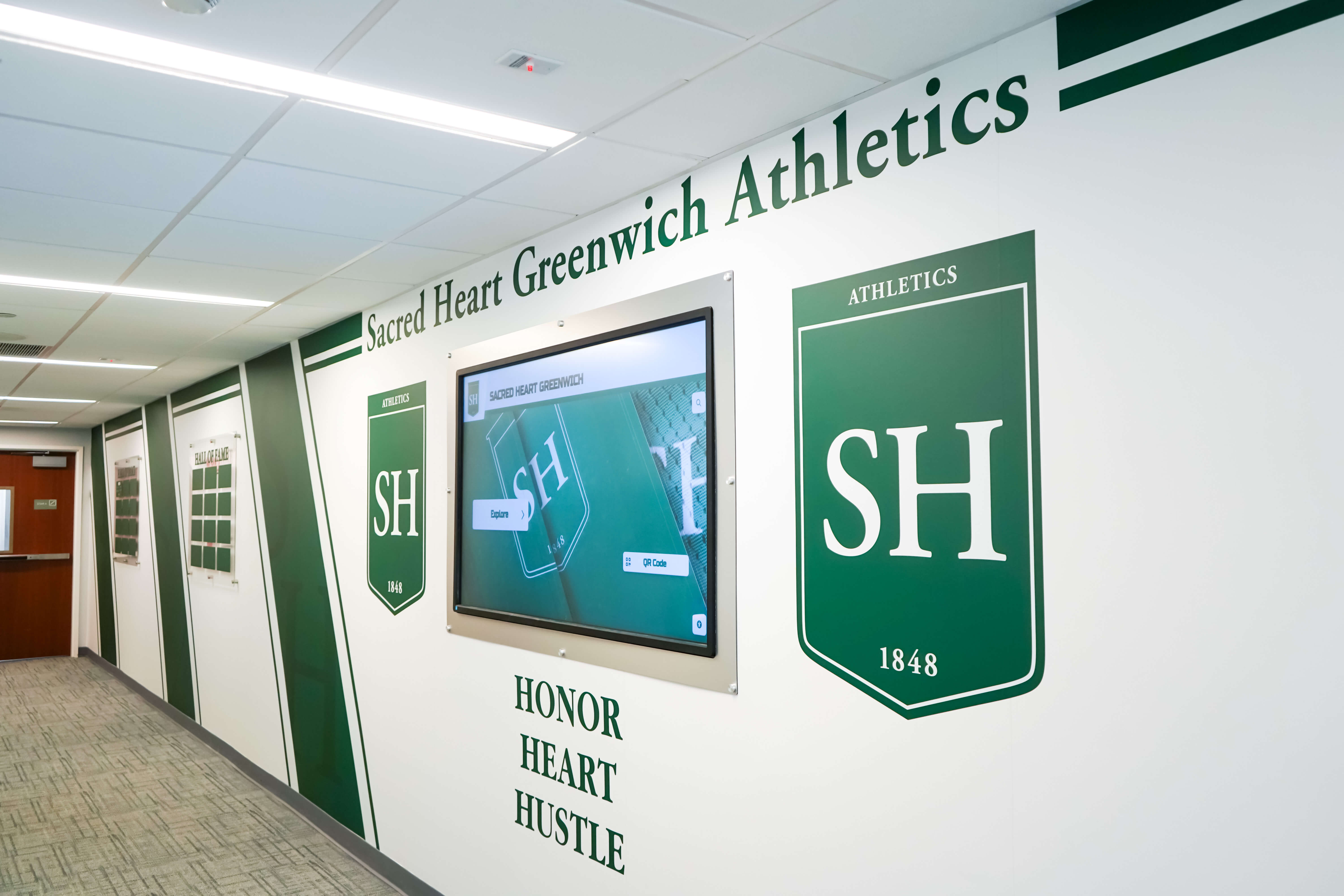
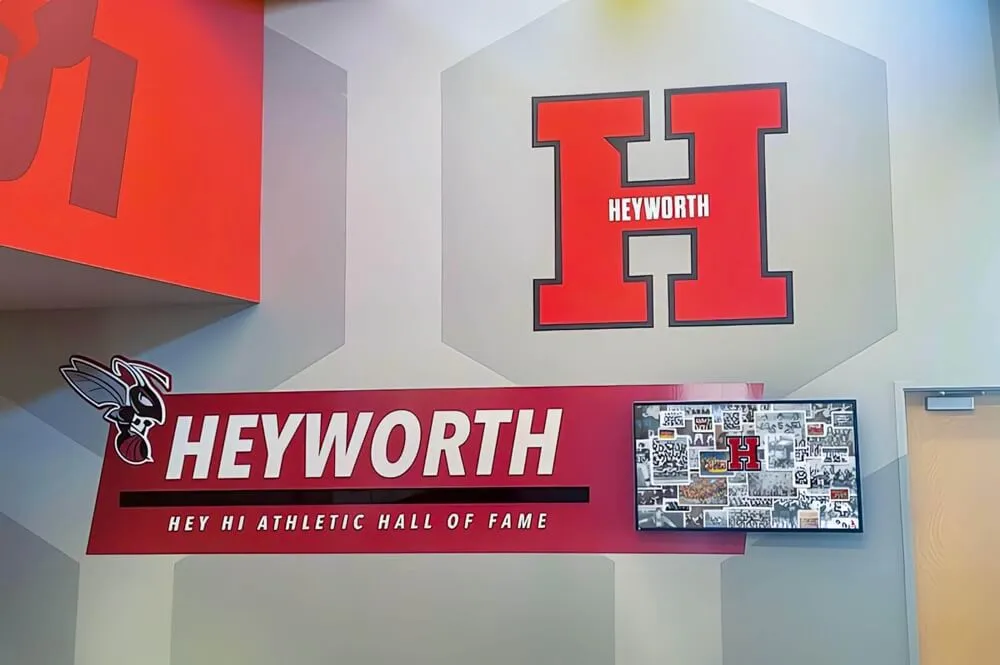
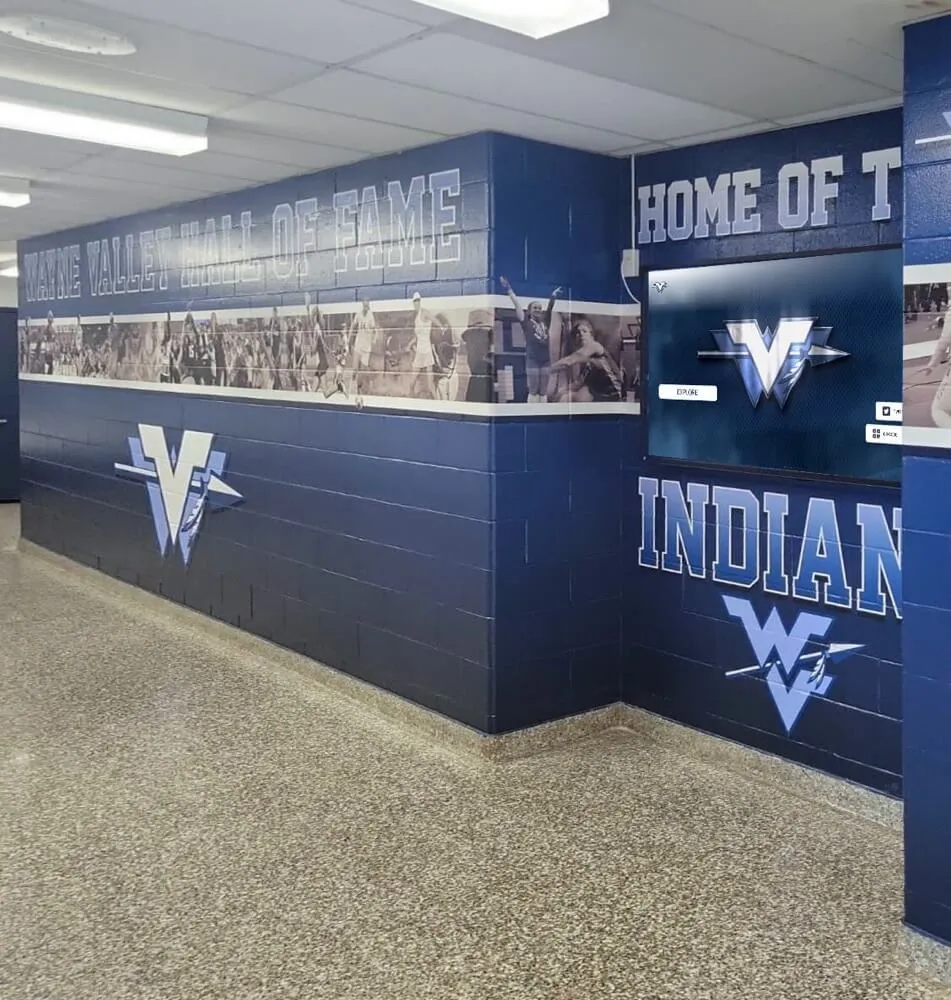
Corridor-spanning recognition displays with sport-specific shields create organized visual zones that guide visitors through school achievement history
Tiered and Hierarchical Layout Patterns
Tiered layouts communicate rank and achievement level through physical placement and scale. In a tiered recognition wall, the most distinguished honorees appear at eye level or center frame in larger format, with broader recognition categories expanding outward or downward.
Why Hierarchy Matters in Hall of Fame Design
Not all recognition is equivalent. A student-athlete who earned a Rhodes Scholarship and an Olympic medal has achieved at a different level than a varsity letterman who completed their eligibility. Treating these achievements identically on the same wall doesn’t serve either honoree well.
Tiered layouts solve this by:
Differentiating achievement levels visually: Larger photo formats, premium placement at eye level, and distinguishing graphic treatment communicate relative distinction without requiring visitors to read fine print.
Creating aspirational “pantheon” positions: When current students see that the top tier of the recognition wall represents truly extraordinary achievement, the display motivates at a deeper level than a uniform grid.
Organizing donor tiers appropriately: For donor recognition specifically, tiered layouts directly communicate giving levels that relate to specific campaign priorities.
Common Tiered Layout Structures
Center pyramid: The most distinguished honorees occupy the center of the wall in larger format, with broader recognition expanding outward in progressively smaller cells.
Top-row pantheon: A dedicated top row features the school’s most distinguished honorees in premium format, with general recognition filling the rows below.
Year-based tiers: Recent inductees appear prominently at eye level in full photo format; older classes appear above in smaller format with name and year only—a pattern that simultaneously honors history while keeping the wall visually current.
For schools with large hall of fame induction criteria requirements, tiered layouts provide natural mechanisms for distinguishing between general inductees and true legends of the school’s history.
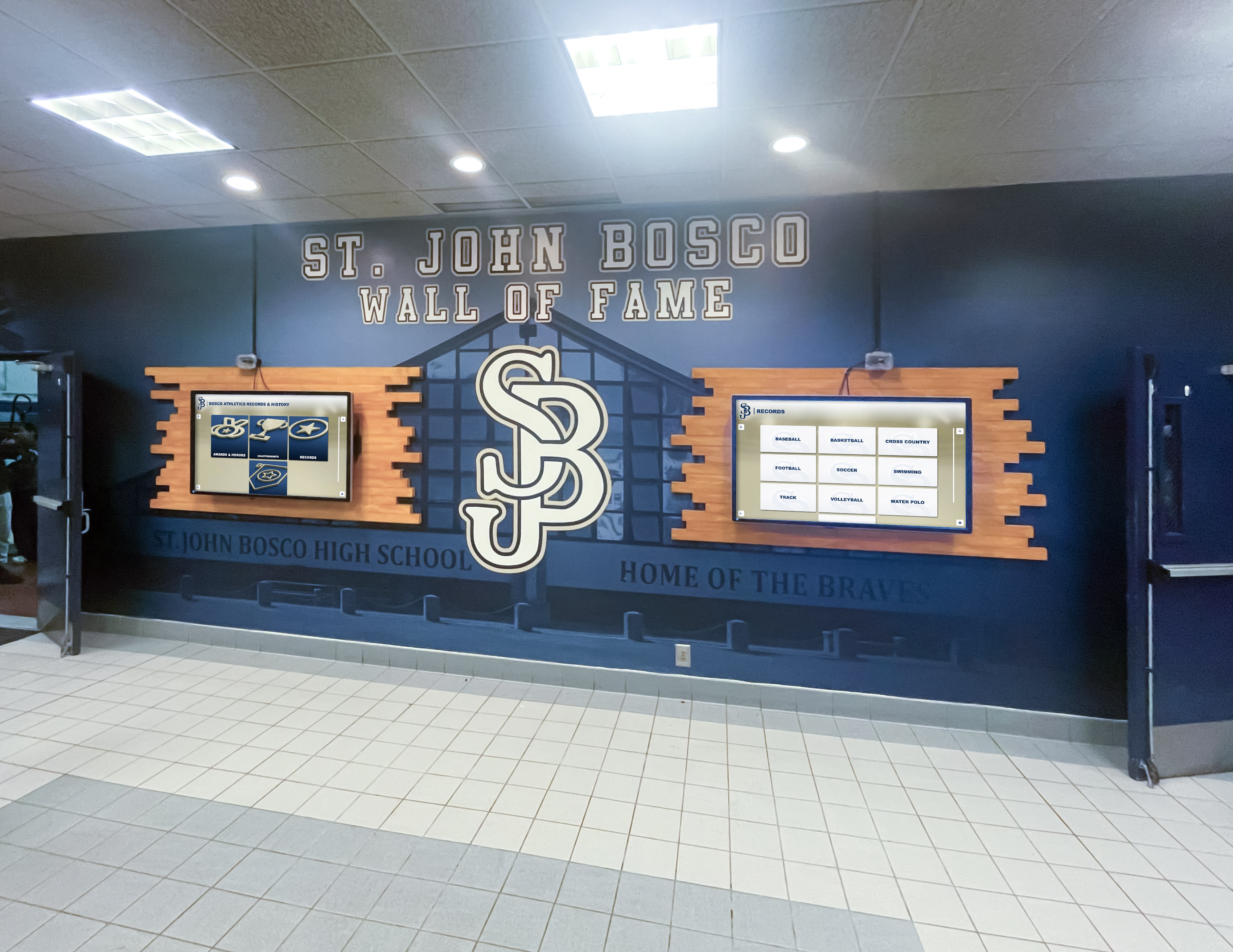
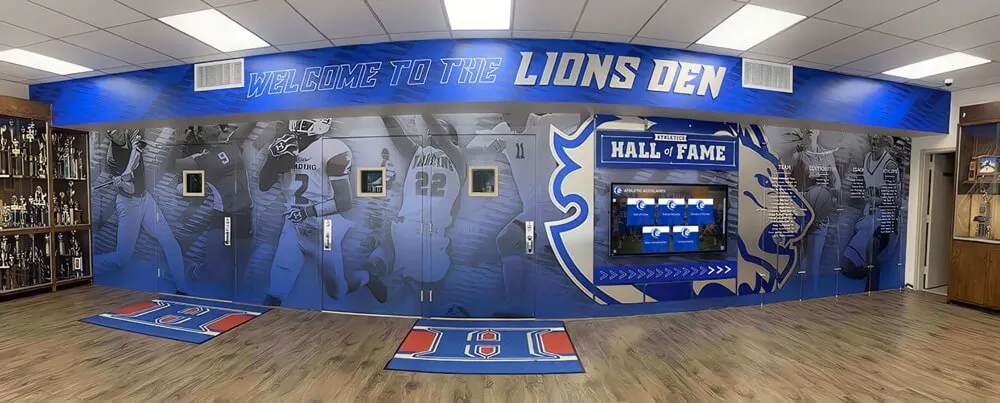
Dual digital screen integrations allow tiered layouts to feature static traditional recognition alongside dynamic digital content simultaneously
Traditional Plaque Layouts vs. Digital Displays
The fundamental layout decision for most K-12 schools today isn’t just grid vs. vertical vs. tiered—it’s how much of the wall to dedicate to traditional physical plaques versus integrated digital screens.
What Traditional Plaque Layouts Do Well
Physical plaques, shields, and engraved panels have served school recognition programs for generations because they deliver several genuine advantages:
Permanence and prestige: A bronze plaque communicates institutional weight that a digital screen cannot fully replicate. For certain recognition categories—particularly academic and distinguished alumni honors—physical permanence aligns with the gravity of the achievement.
No technology dependency: Physical displays don’t require power, network connectivity, or software maintenance. A plaque installed in 1978 still reads exactly the same today.
Tactile engagement: Visitors can touch, photograph, and interact with physical plaques in ways that feel genuine and personal.
Lower ongoing costs: Once fabricated, traditional plaques require no subscription fees, hardware refresh cycles, or IT support.
Where Traditional Layouts Reach Their Limits
The limitations of purely physical recognition walls become apparent as schools age and inductee counts grow:
Space exhaustion: A K-12 school inducts athletes, academics, and alumni across decades. Even with careful planning, physical walls fill to capacity, forcing schools to choose between removing old recognition (damaging to alumni relationships) or stopping new inductions (undermining program credibility).
Content depth constraints: A physical plaque can display a name, graduation year, sport, and perhaps one achievement line. A student-athlete’s full story—career statistics, college destination, post-graduation accomplishments—requires far more space than any physical format provides affordably.
Update costs: Correcting a spelling error or adding new achievement data to a physical plaque requires professional fabrication and reinstallation. Donor walls face particular challenges when donors make additional gifts that warrant tier changes.
Accessibility gaps: Physical plaques at standard mounting heights may be inaccessible to wheelchair users, and the information density typical of recognition walls presents challenges for visitors with visual impairments. WCAG 2.2 AA-compliant digital recognition systems address these accessibility requirements in ways physical plaques fundamentally cannot.
Interactive Touchscreen Layout Patterns
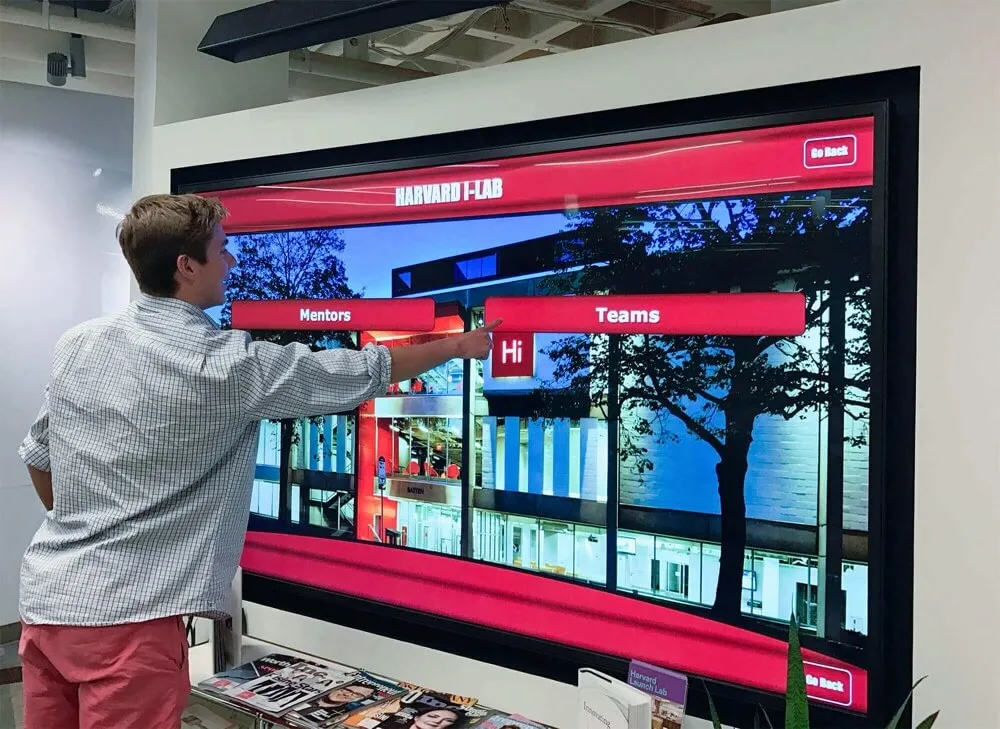
Digital touchscreen displays represent a fundamentally different approach to recognition wall design—one that shifts from a static archive to an active, explorable experience. Schools adding touchscreen components to their recognition walls typically see visitor engagement times increase dramatically compared to traditional plaque-only displays.
Layout Integration Approaches
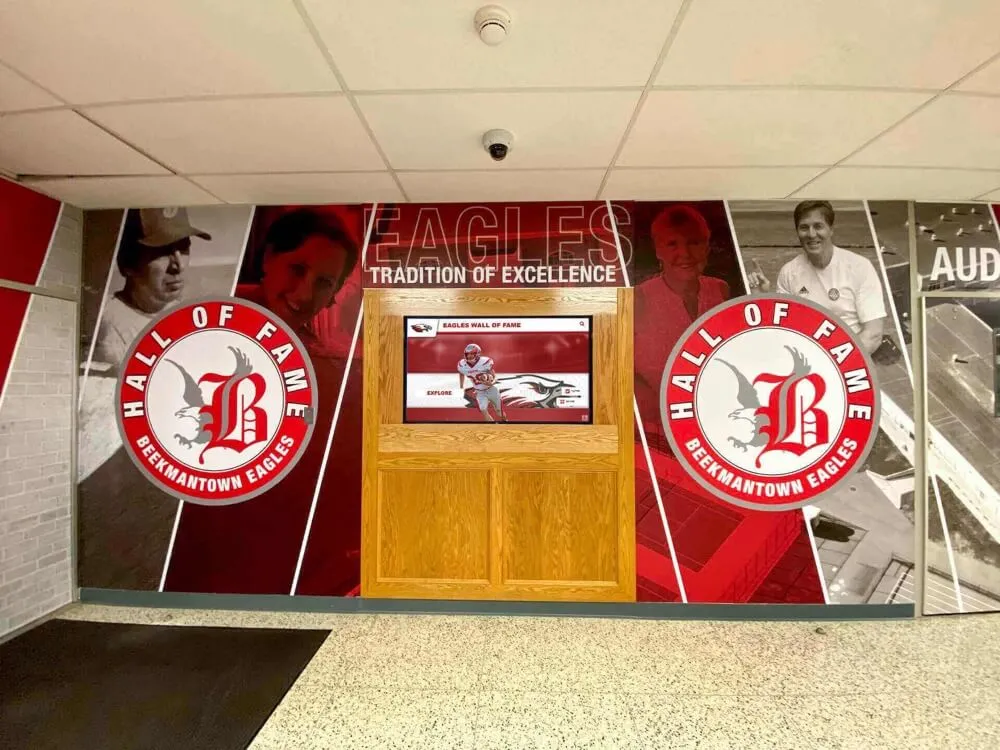
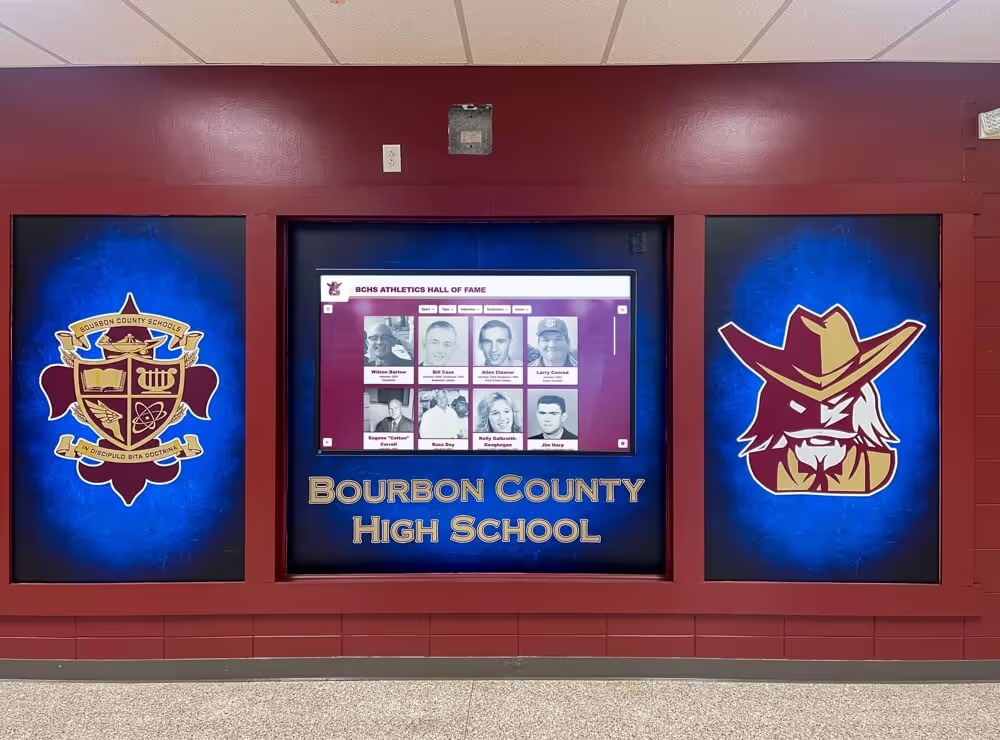
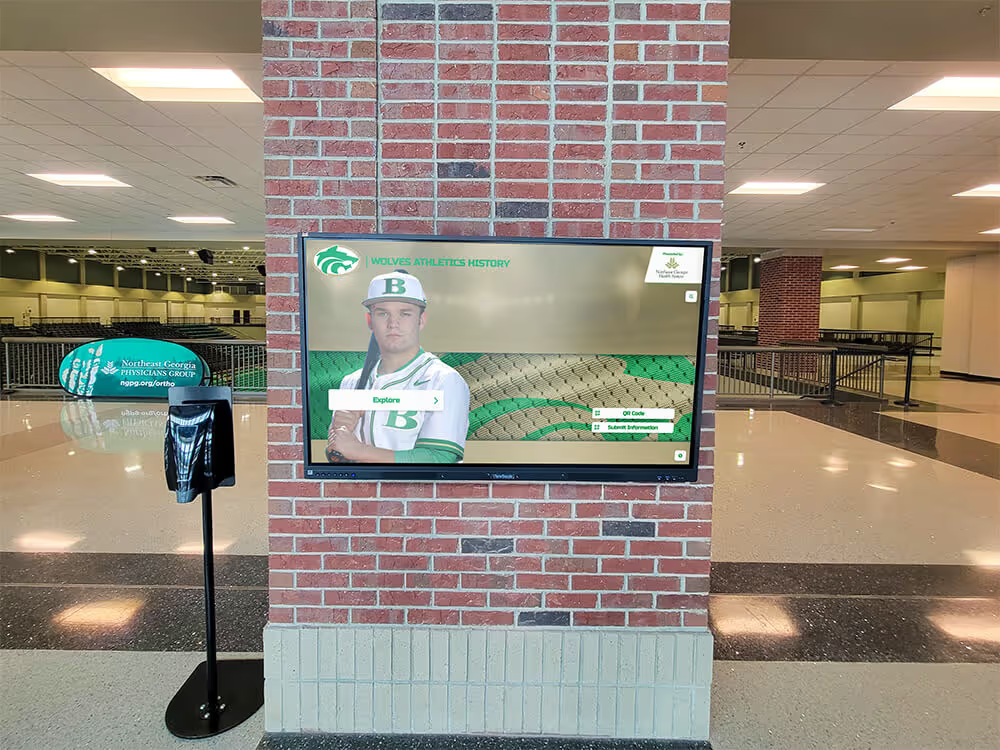
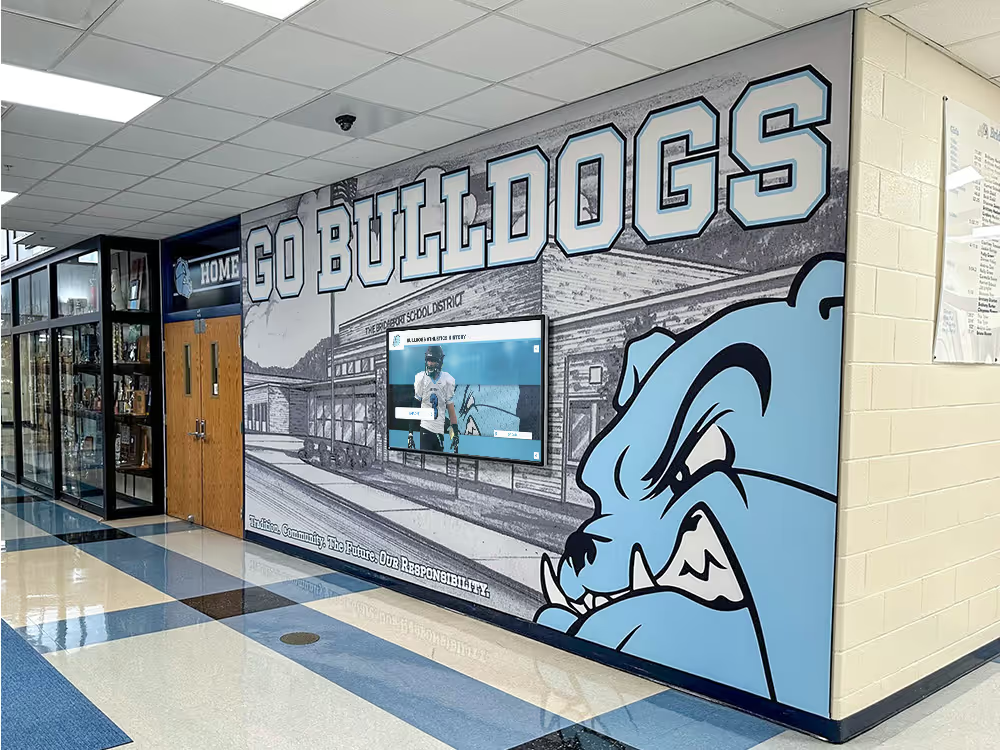
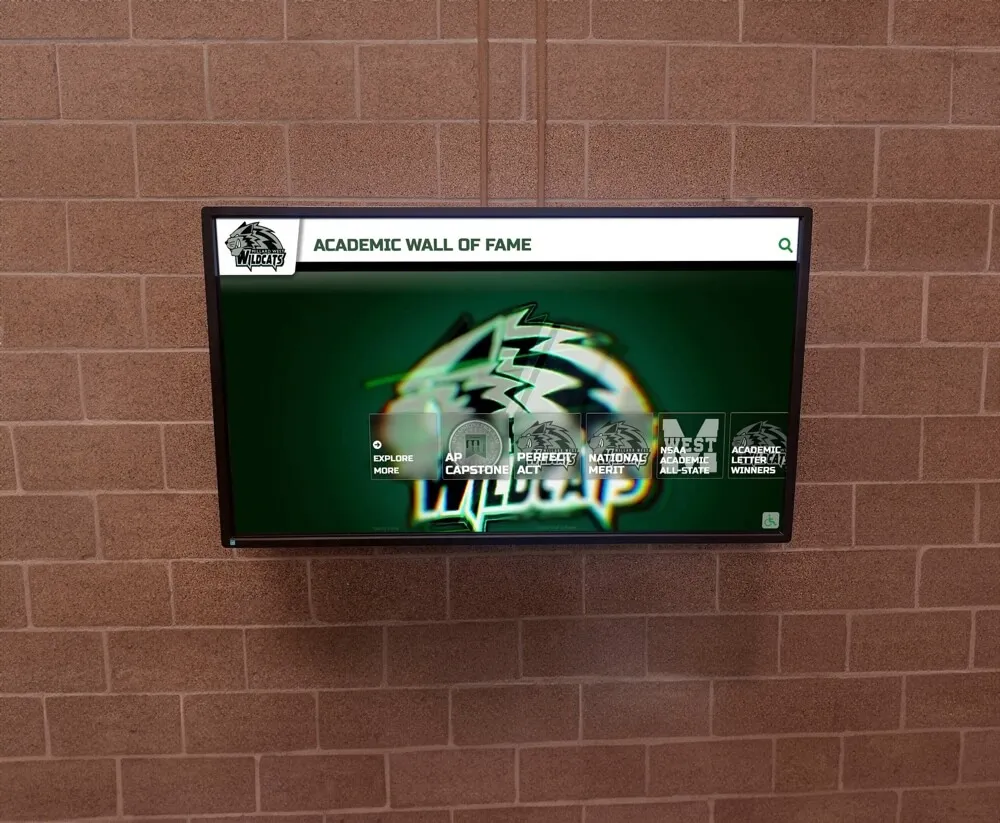
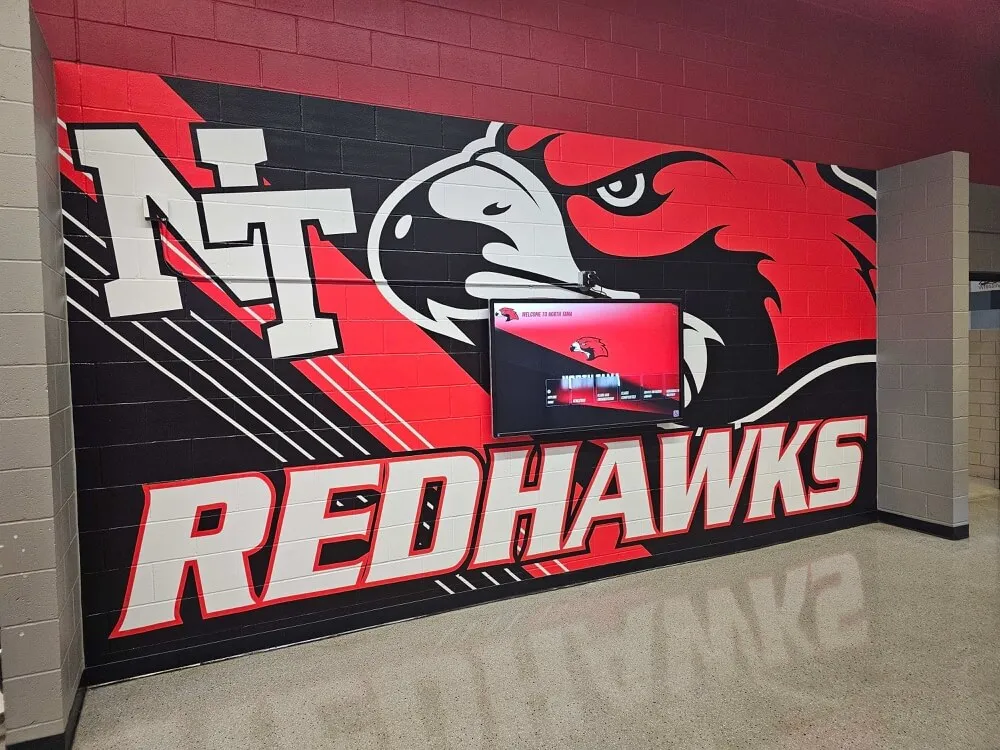
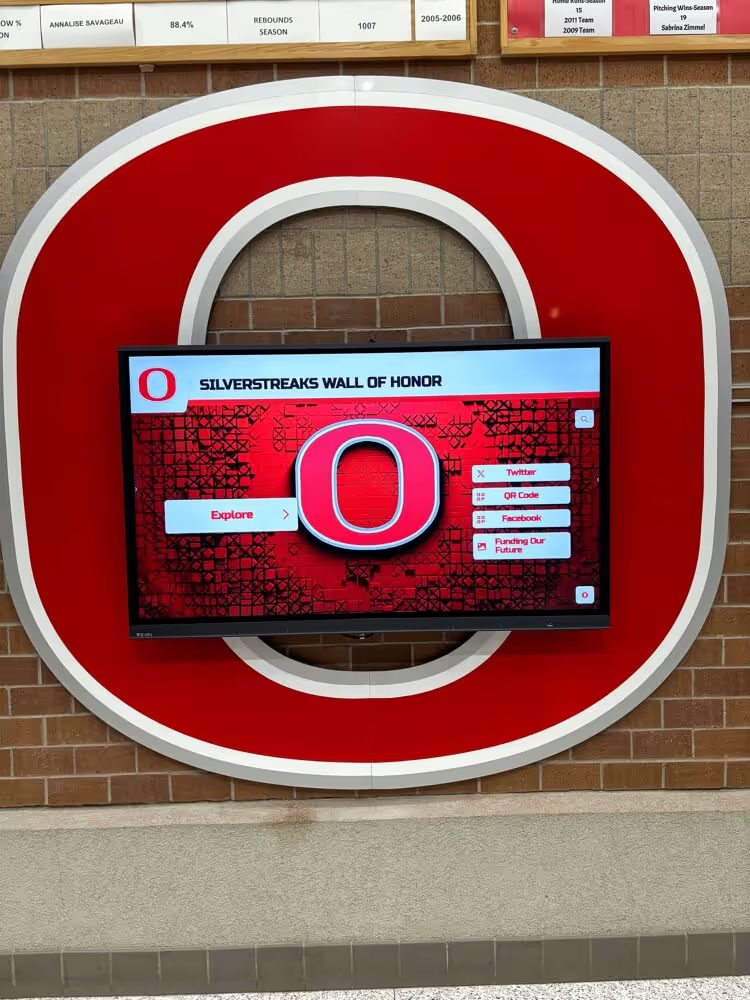
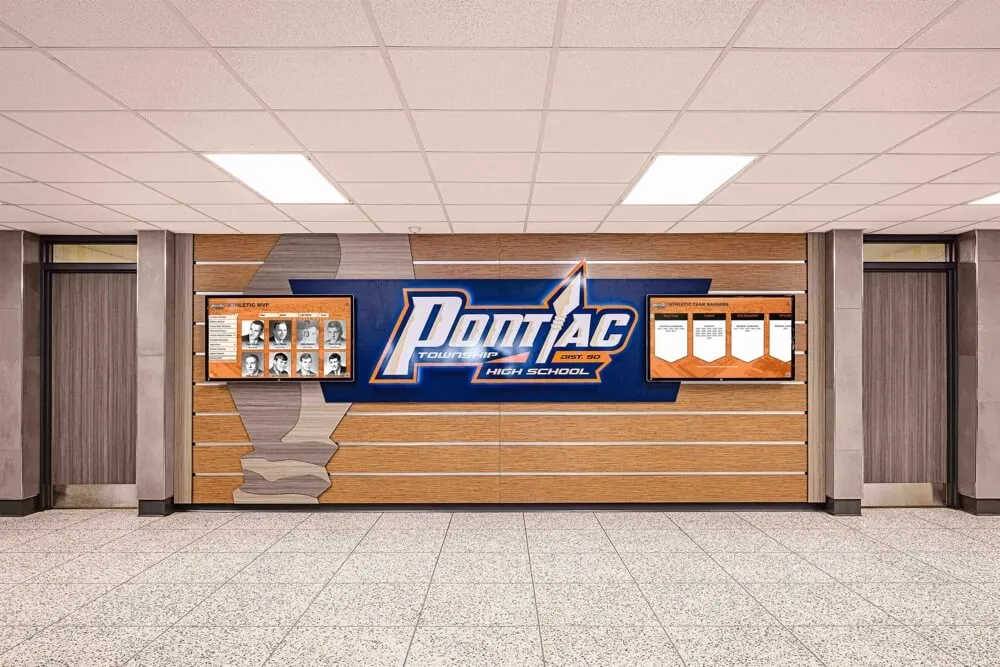
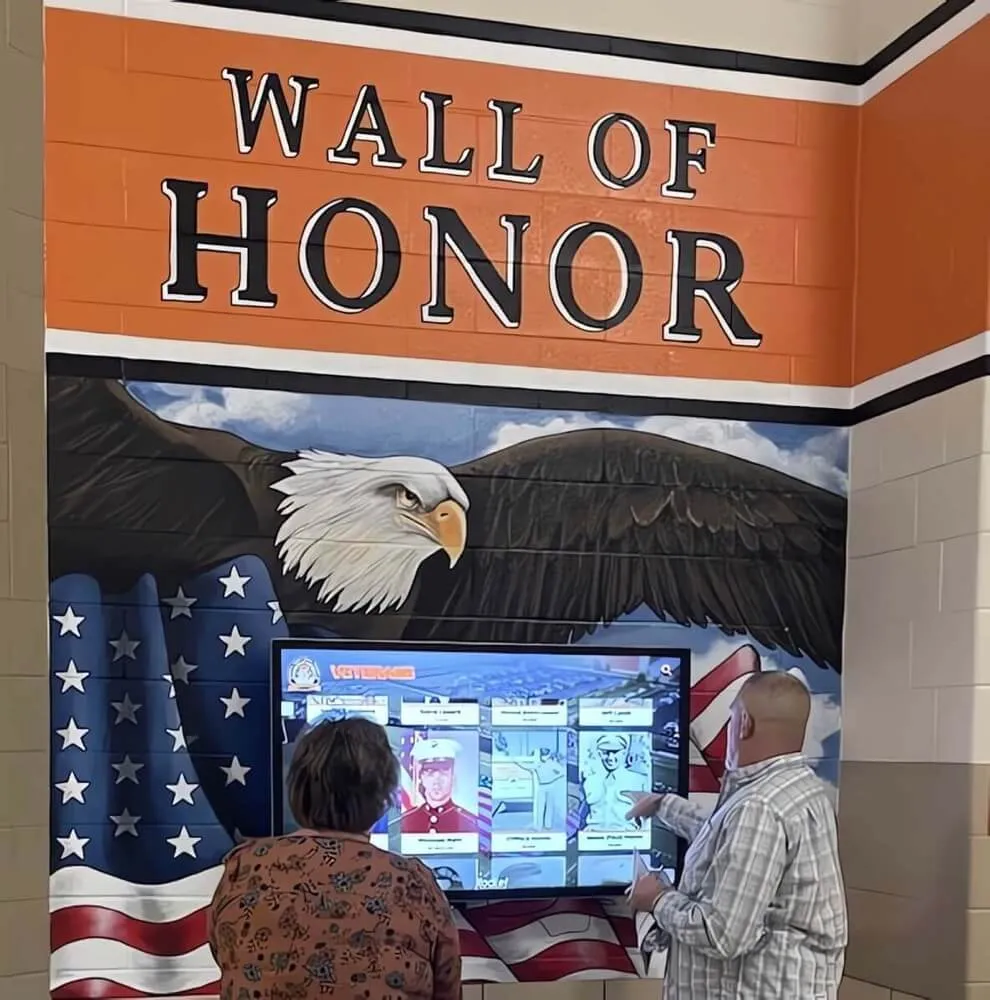
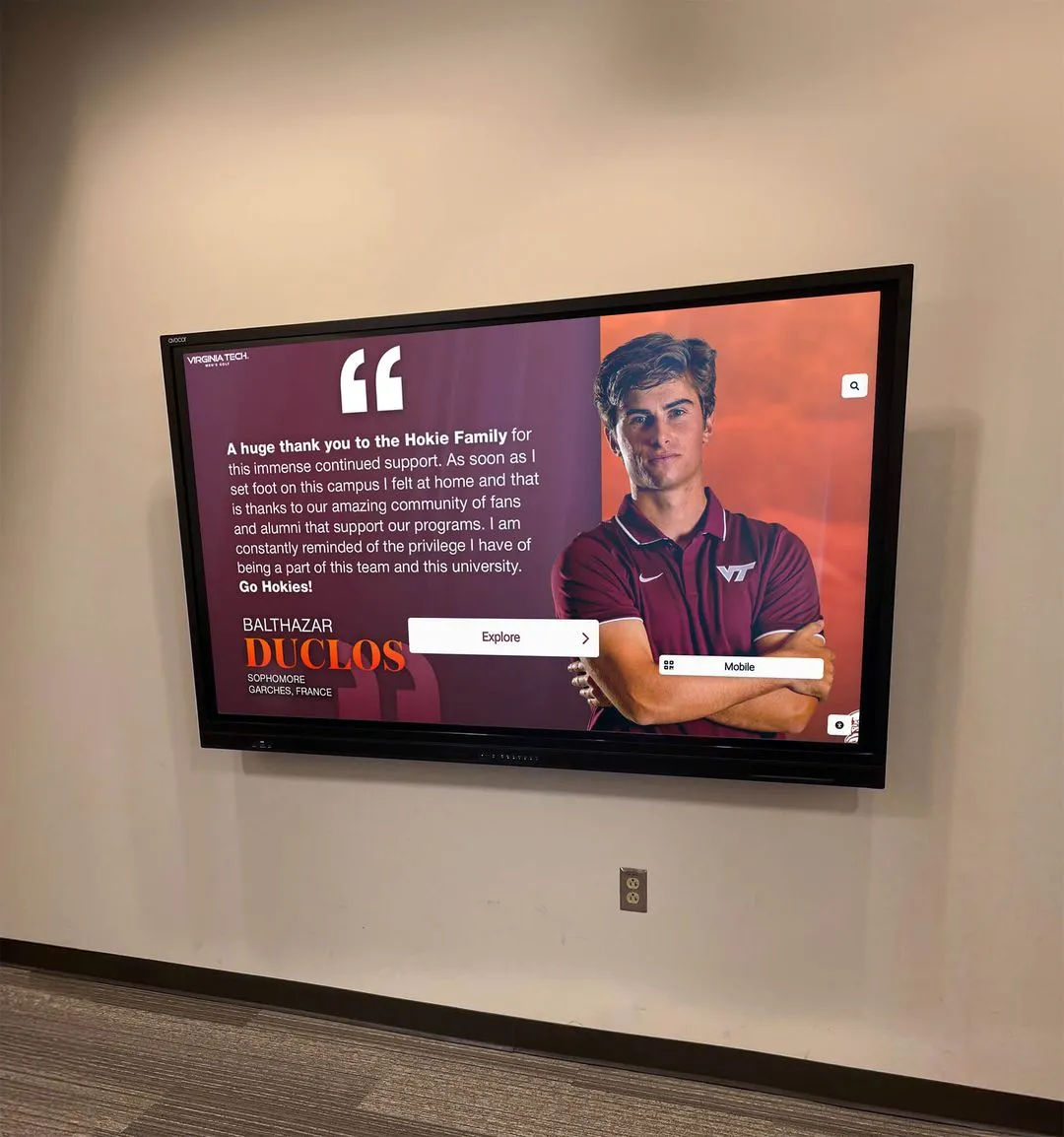
Screen-as-anchor: One or more touchscreen displays serve as the primary focal point of a recognition wall, with supporting physical elements (murals, mascot imagery, school colors) framing the interactive experience. This approach delivers maximum content flexibility since the screens handle all inductee data.
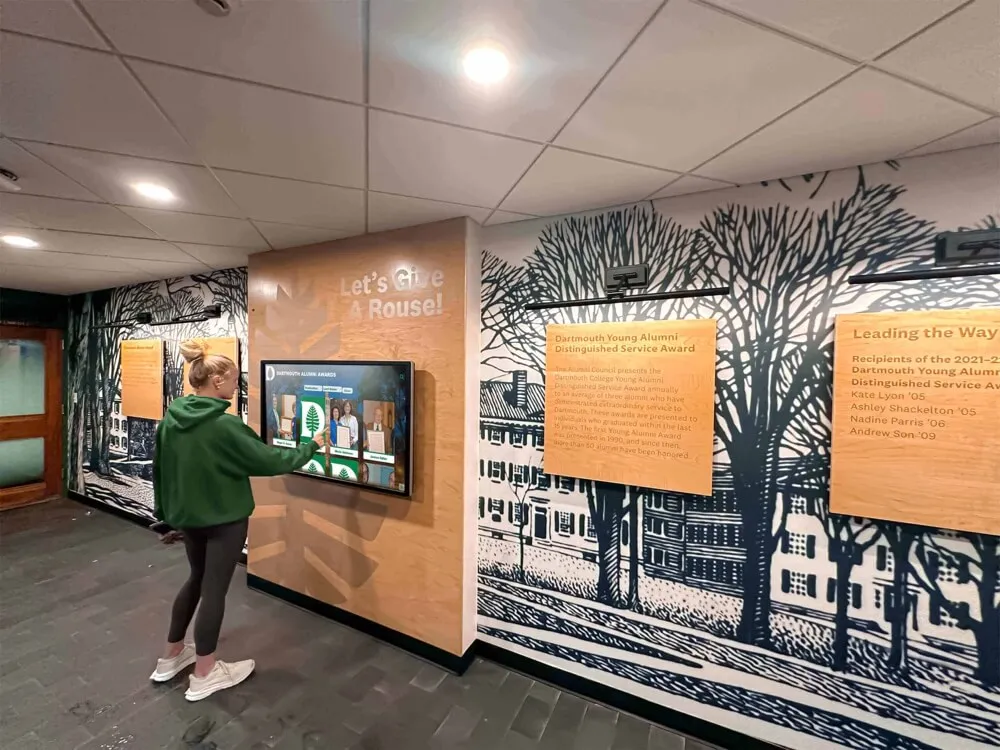
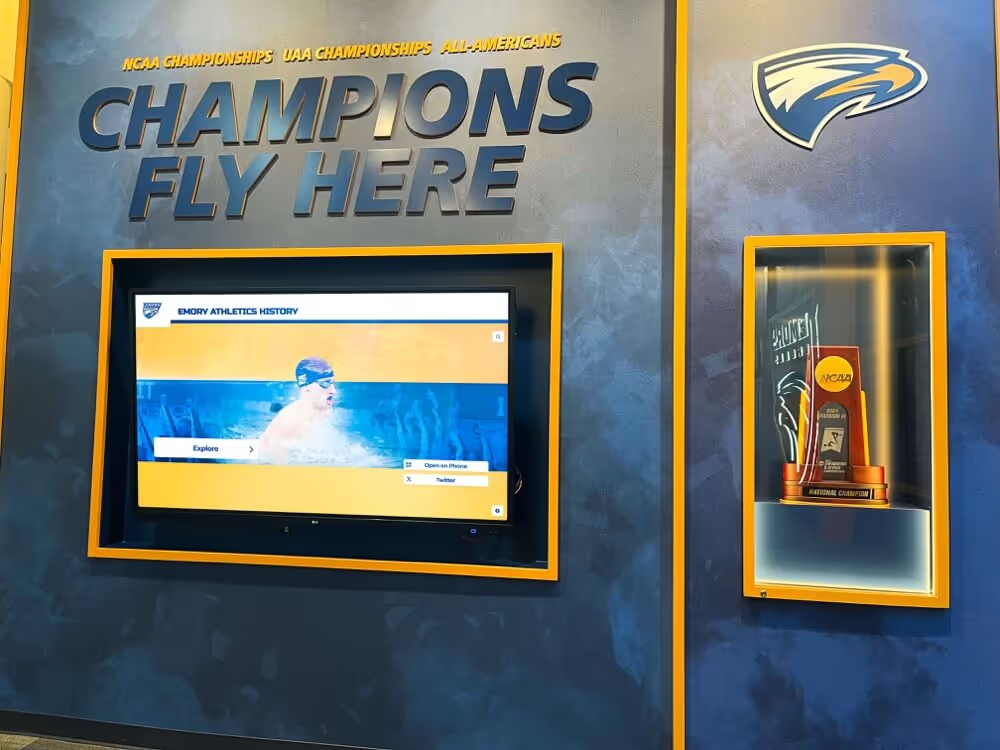
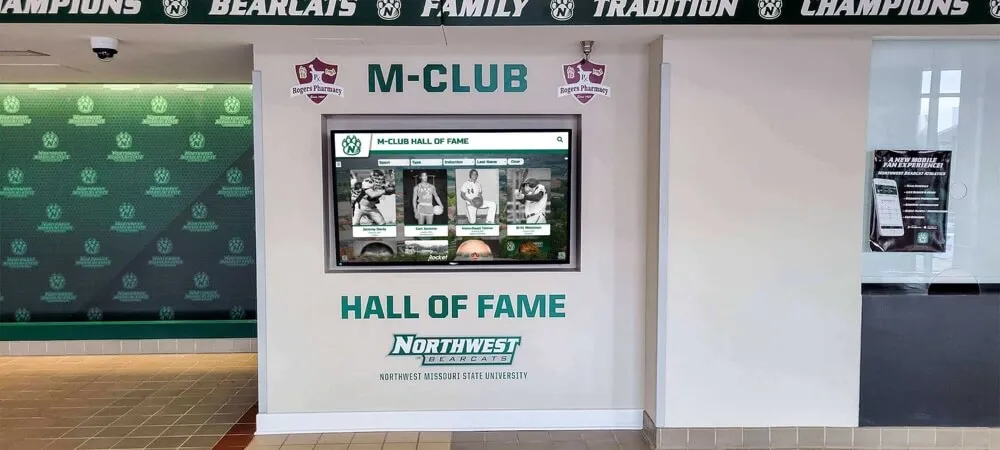
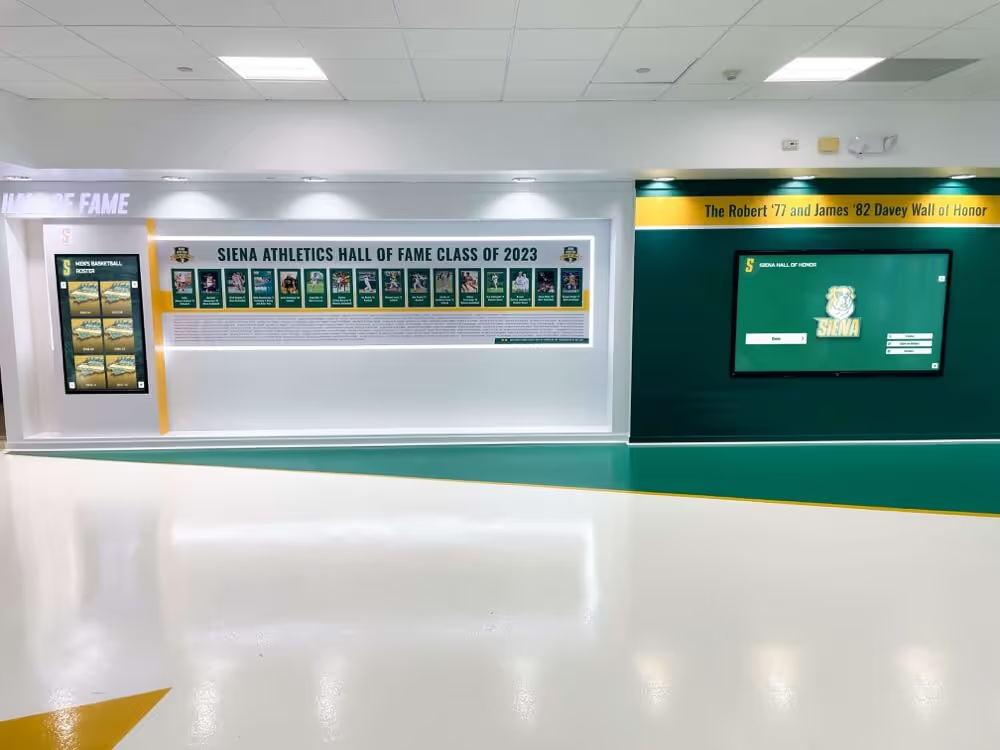
Hybrid plaque-and-screen: Physical plaques or shields handle the top tier of recognition (the school’s most distinguished honorees, naming-gift donors, championship teams) while integrated screens carry the broader inductee database. This layout preserves the prestige of physical recognition while solving the scalability problem for general inductees.
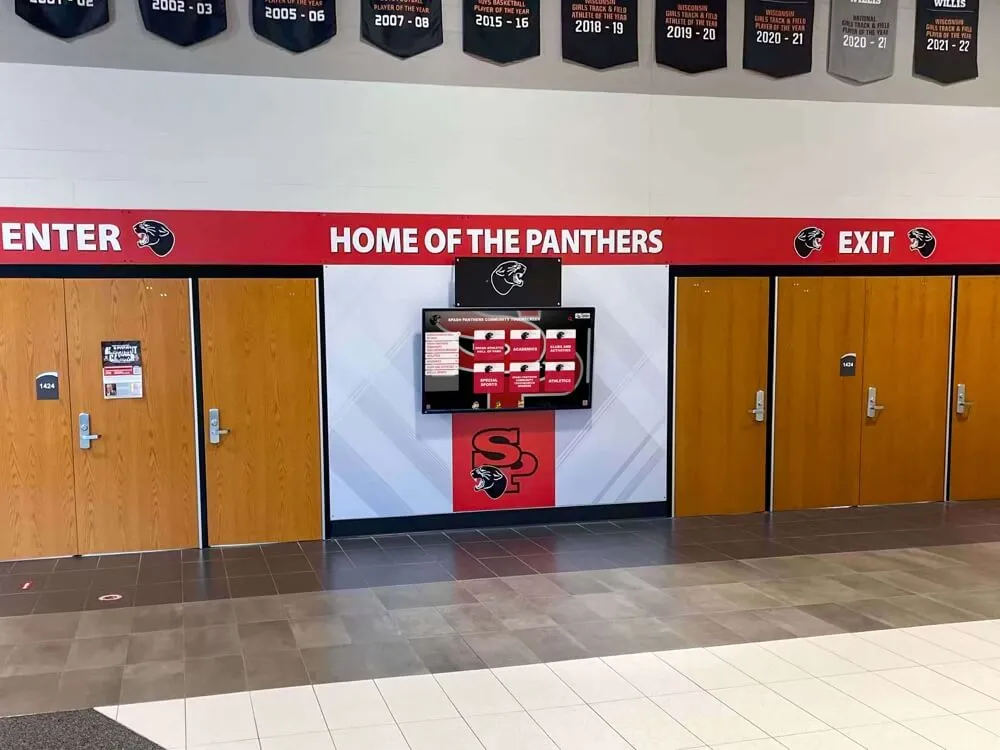
Wayfinding + recognition combination: Schools with large facilities increasingly deploy touchscreen recognition displays that combine hall of fame content with building directory and event calendar functions. Wayfinding signage integrated with recognition displays creates multi-function installations that justify broader facility investment.
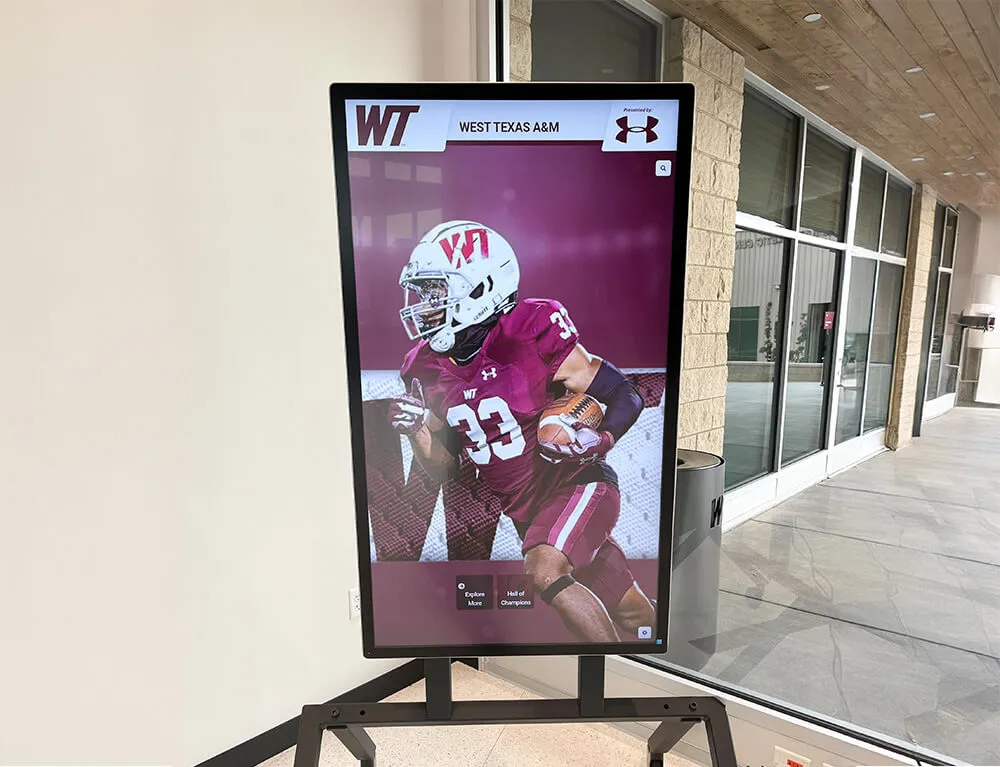
Kiosk freestanding: Freestanding touchscreen kiosks can be positioned in front of or adjacent to existing physical recognition walls, adding digital depth to legacy installations without requiring structural modification of the wall itself.
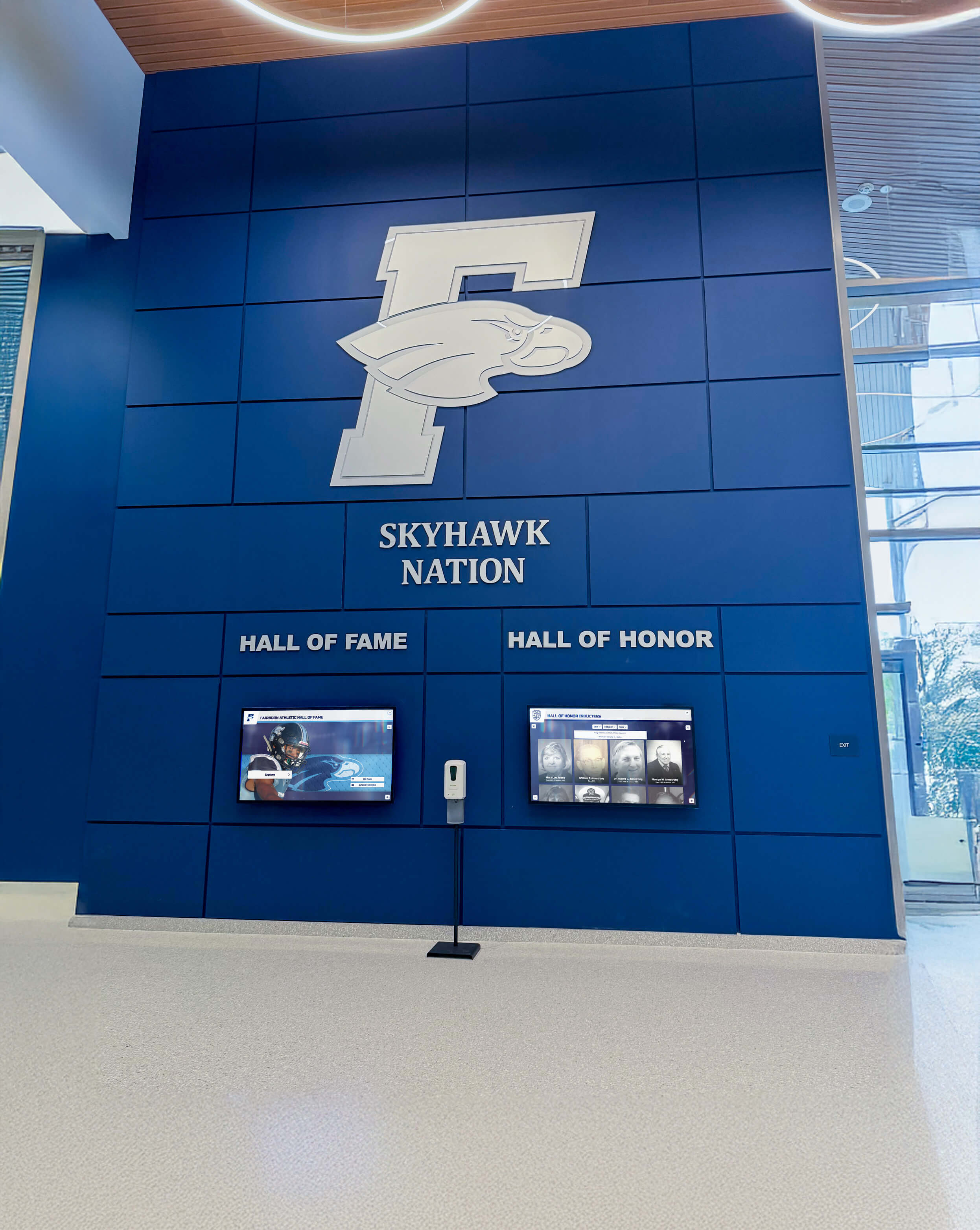
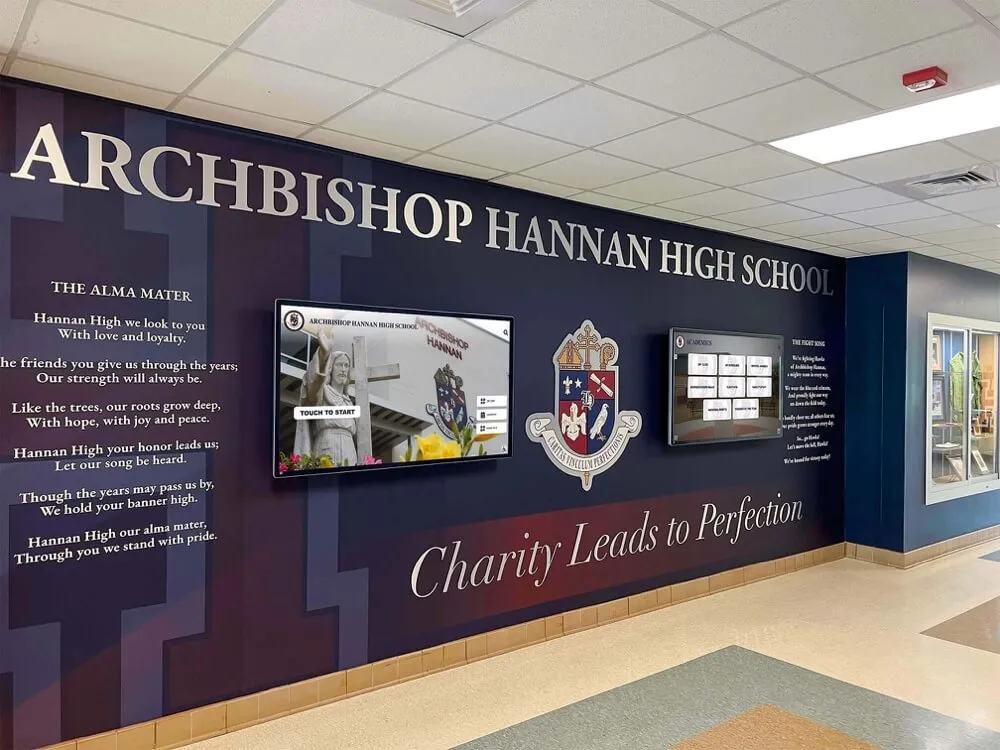
Color-coordinated digital installations in school lobbies create cohesive brand environments while enabling unlimited recognition content
What Interactive Layouts Enable
The shift from static to interactive layouts unlocks capabilities that simply don’t exist in any physical format:
Unlimited inductee capacity: A touchscreen display accommodates the same physical space whether it contains 50 inductees or 5,000. Schools no longer face the spatial ceiling that forces difficult choices about legacy recognition.
Rich multimedia profiles: Each inductee profile can include multiple photos, career statistics, video highlights, articles, and updates tracking post-graduation accomplishments. The depth of storytelling transforms a name-and-year entry into a genuine tribute.
Search and filter functionality: Visitors can find specific athletes by name, sport, graduation year, or achievement type in seconds. A grandmother looking for her husband’s 1974 wrestling induction doesn’t have to scan 200 plaques—she types his name.
Real-time content updates: Cloud-based content management allows athletic directors, administrators, or alumni relations staff to add new inductees, correct information, or feature special content from any internet-connected device. No fabrication lead times, no installation appointments.
QR code mobile access: Many digital recognition platforms generate QR codes that visitors can scan to access an inductee’s full profile on their own smartphones—extending the recognition experience beyond the physical wall location.
For schools evaluating how to effectively implement a digital wall of fame, the content management workflow typically matters as much as the display hardware itself.
Athletic Director Considerations for Digital Layouts
Athletic directors making digital recognition wall decisions should evaluate several factors that affect long-term program value:
Content ownership: Confirm that the school owns all uploaded content and inductee data, with full export capability if the relationship with a vendor ends.
Screen size and placement: Recognition wall screens typically range from 55" to 98" diagonal. Larger formats increase visual impact in wide lobby spaces; smaller screens work effectively in corridor kiosks. For comprehensive guidance on choosing a digital hall of fame provider, athletic directors should evaluate vendor stability alongside product features.
Unlimited vs. per-screen licensing: Some platforms charge per-screen fees that scale with the number of displays. Schools planning multi-zone recognition environments benefit from platforms with unlimited screen licensing.
Platform update frequency: Recognition display software should receive regular updates that add features and maintain security. Platforms that haven’t updated their software in years represent adoption risk.
Installation and training: Professional installation and staff training determine whether the system actually gets used. A technically sophisticated platform that staff can’t manage becomes an expensive static display.
Layout Design for Elementary Schools
Elementary school recognition walls carry different priorities than high school athletic halls of fame. At the K-5 level, recognition programs typically focus on:
- Monthly academic and citizenship honorees
- Reading milestone achievers
- Art and science fair distinction
- Community service recognition
- Staff and teacher appreciation
Elementary recognition displays benefit from bright, accessible, kid-scale design. Lower mounting heights accommodate young visitors who want to find themselves on the wall. Colorful, category-coded layouts help children navigate without reading proficiency. A comprehensive elementary school recognition board guide covers the specific design considerations that differ from secondary school hall of fame displays.
Rotating recognition systems—where student photos cycle through the display monthly or quarterly—work particularly well at the elementary level because they ensure broad participation rather than a static pantheon of permanently featured individuals.
Multi-Zone Recognition Wall Architecture
K-12 schools with larger facilities and comprehensive recognition programs increasingly plan multi-zone recognition environments that distribute different recognition categories across strategically chosen locations.
Zone Planning Principles
Athletic complex entrance: The primary athletic hall of fame, including championship teams, individual sport honors, and record boards, belongs at the entrance to athletic facilities where student-athletes and game-day visitors encounter it naturally.
Main building lobby: The main entrance lobby suits a combined recognition display featuring distinguished alumni, major donors, and school-wide academic honors—the recognition that represents the school to first-time visitors, prospective families, and community members.
Academic hallways: Department-level academic recognition (science olympiad champions, debate team honors, arts awards) belongs in academic hallways where the relevant student population encounters it regularly.
Library and common areas: Career-spanning alumni recognition and milestone documentary displays work well in library and common area settings where extended visitor engagement is appropriate.
Gymnasium and field house: Championship banners, retired jersey displays, and seasonal record boards belong in competition venues where the community experiences athletic achievement directly.
This distributed approach solves the limitation of trying to fit all recognition into a single wall location while ensuring each category appears where it’s most relevant and impactful.
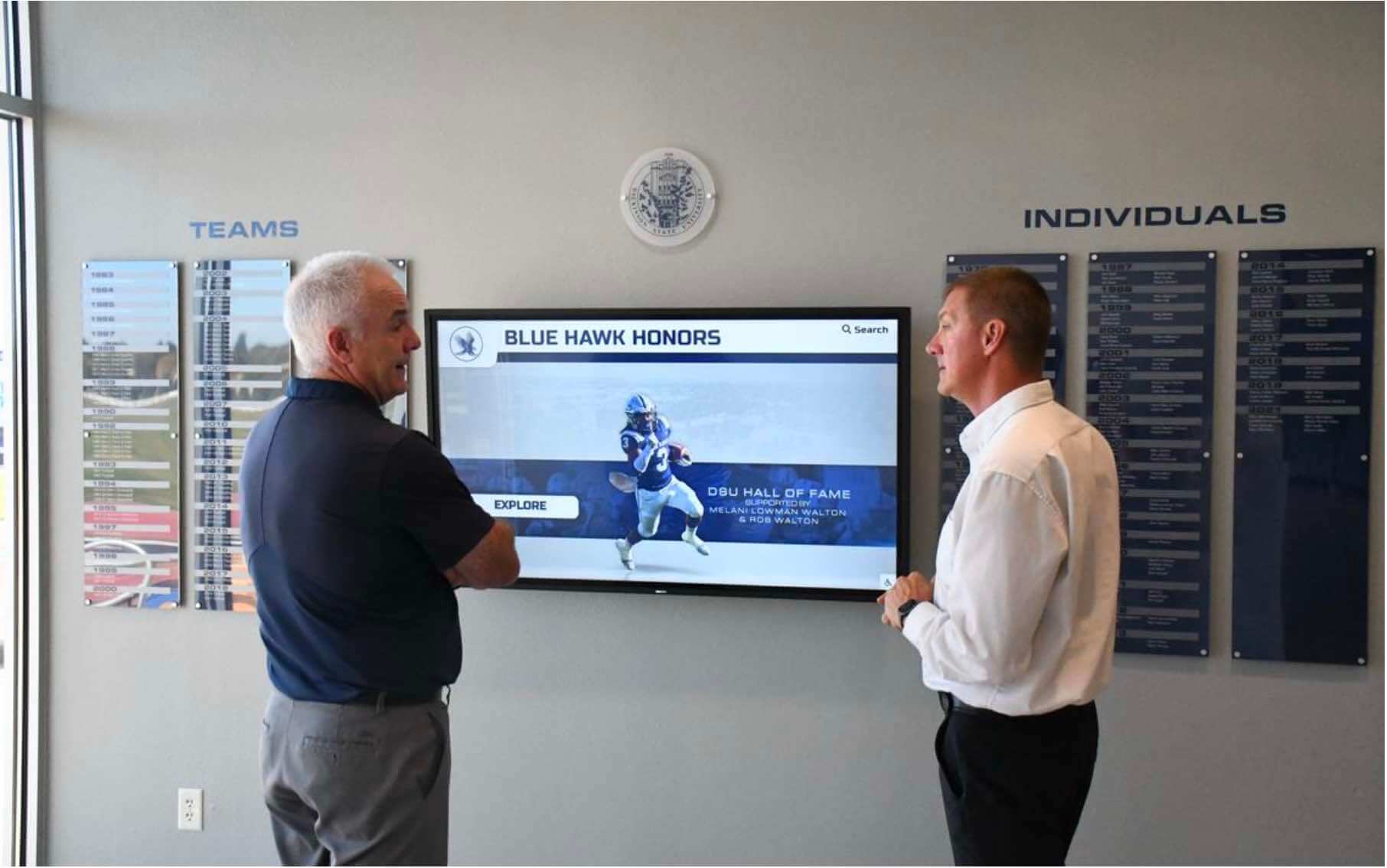
Multi-zone recognition strategies place relevant content in contextually appropriate locations throughout the facility for maximum engagement
Planning Your Recognition Wall Layout: A Decision Framework
Schools ready to plan or redesign their recognition wall should work through a structured decision process before contacting vendors or selecting materials.
Step 1: Inventory Existing Content
Document everything you currently recognize or plan to recognize:
- How many current inductees exist across all categories?
- What content format does each inductee have (name only, photo, biographical text, statistics)?
- What’s the realistic annual induction rate going forward?
- How many years of growth should the design accommodate (aim for 20+ years)?
Step 2: Define Category Architecture
Decide which recognition categories the wall will carry and whether they’ll share space or occupy distinct zones. Mixed-category walls require clear visual separation between sections; single-category walls can use a simpler, more uniform grid or vertical treatment.
Step 3: Assess Space and Traffic
Measure available wall space carefully, noting ceiling height, doorway interruptions, light switch and outlet placement, existing HVAC or electrical infrastructure, and the typical direction of visitor traffic through the space.
High-traffic areas where visitors pass quickly (lobby entrances, main hallways) favor bold, visually dominant layouts with clear hierarchy. Lower-traffic areas where visitors stop deliberately (alcoves, trophy rooms) accommodate more information-dense layouts that reward extended viewing.
Step 4: Evaluate Static vs. Digital Components
Based on your content inventory and growth projections, determine what proportion of the display needs digital flexibility:
- If your inductee count is stable and growth is slow, traditional physical formats may serve long-term needs adequately
- If you currently have 100+ inductees or expect rapid growth, digital components solve scalability problems that physical formats cannot
- If inductee content depth (photos, stats, bios, video) matters to your program, digital layouts are effectively required
Step 5: Plan for Maintenance and Management
Identify who will manage the recognition wall going forward:
- Who adds new inductees?
- Who handles content corrections?
- How will addition logistics work for physical elements (fabrication lead time, vendor relationships)?
- For digital components, who owns login credentials and who receives training?
A recognition wall that nobody can update becomes permanently dated. Management planning is as important as design planning.
Explore how designing a digital hall of fame display layout shapes long-term engagement outcomes beyond the initial installation.
Rocket Alumni Solutions: Touchscreen Recognition for K-12 Schools
Schools planning recognition wall installations with digital components increasingly evaluate Rocket Alumni Solutions, a purpose-built platform for school recognition walls, halls of fame, donor walls, and digital trophy cases.
Rocket’s platform addresses the core limitations of traditional layouts directly:
Unlimited inductees and content: No cap on the number of athletes, academics, alumni, or donors the system can display. A school with 500 athletic inductees and a school with 50 both receive identical display quality.
Any-screen compatibility: The platform operates on virtually any screen size or manufacturer, giving schools flexibility to integrate displays with existing hardware or select the right screen specifications for their specific space.
Cloud-based content management: Administrators update inductee profiles, add new honorees, and modify recognition categories from any web browser. No software installation, no technical expertise required for routine updates.
ADA WCAG 2.2 AA compliance: Rocket’s touchscreen displays meet current accessibility standards, including screen reader compatibility, appropriate touch target sizing, and sufficient color contrast—requirements that physical plaque layouts fundamentally cannot satisfy.
Auto-ranking record boards: Athletic record boards update automatically when new records are logged, eliminating the manual maintenance burden that causes many physical record displays to fall out of date.
QR code mobile access: Every inductee profile generates a scannable QR code, allowing families and alumni to access recognition content on personal devices and share achievements through social channels.
Professional installation and training: Rocket provides installation services and staff training, ensuring that schools get functional, well-integrated displays rather than hardware that sits in a box waiting for someone to figure out the mounting specifications.
Rocket serves 600+ institutions across K-12 schools, colleges, and universities—giving the platform a reference base that covers the full range of recognition wall challenges schools encounter.
See How Your School's Layout Could Look
Rocket Alumni Solutions creates custom digital recognition wall mockups so you can visualize exactly how your hall of fame, athletic honors, and alumni recognition would appear before committing to an installation.
Request Your Free Custom MockupCommon Recognition Wall Layout Mistakes to Avoid
Schools planning recognition walls benefit from understanding the patterns that consistently create problems:
Designing for today’s inductee count: The most common mistake. A wall filled to 90% capacity at installation becomes overcrowded within three to five years. Plan for 15-20 years of inductions from day one.
Mixing categories without visual separation: Athletic inductees, academic honorees, and alumni recognition listed in the same undifferentiated grid creates confusion about why each person appears. Clear category headers and visual zone separation are essential.
Prioritizing aesthetics over function: Beautiful displays that nobody can read (insufficient contrast, text too small, no search capability) fail at the fundamental mission. Form follows function in recognition wall design.
Ignoring lighting: Recognition wall installations depend on appropriate ambient and accent lighting. A beautifully designed wall in a poorly lit hallway loses most of its impact. Factor lighting into the installation plan and budget.
Skipping ADA compliance planning: Physical mounting heights, touch target sizing on interactive elements, and color contrast all carry ADA implications that are easier to address during initial planning than to retrofit later.
No clear ownership: Recognition walls without a designated owner who manages additions and maintains content quality become outdated displays within a few years of installation. Assign explicit responsibility before the first plaque goes up.
Conclusion: Choosing the Right Recognition Wall Layout
The best recognition wall layout for a K-12 school is the one that serves your specific student population, inductee volume, space constraints, and long-term management capacity—not the one that looks most impressive in vendor photographs. Grid layouts provide visual consistency for uniform inductee categories. Vertical and corridor layouts transform long hallways into recognition environments that guide visitors through school history. Tiered layouts communicate achievement hierarchy that motivates aspiring students. Interactive touchscreen layouts solve the scalability and content-depth problems that eventually defeat every purely physical installation.
Most successful K-12 recognition programs today use hybrid approaches: physical elements that communicate permanence and prestige for top-tier honorees, integrated with digital displays that handle the full breadth of recognition with unlimited capacity and rich content depth. This combination preserves the gravitas of traditional recognition while providing the flexibility that long-term programs require.
Whatever layout pattern you choose, the fundamental goal remains constant: create a space that makes inductees feel genuinely honored, inspires current students to pursue distinction, and gives the entire school community a visible, tangible reason to feel proud of what this institution has built and who it has developed.
Ready to Design Your Recognition Wall?
Explore Rocket Alumni Solutions' digital recognition wall platform—purpose-built for K-12 schools, ADA-compliant, unlimited capacity, and backed by professional installation across 600+ institutions.
Learn About Digital Wall of Fame SolutionsLive Example: Rocket Alumni Solutions Touchscreen Display
Interact with a live example (16:9 scaled 1920x1080 display). All content is automatically responsive to all screen sizes and orientations.