School History Display Ideas: Showcasing Your Legacy Across Generations
- Home /
- Digital Wall of Fame Blog - Recognition Display Insights & Resources /
- School History Display Ideas: Showcasing Your Legacy Across Generations
The Easiest Touchscreen Solution




Live Example: Rocket Alumni Solutions Touchscreen Display
Interact with a live example (16:9 scaled 1920x1080 display). All content is automatically responsive to all screen sizes and orientations.
Walk into nearly any school built more than a few decades ago and you’ll find evidence of an unfinished project: photographs fading in hallway frames, championship banners straining their mounting hardware, newspaper clippings yellowing behind glass, and trophy cases filled to capacity with no clear plan for what comes next. These fragments of institutional history deserve better. A well-designed school history display transforms scattered artifacts and achievements into a cohesive narrative that current students, returning alumni, and first-time visitors can all connect with—a living record of every generation that shaped the school into what it is today.
This guide covers proven school history display ideas across the full spectrum, from low-cost traditional approaches to fully interactive touchscreen installations. Whether you’re starting from scratch or rethinking a display that’s run out of space, you’ll find practical frameworks for deciding what to include, how to organize it, and how to keep it relevant for the next fifty years.
Preserving institutional memory is one of the most meaningful investments a school can make. Students who understand where their school came from develop stronger connections to where it’s going. Alumni who see their era represented return more often, give more generously, and advocate more enthusiastically. Visitors who encounter a thoughtfully curated school history display leave with an immediate sense of the school’s character and values—something no brochure accomplishes as effectively.

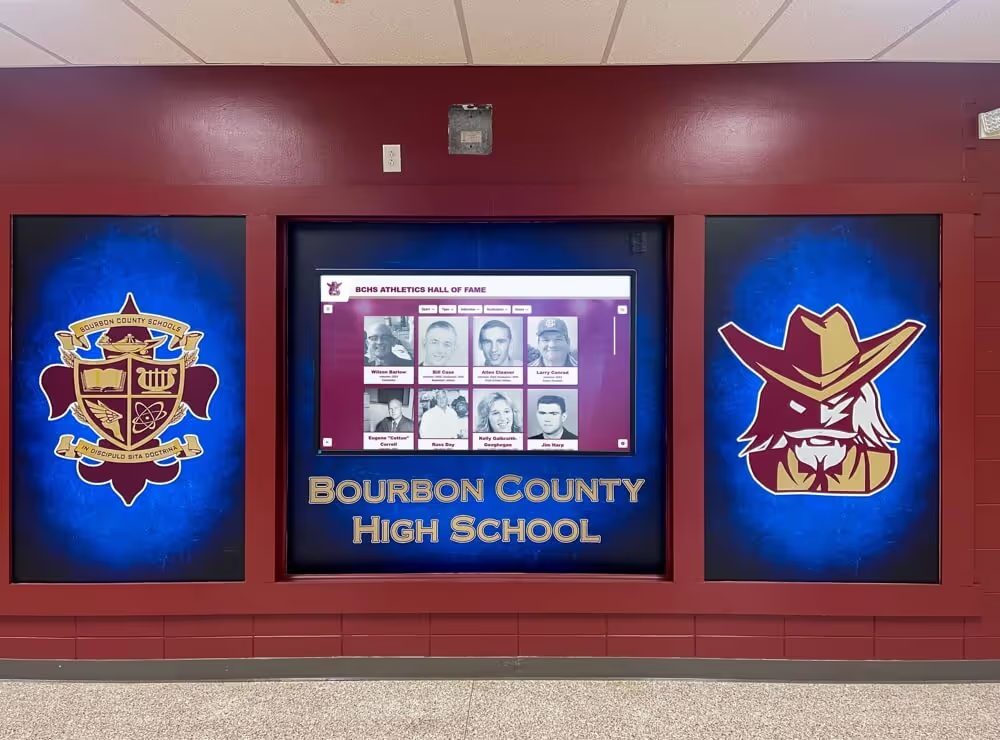
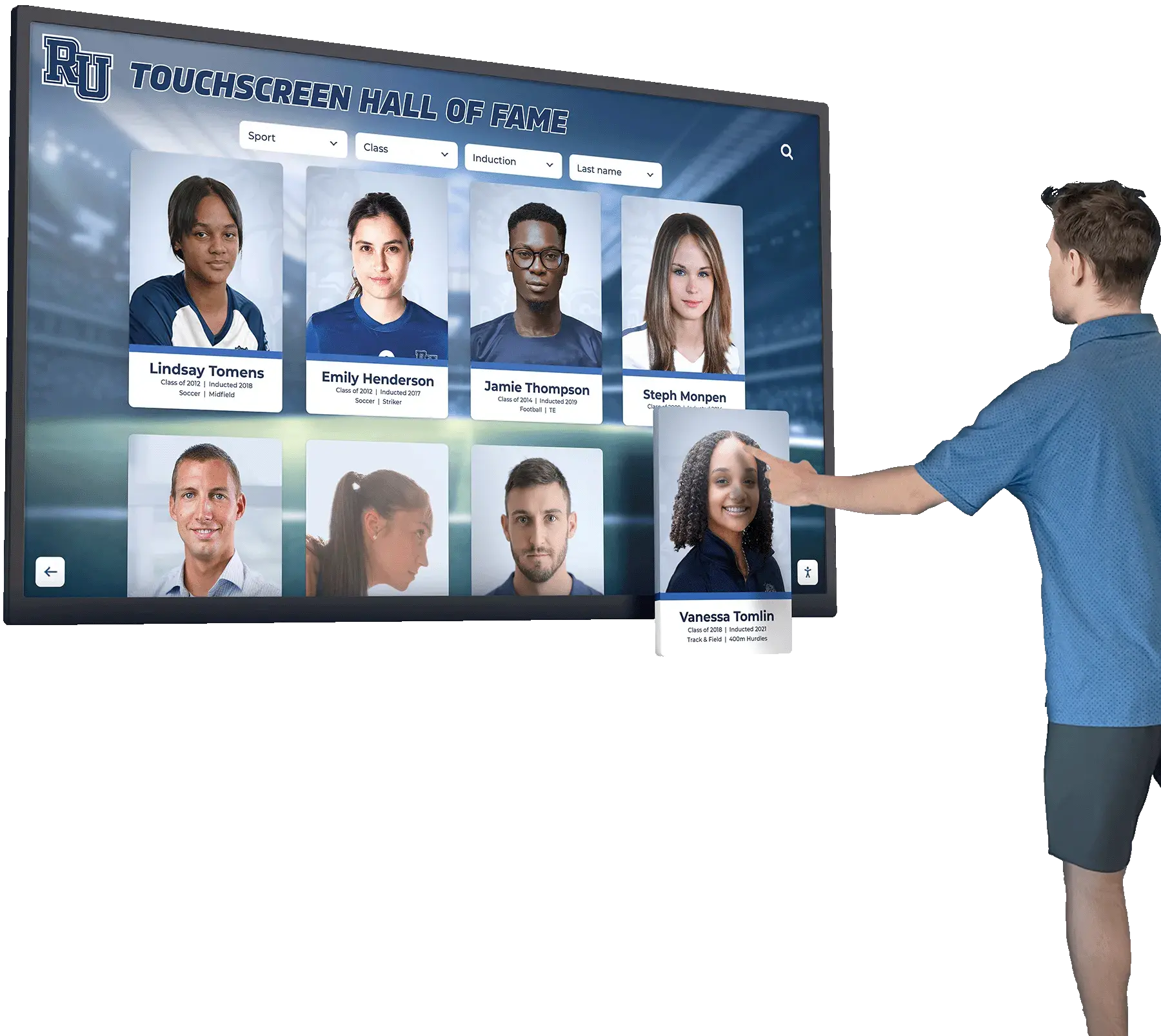
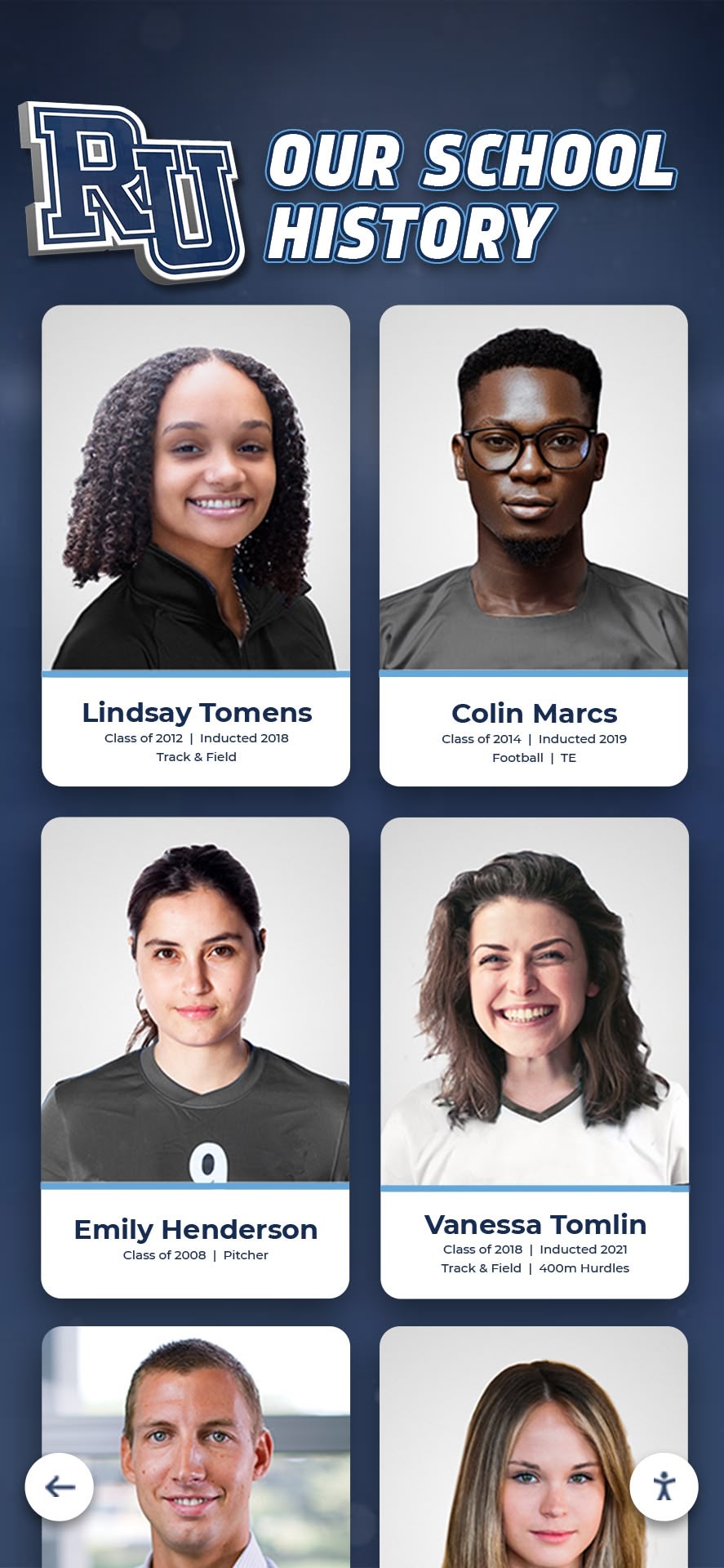
Portrait-based school history displays create immediate human connection, putting faces to the names and achievements that shaped institutional legacy
Why School History Displays Matter More Than You Think
Most schools underestimate the work their physical environment does every single day. Hallways, lobbies, and common areas either reinforce institutional identity or exist as neutral spaces that communicate nothing. A school history display is one of the most efficient ways to shift a hallway from neutral to meaningful.
For current students, visible history creates aspirational context. When a freshman passes a display showing the 1987 state championship team, the 2003 class valedictorian, and the 1999 founding of the robotics program, they’re receiving a message about what this school has produced and what’s possible for them specifically.
For returning alumni, history displays make homecoming personal. Seeing your class, your coach, your team, or your program’s founding moment displayed with care communicates that the school values what you contributed—and that memory of you hasn’t been discarded.
For prospective families, school history displays signal organizational health. A school that documents its achievements with care is a school that takes its mission seriously. This impression forms in seconds and influences decisions that unfold over months.
For the school’s development program, a compelling history display directly supports fundraising. Alumni who feel connected to institutional heritage are significantly more likely to give when asked. The display does relationship work that staff cannot replicate at scale.
School lobby design ideas consistently show that history-focused displays outperform generic décor in creating emotional first impressions. The investment in getting this right pays dividends far beyond the display itself.
Traditional School History Display Ideas
Physical displays remain the foundation of most school history programs. They require no power, no software maintenance, and they work reliably for decades when properly maintained. The challenge is designing them to scale—a display that looks full after fifteen years isn’t serving the school well.
Chronological Timeline Walls
The timeline wall is the most universally legible format for school history displays. Organized by year or decade along a hallway or lobby wall, timelines invite visitors to move through the school’s story from beginning to present.
Effective timeline walls share several characteristics:
Anchored founding narrative: The starting point—founding year, original building, founding headmaster or principal—establishes the school’s origins with enough detail to feel substantive rather than perfunctory.
Decade markers as visual anchors: Bold decade callouts (1960s, 1970s, 1980s) give visitors navigational reference points and allow them to jump directly to their era.
Balanced content mix: A timeline that shows only athletic achievements reads as an athletics-only school. Balance championship seasons with academic milestones, arts program highlights, facility expansions, and community service recognition.
Photographic density: Text-heavy timelines lose visitors. Anchor each decade with at least three to four photographs—team portraits, building images, candid moments from significant events—that make the history tangible.
Deliberate white space: Pre-plan expansion zones so the timeline can grow forward into the future without requiring visual surgery on existing sections. A timeline filling 70% of its available wall space at installation is a timeline designed to last.
Decade-by-Decade Photo Archives
Photo archive displays organize school history by generation rather than continuous timeline. Each decade receives its own dedicated display section—typically framed around a recognizable aesthetic or historical context—allowing visitors to scan entire eras quickly.
Decade-based archives work particularly well in libraries, media centers, and history classrooms where deeper engagement is appropriate. Students doing research projects, alumni visiting for class reunions, and community historians all benefit from the depth this format accommodates.
The practical challenge with photo archives is sourcing material. Many schools have rich photographic records only for recent decades; earlier eras may have sparse documentation. Solutions include:
- Alumni outreach campaigns requesting donated photographs from their era
- Partnerships with local newspapers and historical societies that may hold relevant archives
- Digitization projects converting deteriorating physical prints to archival-quality digital files
- Oral history documentation capturing recollections from long-serving faculty and staff
Founding Story and Heritage Displays
Every school has a founding story worth telling—who started it, why, under what circumstances, and what vision animated the original effort. This narrative rarely receives dedicated display space, yet it provides the deepest context for everything the school has become.
A dedicated heritage display near the school entrance or main lobby typically includes:
Original charter or founding documents (framed reproductions rather than originals): These anchor the school’s mission in its own language from its own time.
First class photographs: The original students and faculty, when photographed and displayed with care, humanize institutional history in a way no descriptive text achieves.
Architectural history: Original building blueprints or photographs showing how the physical campus has grown communicate institutional investment across generations.
Mission continuity: Connecting founding values to present mission language—when the language hasn’t drifted too far—reinforces that the school operates from enduring principles rather than shifting trends.
Glass display case ideas for schools work particularly well for founding artifacts—original correspondence, early yearbooks, historical photographs—that benefit from protective enclosure and three-dimensional presentation.
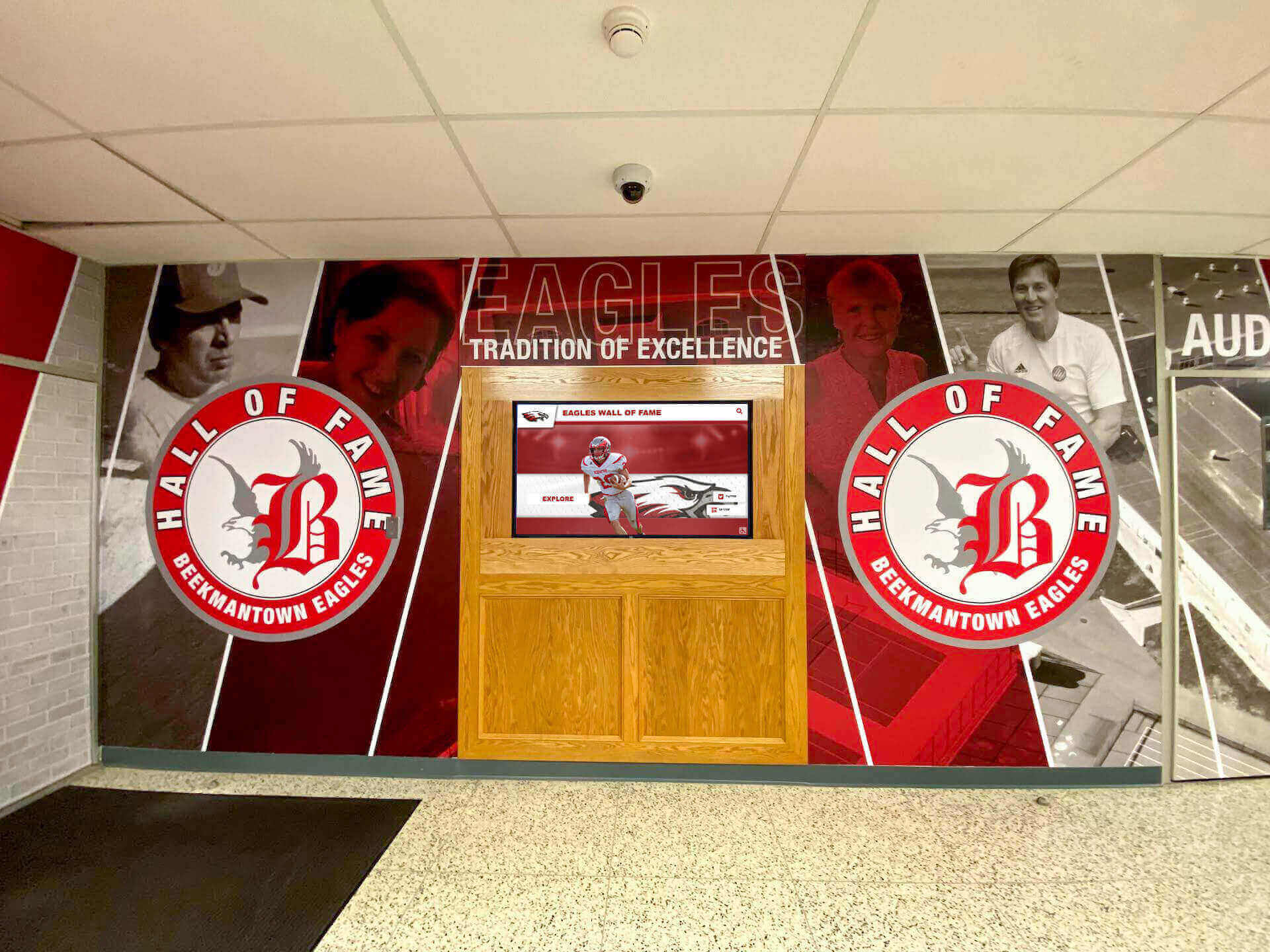
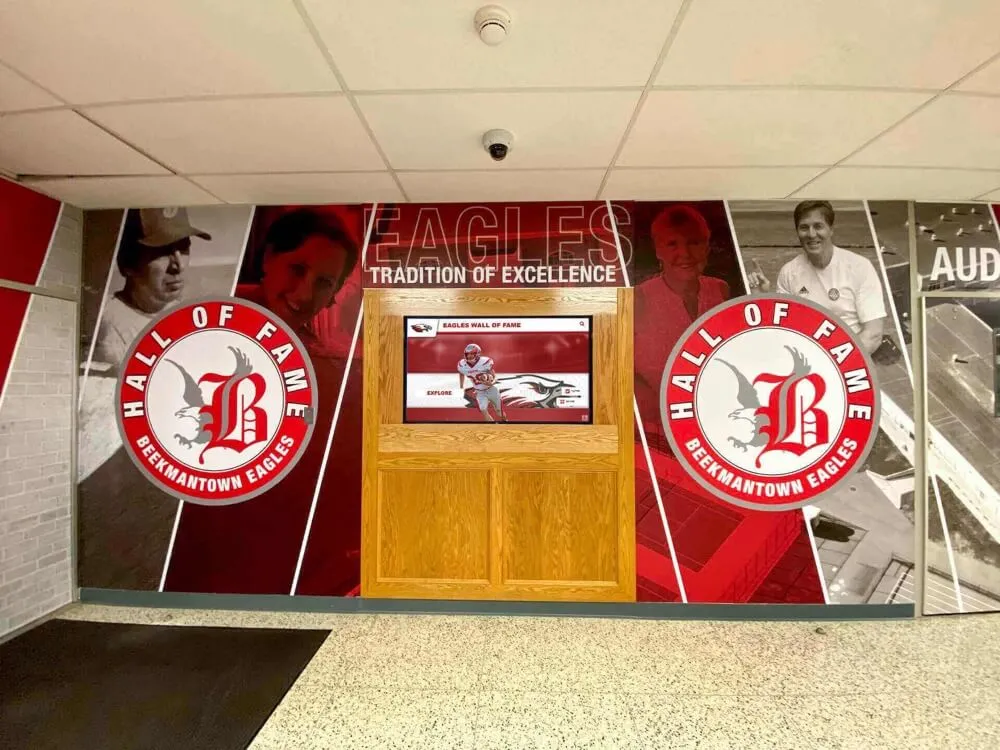
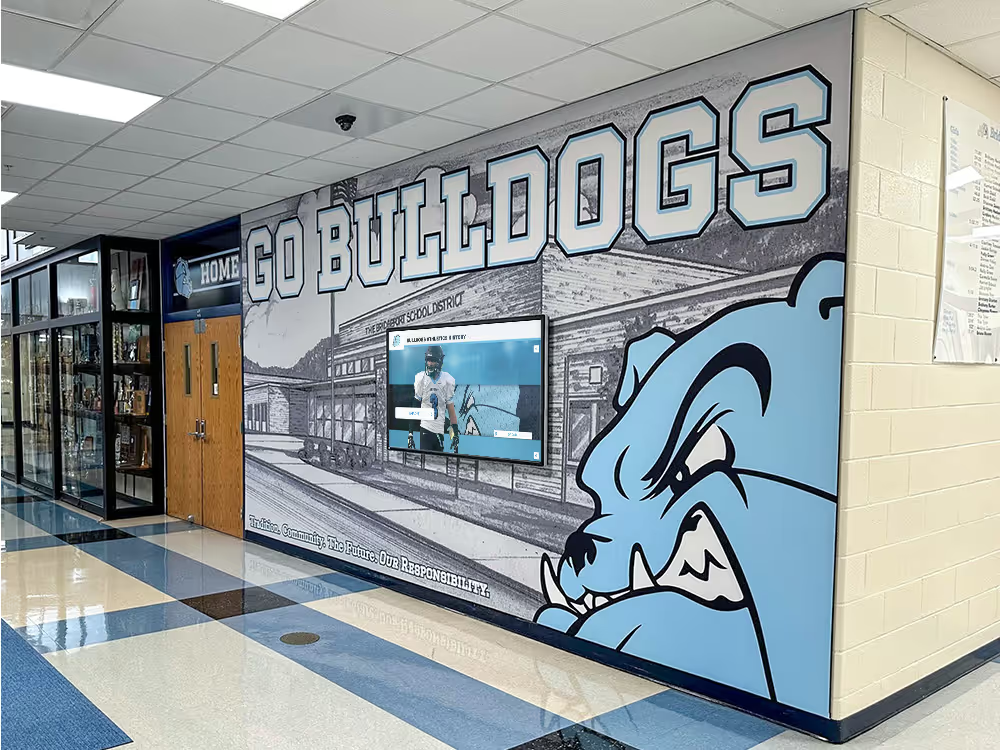
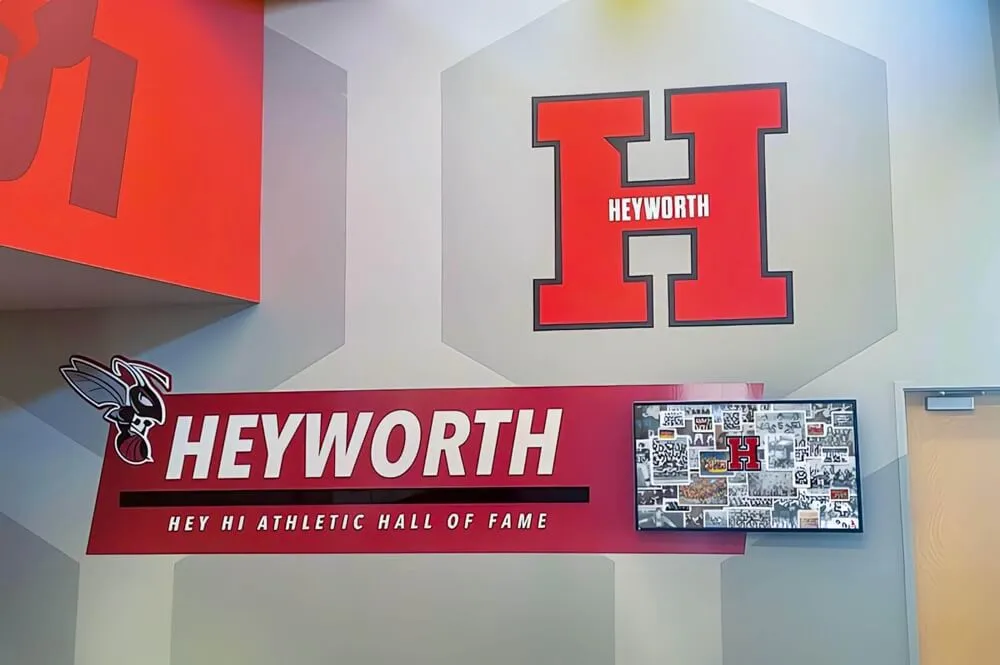
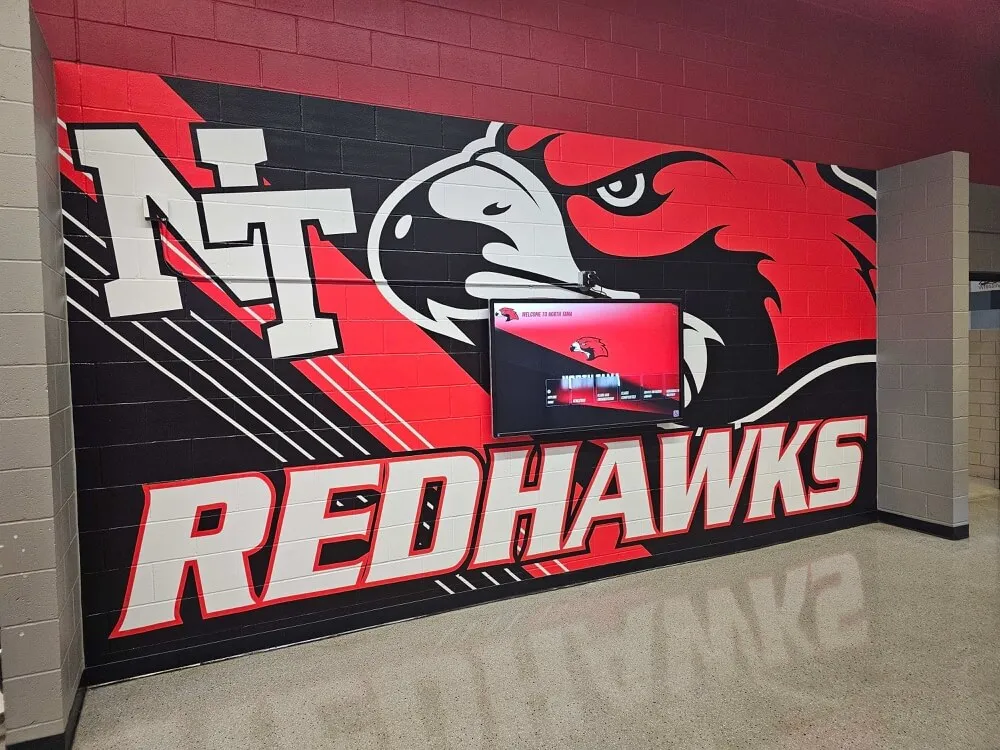
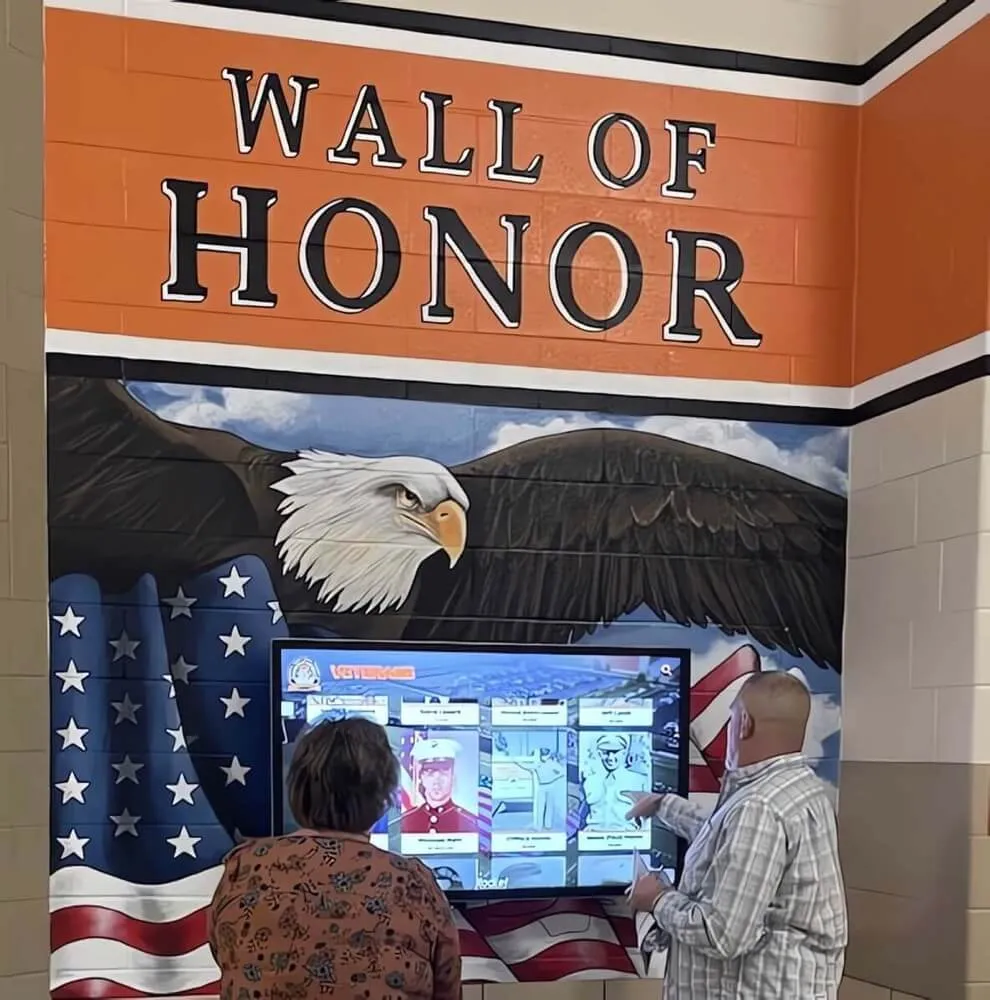
Lobby murals create immersive history environments that communicate school identity to every visitor before they've read a single word
Wall Murals with Integrated History Elements
Painted or printed murals that incorporate historical imagery—vintage team photographs, founding-era building illustrations, progression-of-years collages—create the most visually dramatic traditional history displays available. Unlike framed photographs or plaques that viewers approach and then leave, murals define entire spaces and establish ambient identity.
Murals work best when designed as intentional visual systems rather than collections of individual images. A skilled designer builds a visual narrative into the composition, guiding the viewer’s eye from founding era through current day without requiring explicit labels.
The practical limitation of traditional murals is permanence. Once painted, they require significant effort to update. Schools planning mural-based history displays should:
- Reserve sections for digital screen integration, which allows dynamic content in a static visual framework
- Avoid incorporating content likely to become outdated (specific scores, individual achievements with disputed legacy)
- Design for maximum timelessness in the mural’s core visual language
Digital School History Display Ideas
Digital displays address the fundamental limitation of every traditional format: the inability to grow, update, and add new content without physical intervention. As school history programs accumulate decades of material, the management challenge grows faster than most institutions anticipate.
Interactive Touchscreen History Kiosks
Interactive touchscreen kiosks represent the most powerful school history display technology currently available. Rather than selecting a small fraction of available history for physical display, a touchscreen system stores unlimited content—thousands of photographs, video archives, inductee profiles, championship records, oral history recordings—and makes all of it navigable through intuitive touch interfaces.
The visitor experience differs fundamentally from traditional displays. Rather than scanning a fixed arrangement of photographs and plaques, a visitor explores:
- Timeline interfaces showing the school’s complete history with tap-to-expand detail for any era or event
- Individual inductee profiles with photographs, biographical information, career highlights, and personal connections to the school’s story
- Championship archives organized by sport, year, coach, and achievement type
- Faculty and staff recognition honoring educators who shaped generations of students
- Community connection features linking school history to local history and broader context
Building a digital history archive through touchscreen platforms allows schools to incorporate content types impossible in physical displays—video interviews with alumni, audio recordings from historic events, digitized yearbook collections, game film from championship seasons.
The other defining advantage of touchscreen history displays is remote updateability. New achievements, recent inductees, and updated historical information can be added from any internet-connected device through a cloud-based content management system—no contractor visits, no reprinting, no physical installation required.
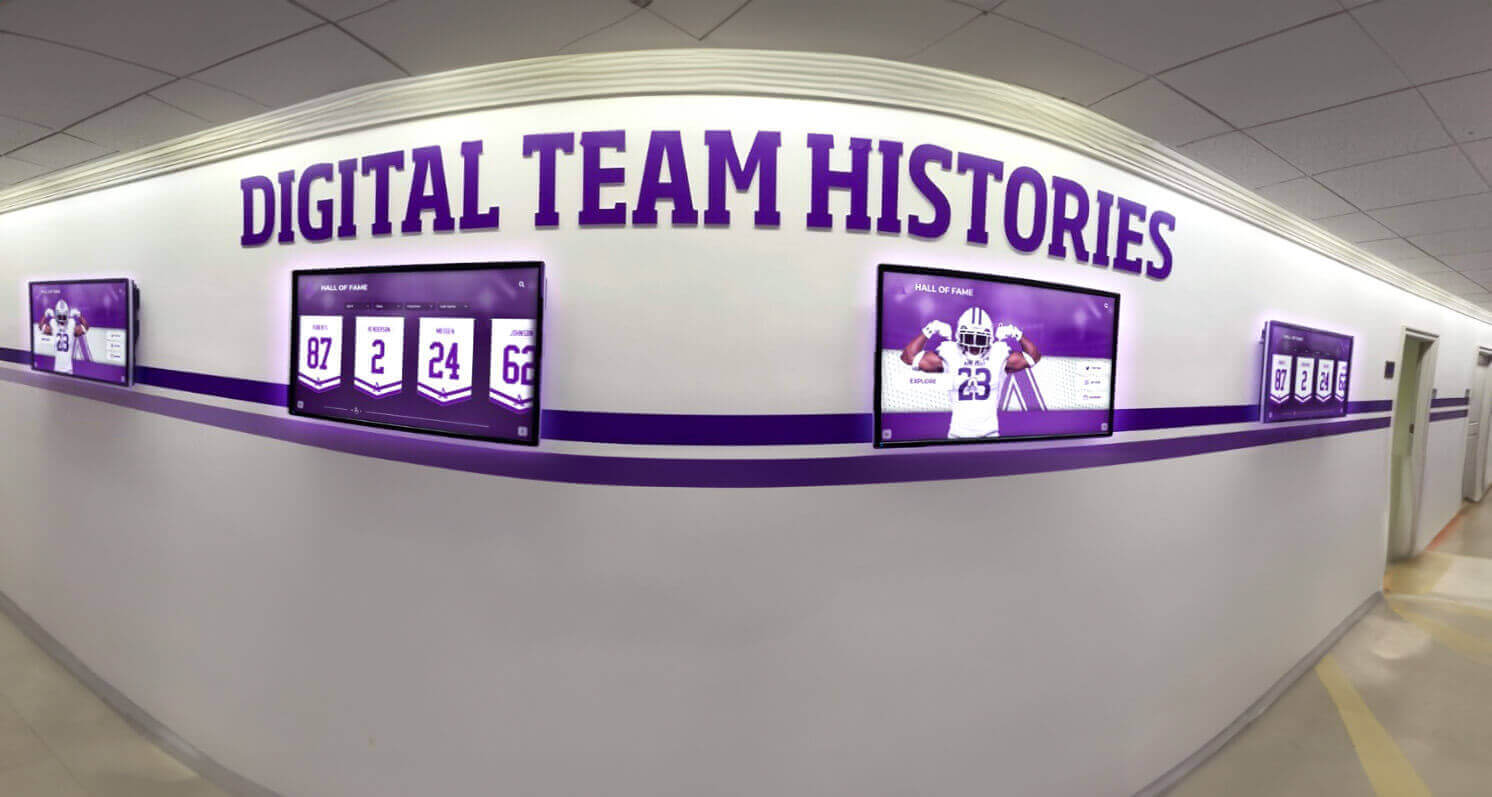
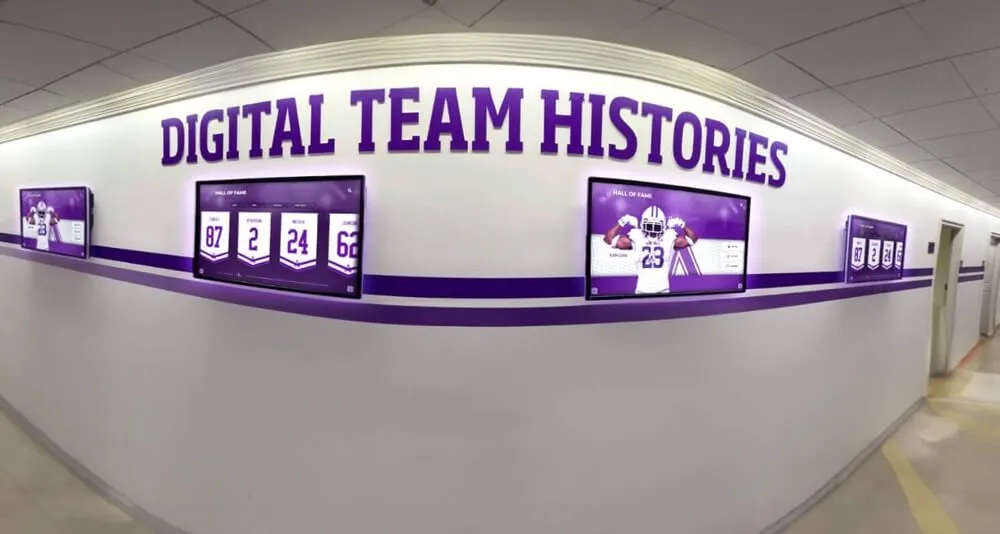
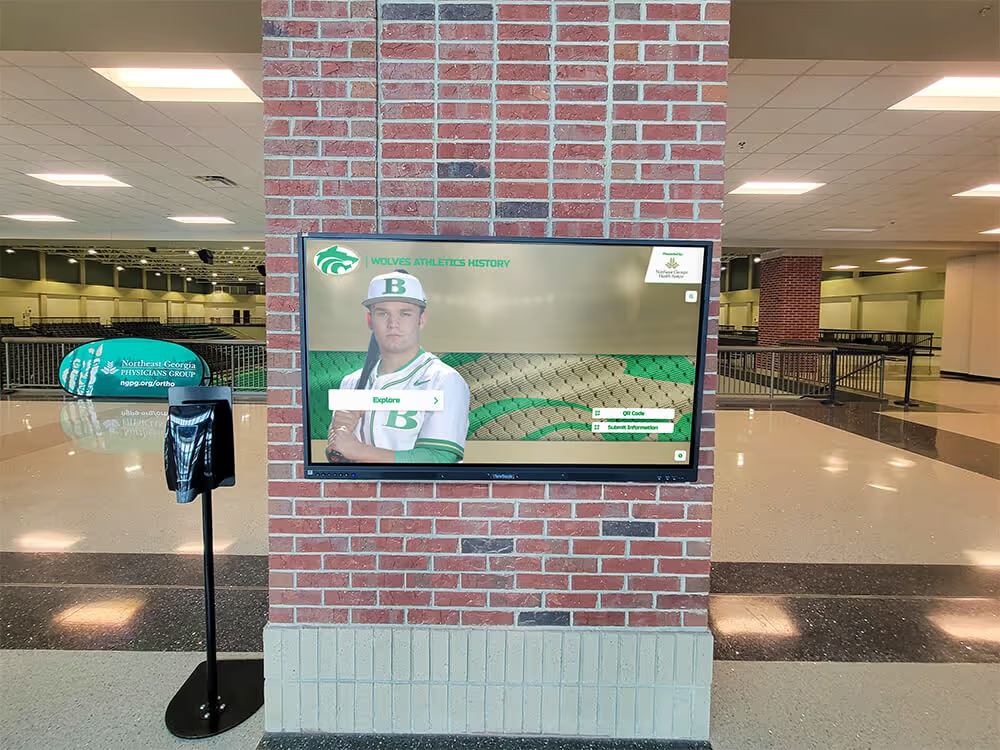
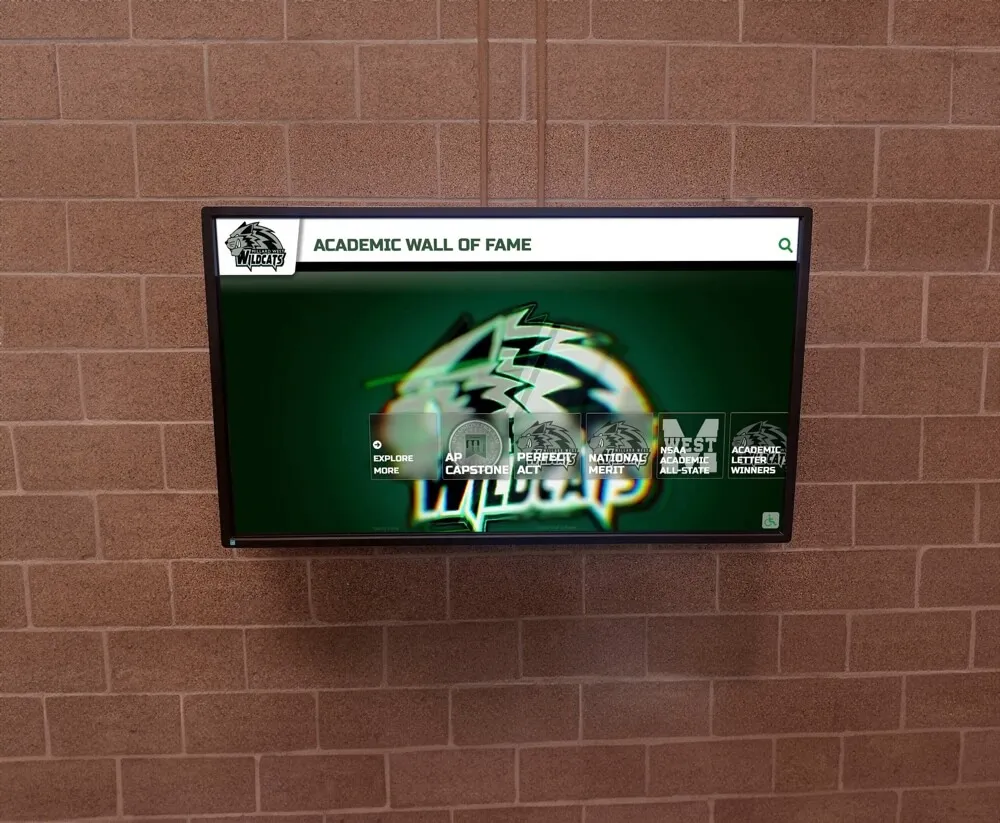
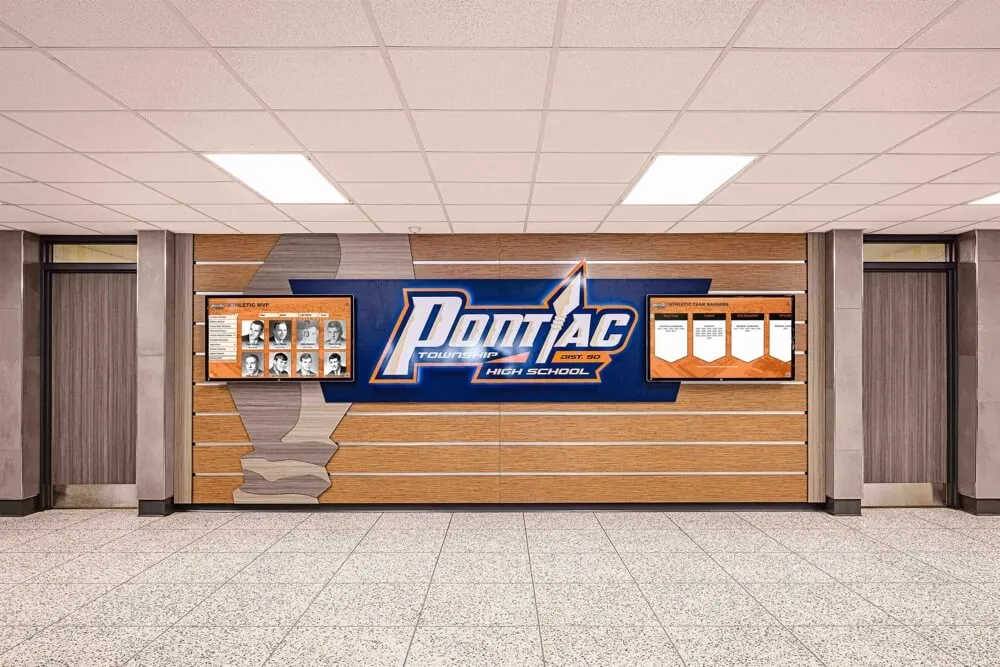
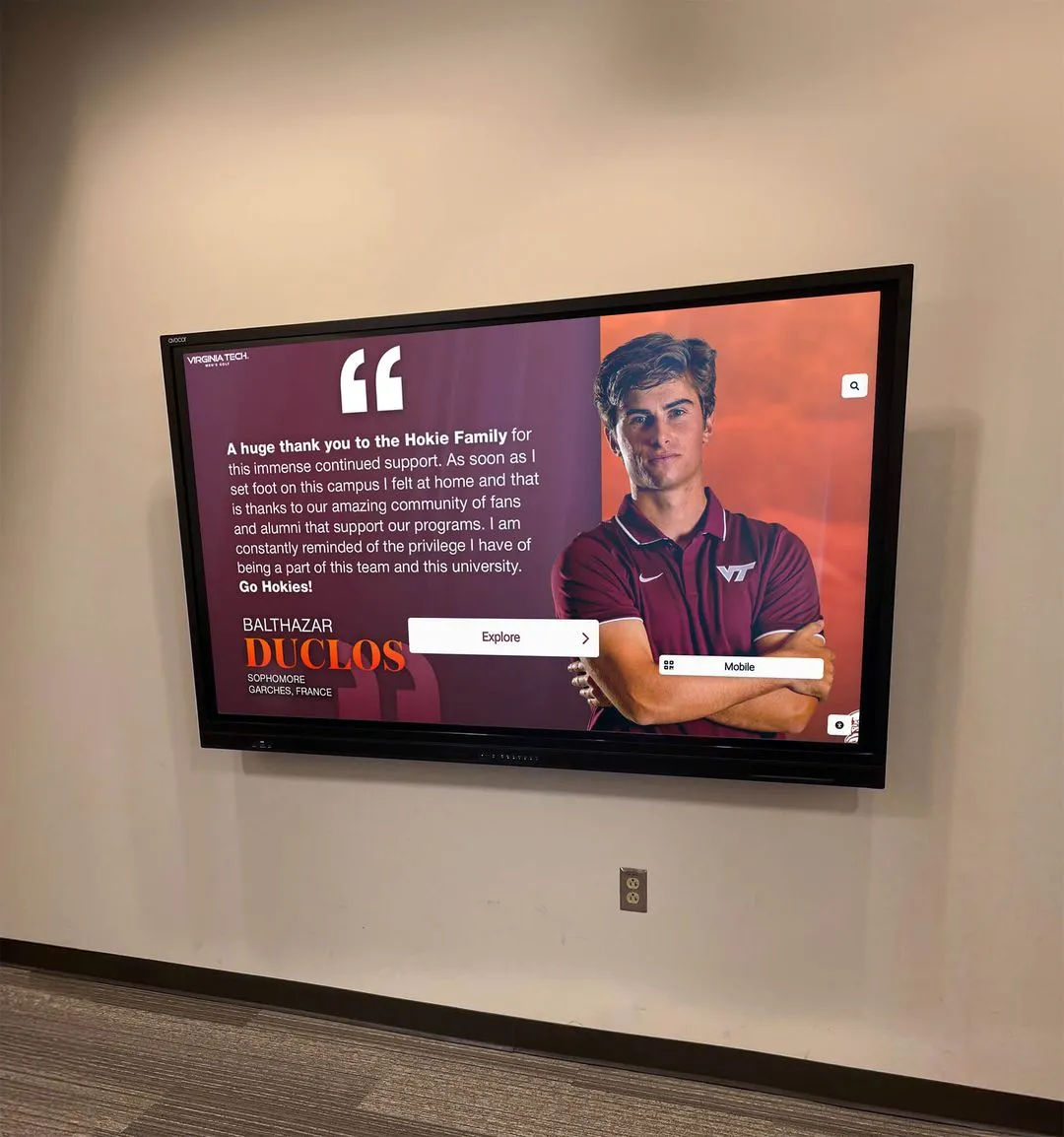
Digital hallway displays create continuous history environments that show team records, portraits, and achievements without space constraints
Full-Service vs. DIY Digital History Displays
Schools considering digital history displays face a fundamental choice between full-service managed installations and do-it-yourself software platforms. Understanding this distinction saves significant time and frustration.
Full-service platforms like Rocket Alumni Solutions provide hardware, software, content management system, professional installation, and ongoing technical support as a unified offering. Schools receive a finished system ready for content population—not a collection of components requiring integration expertise. For institutions without dedicated IT staff or display technology experience, this approach eliminates the gap between purchase and practical use.
DIY platforms provide software tools that schools configure themselves, often requiring separate hardware procurement, installation contracting, and self-managed technical maintenance. For schools with strong in-house technical capacity, this approach offers more customization control. For most schools, the ongoing management burden outweighs the initial cost savings.
School history touchscreen full-service versus DIY approaches examines this choice in detail, including the hidden costs of DIY systems that make full-service options more economical over multi-year deployment windows.
Digital Signage as Living History
Beyond dedicated kiosks, digital signage networks throughout a school building can serve as distributed history display infrastructure. Hallway screens that rotate between current announcements and historical content—this week’s games alongside the 1978 championship game highlights—keep school history visible without requiring visitors to seek it out specifically.
Effective digital signage for school history typically includes:
- “On this day” historical features tying today’s date to relevant school milestones
- Alumni spotlights rotating through distinguished graduates with career updates
- Championship anniversary recognition marking significant victories as their dates arrive each year
- Program history retrospectives showing how individual sports, clubs, or academic departments have evolved
Digital signage for schools creates ambient institutional storytelling that reaches students and visitors who would never specifically seek out a history kiosk.
What to Include in Your School History Display
The content selection challenge is usually the opposite of what schools expect. Most institutions don’t struggle to find enough material—they struggle to decide what to leave out. A structured content framework prevents both overcrowding and the inadvertent omission of important history threads.
Athletic History Content
- State and regional championship seasons with roster documentation
- Individual sport records and statistical leaders
- Athletes who advanced to collegiate or professional competition
- Coaches with significant tenure, win records, or program-building accomplishments
- Historic rivalries and signature rivalry outcomes
- First-season histories for each program
Academic and Intellectual Achievement
- Valedictorians and academic distinction graduates by year
- National Merit Scholars and competitive scholarship recipients
- Academic competition championships (debate, quiz bowl, Science Olympiad)
- Faculty members with distinguished service or external recognition
- Significant research projects or academic innovations originating at the school
Arts and Activities Heritage
- Theater productions with notable performances or alumni connections
- Music ensemble championships and prestigious performance venues
- Visual arts recognition and published works
- Student journalism achievements and publication history
- Leadership organization milestones (student government, service clubs)
Institutional Milestones
- Founding year and original mission documentation
- Facility expansions and campus development timeline
- Accreditation milestones and institutional recognition
- Major donor contributions and named facility history
- Community partnerships and service program origins
- Significant faculty and administrative tenure milestones
Alumni Legacy Content
Distinguished alumni recognition adds depth to any school history display by connecting institutional history to outcomes in the wider world. Highlighting famous alumni through career achievement profiles, community contribution documentation, and visible recognition creates the most compelling content in the display for first-time visitors.
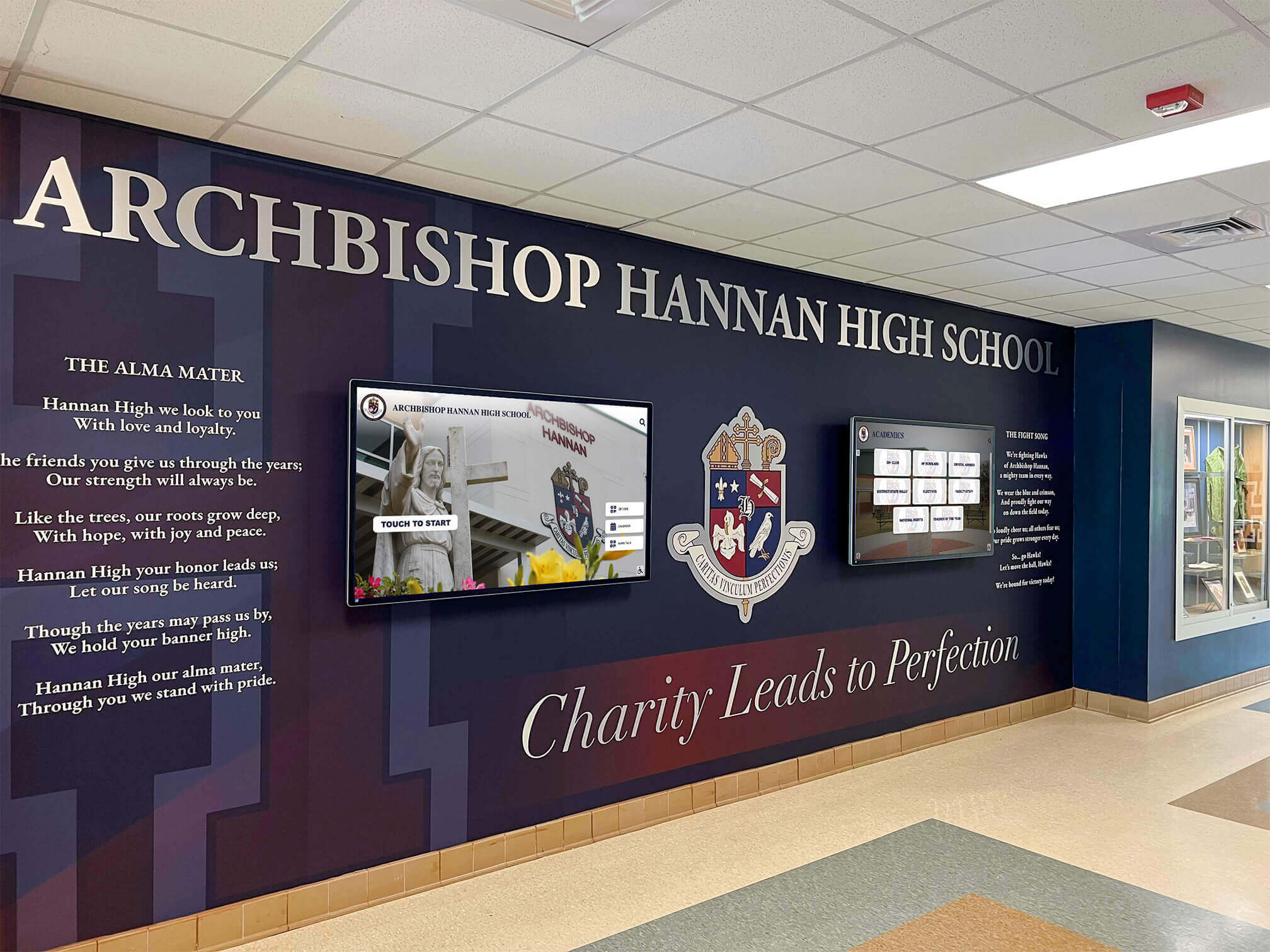
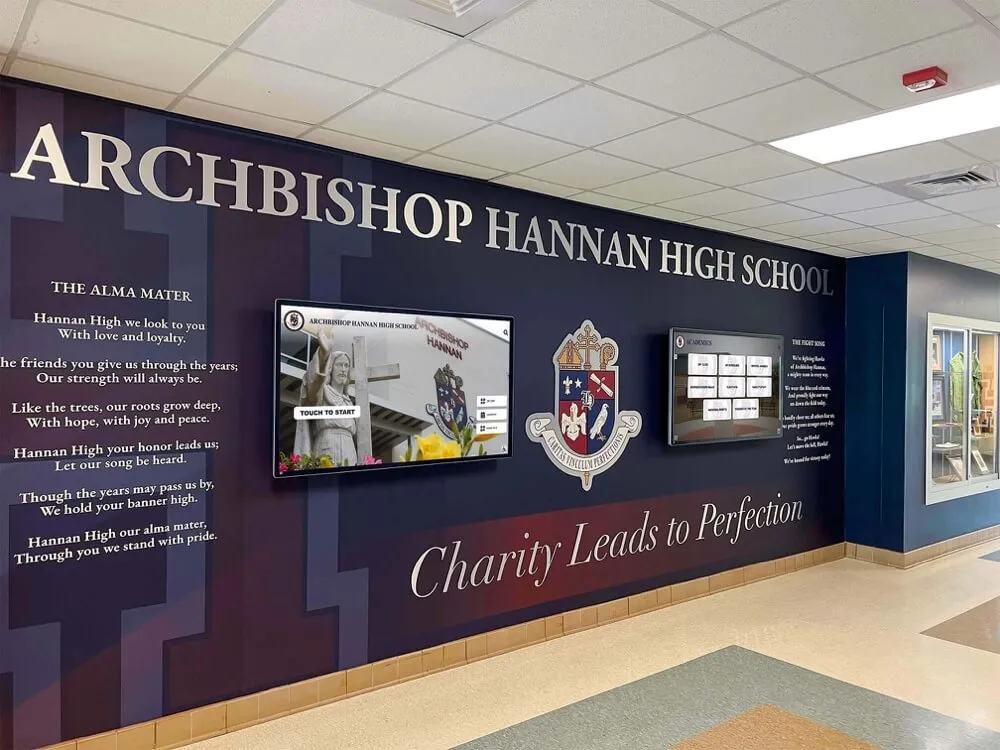
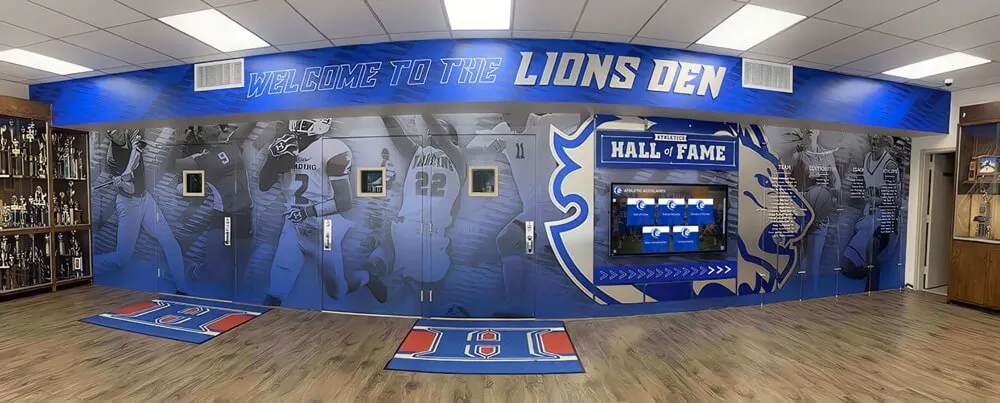
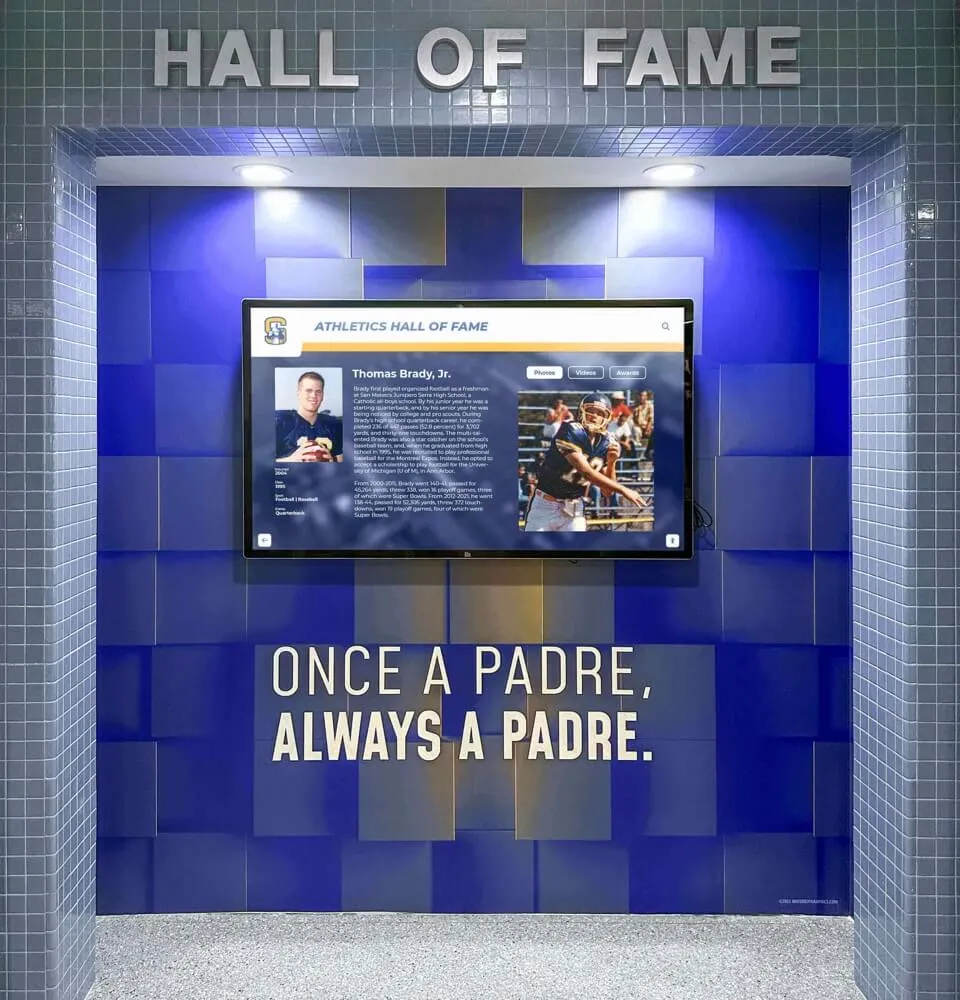
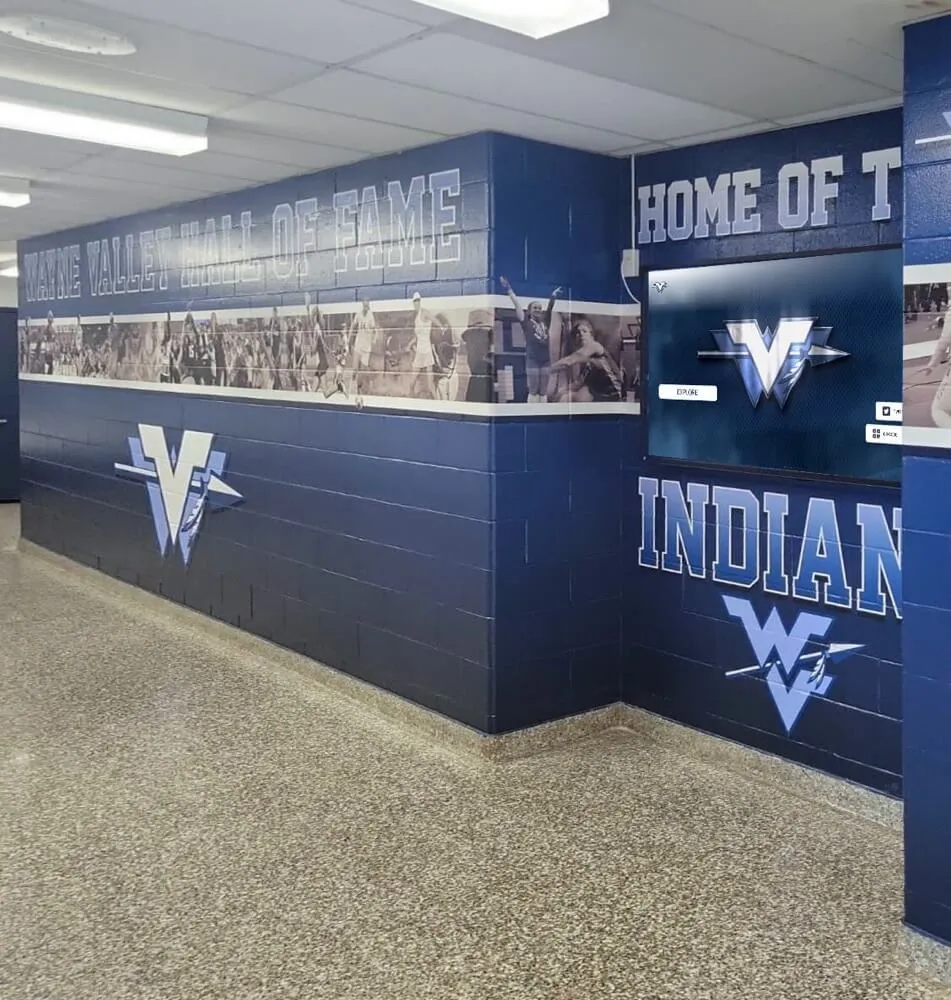
Combining heritage murals with integrated digital screens allows schools to maintain traditional visual identity while providing unlimited content depth through interactive technology
Organizing School History Across Generations
How history is organized determines whether visitors can navigate it meaningfully. Schools with fifty or more years of documented history face real organizational challenges—the sheer volume of content creates navigation problems that layout and taxonomy must solve.
Era-Based Organization
Dividing school history into named eras based on significant institutional transitions—founding era, expansion period, championship dynasty years, current era—creates natural organizing categories that give visitors cognitive anchors. Each era can be characterized by its distinctive context: the economic conditions affecting the school’s community, the sports programs that defined that period, the faculty who shaped those years.
Era-based organization works particularly well for schools with distinct historical chapters. A school that consolidated with a neighboring district in 1975, moved to a new campus in 1992, and achieved national academic recognition in 2008 has three clear chapter breaks around which history can be organized.
Thematic Organization
Some schools organize their history display around themes rather than time periods:
“Champions and Achievers”: Athletic and academic achievement across all eras “Builders and Leaders”: Faculty, staff, administrators, and alumni who shaped the institution “The Community We Serve”: History organized around the school’s relationship to its surrounding community “Programs and Their Origins”: How each major program, sport, or department came to exist
Thematic organization works best when the school has a strong, clear identity that translates naturally into a small number of meaningful themes.
Chronological Organization with Curated Highlights
For most schools, a chronological framework with curated milestone callouts provides the best balance of navigability and completeness. The chronological backbone gives visitors temporal orientation; the curated highlights ensure key moments receive appropriate emphasis rather than being buried in a uniform timeline.
Alumni wall display ideas frequently inform school history organization decisions, since alumni recognition is typically the content category with the longest timeline and the most complex sorting logic.
School History Displays for Different Spaces
The right display format depends significantly on where it will live. Each school space creates different visitor contexts, dwell times, and navigation behaviors that the display should be designed around.
Main Lobby
The main lobby display serves the widest audience—every visitor, every day. Content here should be immediately readable without close inspection, visually impressive from a distance, and oriented toward institutional pride rather than detailed documentation. A hero image, founding year, and key achievement callouts work better here than comprehensive name lists.
For digital displays in main lobbies, auto-playing video content showing historical moments, current students, and alumni spotlights creates the most engaging ambient experience without requiring visitor interaction.
Athletics Hallways
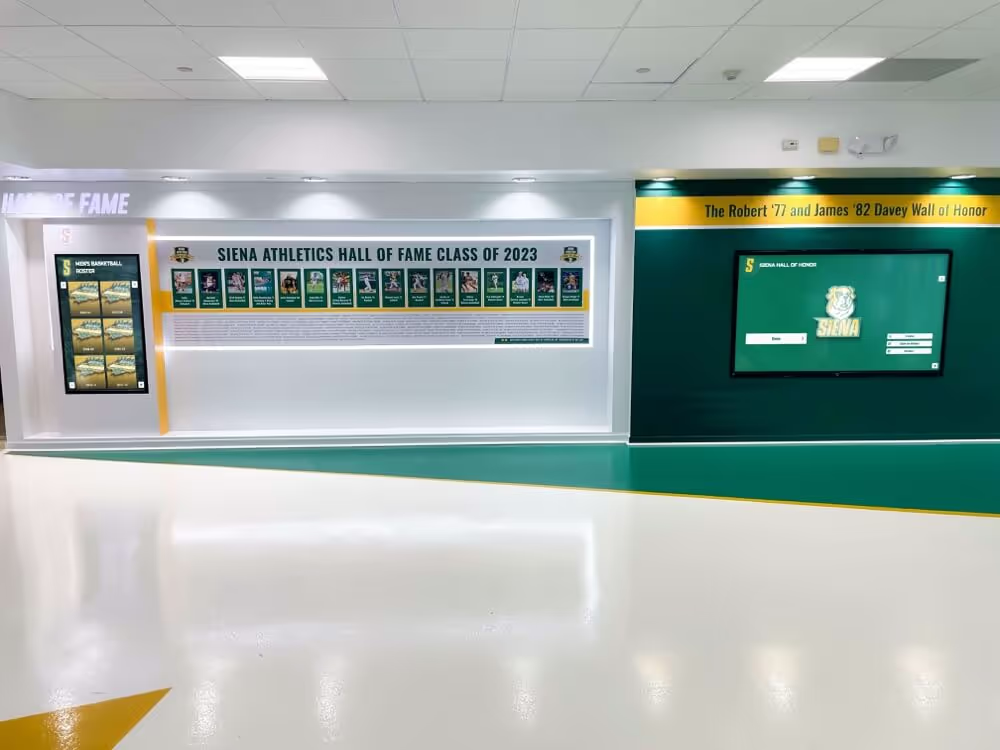
Athletics hallways are natural homes for the most comprehensive school history displays because they already draw the most traffic from the audiences most interested in historical depth—athletes, parents, alumni, and recruiting families. The extended dwell time of visitors waiting before games or practices makes detailed content appropriate here.
Campus wayfinding principles apply directly to athletics hallway history displays: directional logic, clear entry and exit points, and content density calibrated to natural walking pace.
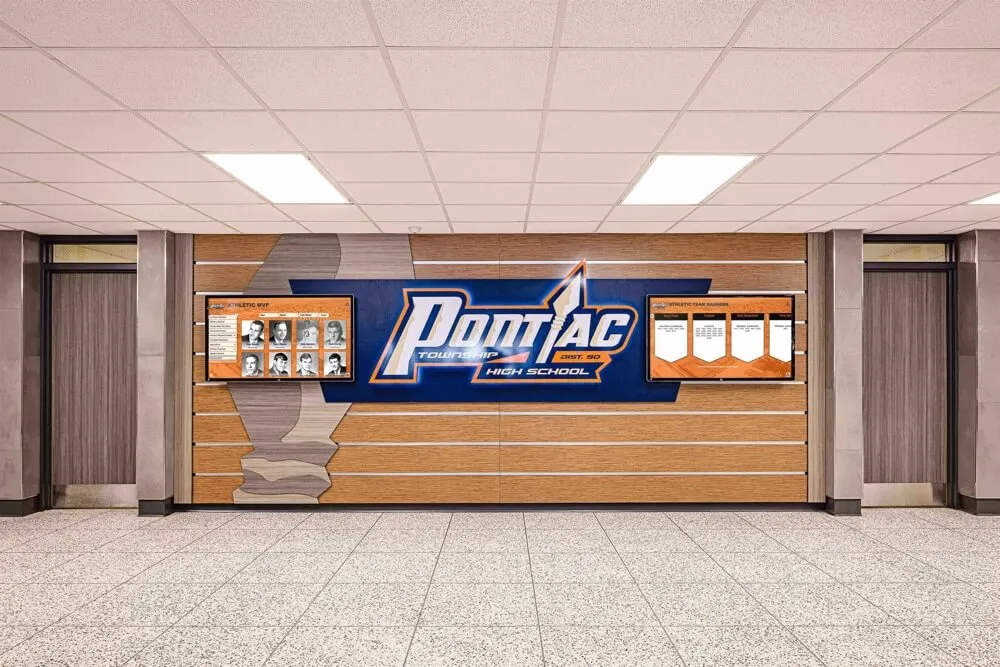
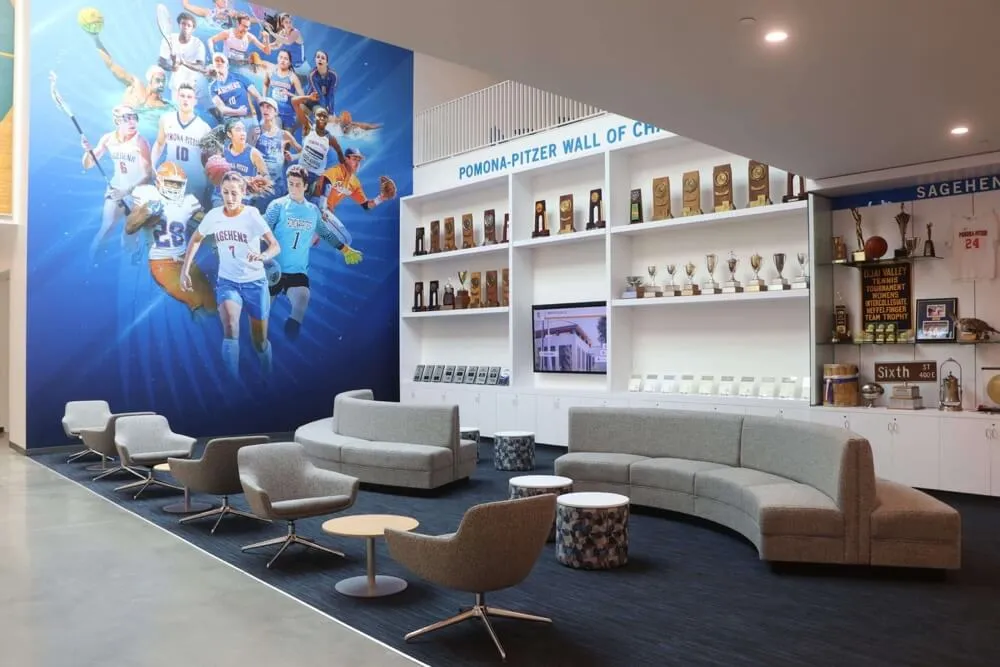
Dedicated athletics hallways provide extended wall space and naturally concentrated audiences for comprehensive school history displays
Library and Media Center
Library and media center history displays serve a research-oriented audience that expects depth. Students doing school history projects, community researchers, and returning alumni often seek the library specifically for historical documentation. This context supports more text-dense formats, document reproduction displays, and deep archive access through touchscreen systems.
Gymnasium and Auditorium Lobbies
Pre-event lobbies see concentrated traffic in short windows—the fifteen minutes before a basketball game or school concert fills these spaces with engaged visitors who have time to explore a display. Seasonal content updates that highlight current team accomplishments alongside historical context keep these displays fresh for repeat visitors.
Going Beyond Athletics: Full Institutional History
Many school history displays default to an athletics-focused narrative because athletic achievements are the most systematically documented category of school history. But schools that limit their history displays to athletics misrepresent themselves—and miss the alumni audiences whose school experience was defined by academics, arts, or community service rather than sport.
A genuinely comprehensive school history display dedicates meaningful space to:
Academic excellence history: The valedictorian from 1968, the debate team that won nationals in 1994, the student who earned a presidential scholarship in 2002—these achievements represent the school’s intellectual character and deserve recognition equal to championship athletics.
Arts and performance heritage: Theater productions, music ensembles, visual arts exhibitions, and student publications are often the aspects of school life alumni remember most vividly. Documenting this history honors the students who devoted their school years to creative achievement.
Faculty and staff legacy: Long-serving educators who shaped generations of students are often absent from school history displays entirely. A dedicated section honoring distinguished faculty—thirty-year teachers, beloved counselors, legendary coaches who shaped the school’s culture—adds depth that resonates with alumni who remember these individuals.
Service and community contribution: Schools that have organized significant community service programs, sent students on meaningful service trips, or partnered with local organizations over decades have a service history worth celebrating.
Many schools find that their most powerful history display moments come from the categories they almost didn’t include—the mathematics teacher who served for forty years, the theater program that produced a working actor, the service club that planted a thousand trees.
From Static to Interactive: The Digital Upgrade Path
Schools with existing physical history displays don’t face a binary choice between keeping what they have and starting over with digital technology. Most effective contemporary school history environments combine both approaches.
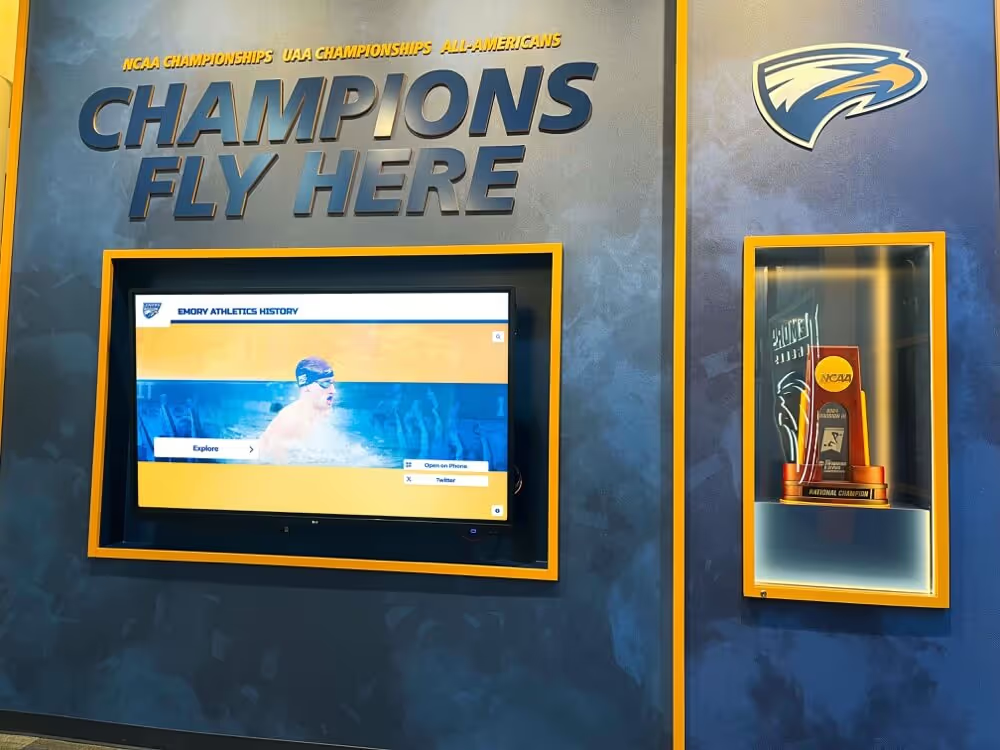
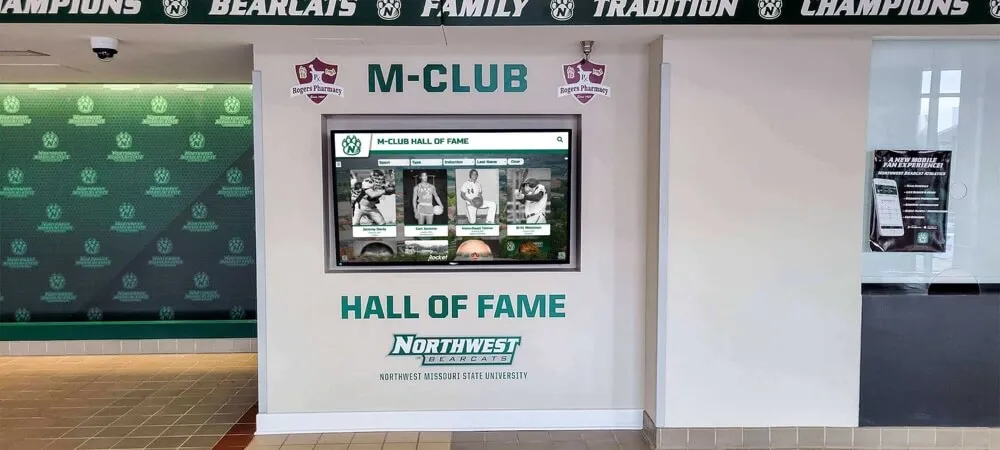
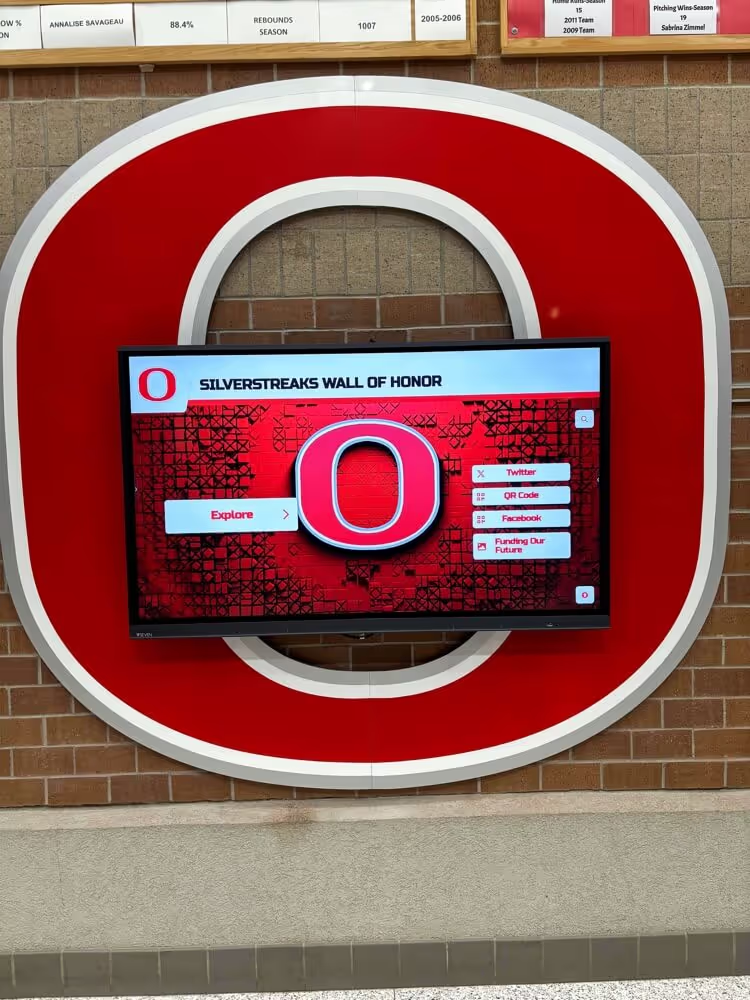
Integrated digital screens in traditional display walls: A hallway lined with physical plaques and championship photos becomes significantly more powerful when a digital screen is integrated at eye level, displaying video archives, rotating alumni spotlights, and historical content that supplements the static material.
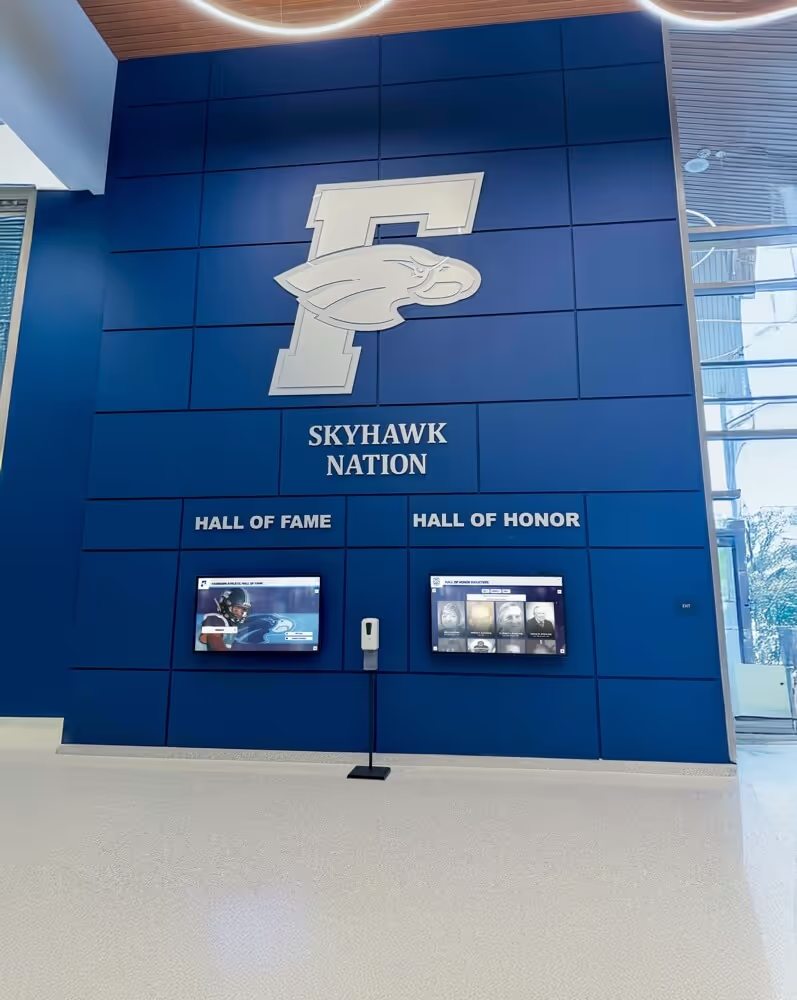
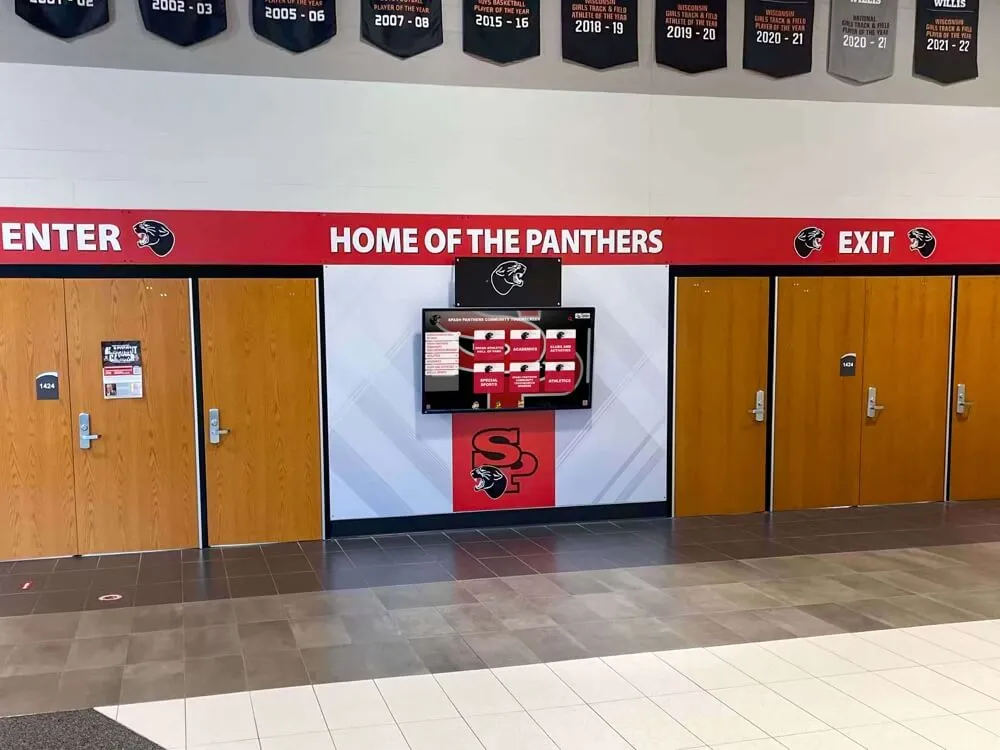
Touchscreen kiosks alongside traditional displays: A freestanding or wall-mounted touchscreen kiosk adjacent to traditional display cases gives visitors who want deeper engagement an obvious path while the physical displays continue serving casual passersby.
Full digital migration for content that has outgrown physical space: When a trophy case is full and a plaque wall has no more room, transitioning from physical storage to digital recognition preserves the historical record while permanently solving the space problem.
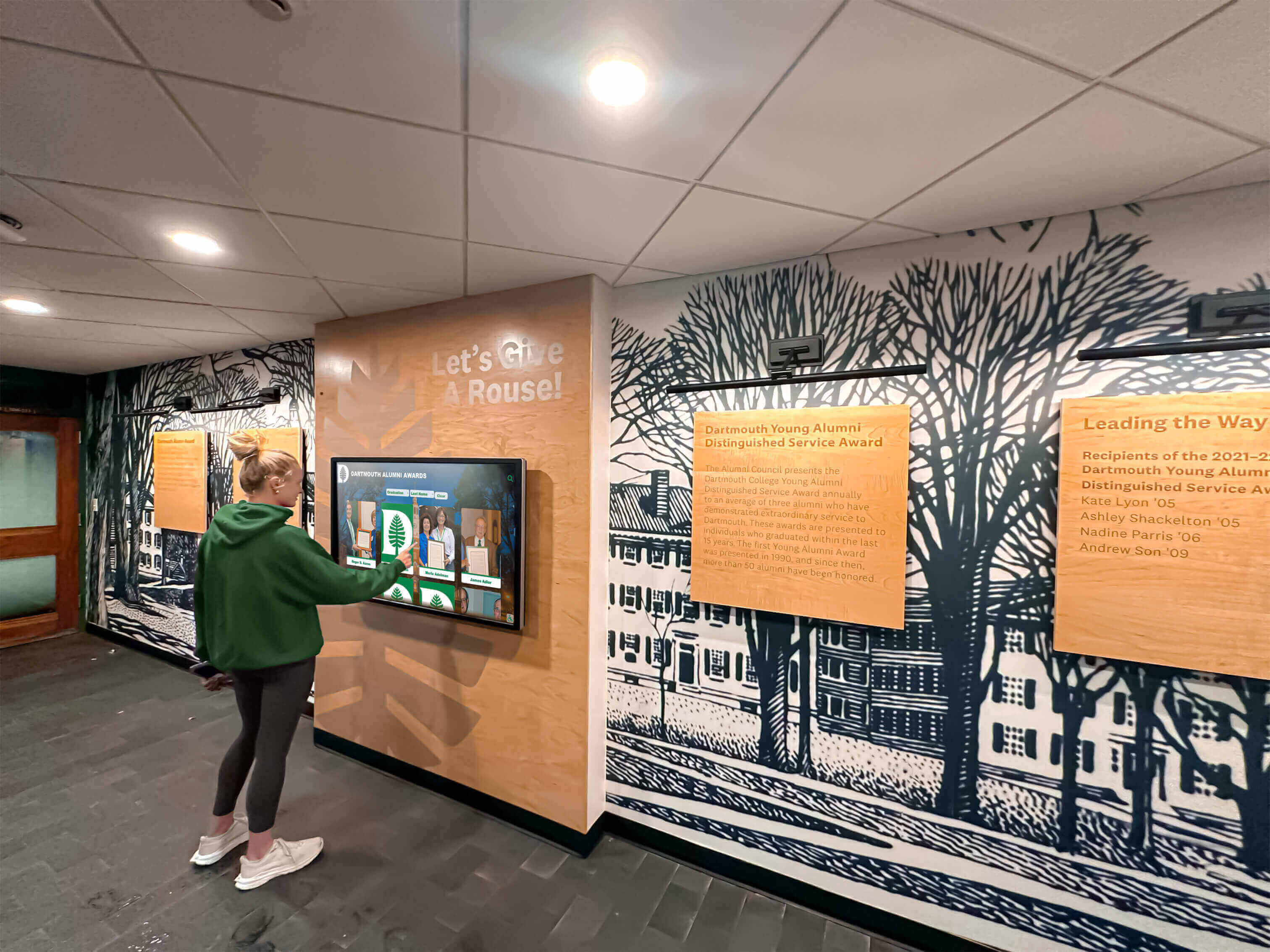
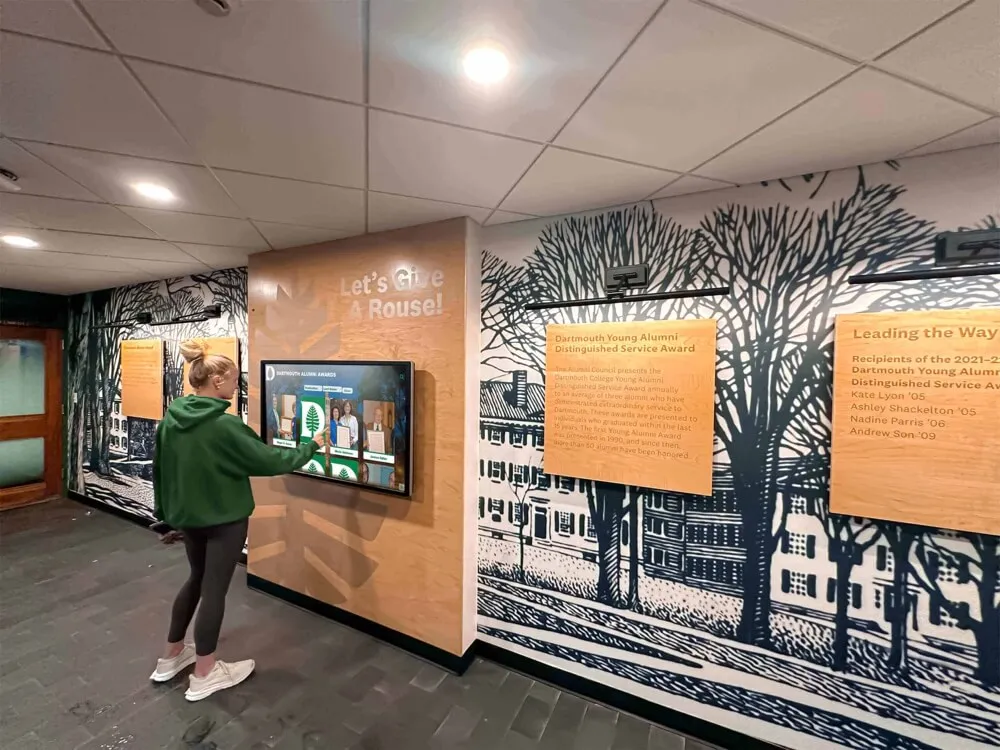
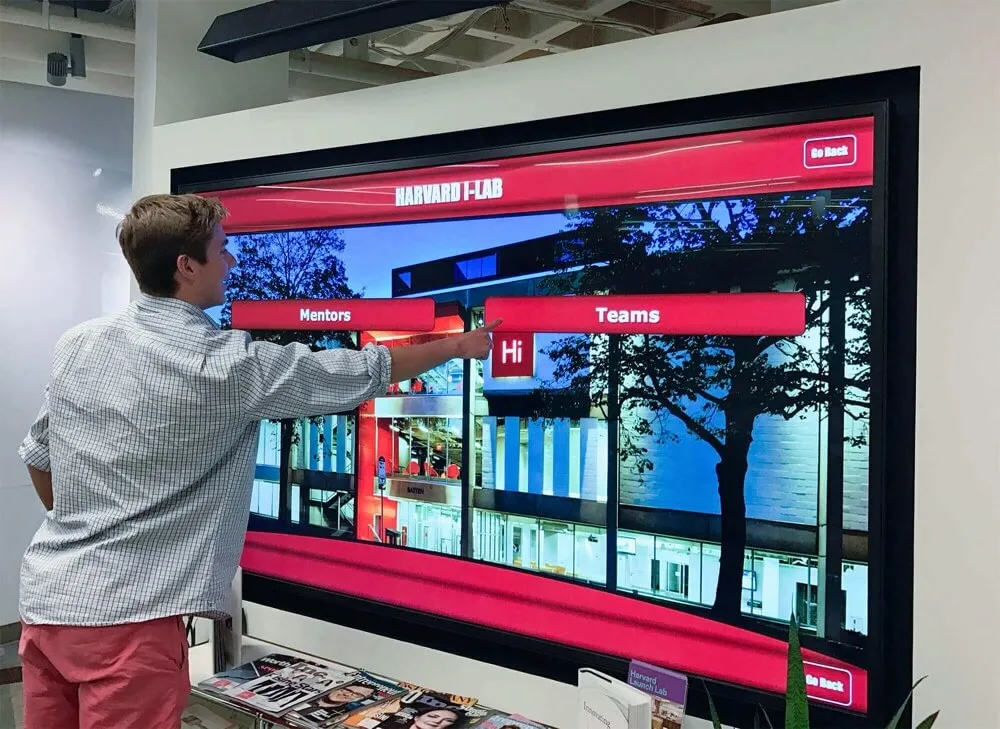
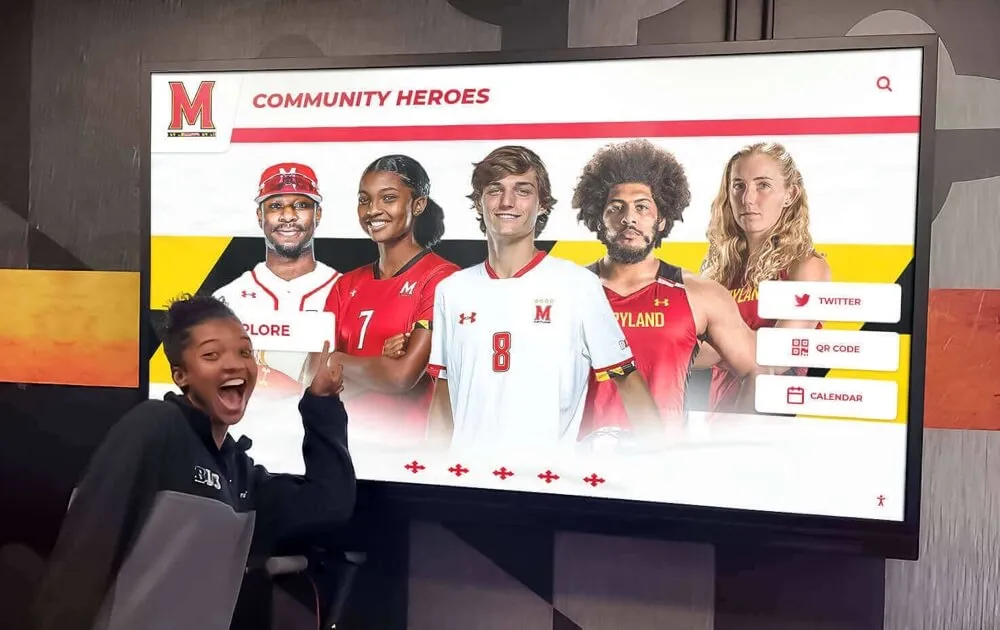
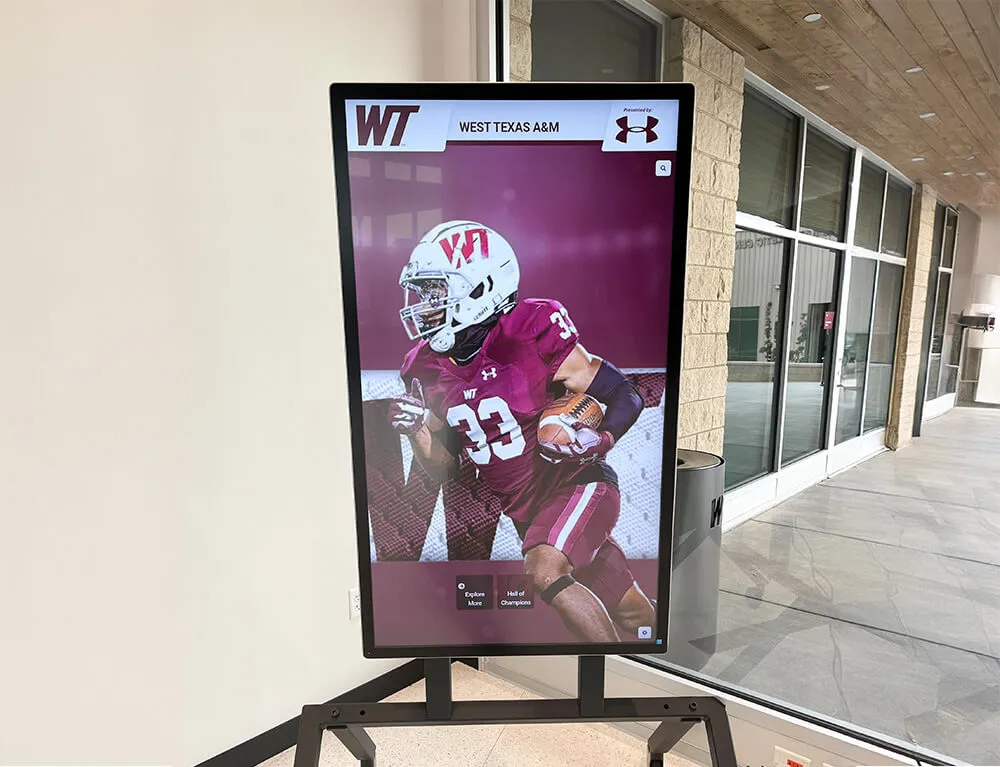
Interactive touchscreen displays engage current students with school history content in ways that static plaques and photographs cannot replicate
What Rocket Alumni Solutions Offers
Rocket Alumni Solutions provides turnkey touchscreen display systems specifically designed for school history and hall of fame applications. The platform combines:
- Any-size touchscreen compatibility: From compact 43-inch hallway displays to large-format 98-inch lobby installations
- Unlimited content storage: Photographs, videos, documents, and inductee profiles without tier limits
- Cloud-based remote CMS: Update content from any device without visiting the school
- ADA WCAG 2.1 AA compliance: Ensuring history displays are accessible to all visitors
- Professional installation and training: Hardware delivery, wall mounting, network setup, and staff training included
- QR code mobile access: Visitors continue exploring school history on personal devices after leaving the physical display location
- Sponsorship revenue suite: Generate ongoing revenue through display sponsorships that offset system costs
The touchscreen digital hall of fame format Rocket delivers is purpose-built for school history environments—not a generic digital signage platform repurposed for recognition, but software and hardware designed from the ground up for inductee profiles, chronological archives, and multi-category history navigation.
Getting Started with Your School History Display
Regardless of the format you choose, the most important first step is content inventory. Schools consistently underestimate what they have and overestimate how difficult it will be to organize.
Step 1: Conduct a full content audit Assign someone to catalog every photograph, trophy, plaque, document, and artifact currently in the school’s possession. Include items in storage—many schools are surprised to discover how much award and display material has accumulated in closets and back rooms over the decades, representing hidden history waiting to be surfaced.
Step 2: Identify your content gaps Once you know what you have, you’ll see clearly where the documented record is thin. Early decades often have sparse photographic coverage; some programs may have no documentation at all. Targeted alumni outreach campaigns can fill many gaps with material families have preserved privately.
Step 3: Define your organizational framework Choose chronological, thematic, or era-based organization before designing any physical or digital display. The organizational framework determines how visitors navigate the content; retrofitting it after design is expensive.
Step 4: Choose your display format based on your space and budget Traditional displays make sense for limited budgets and spaces without convenient power access. Digital touchscreen systems make sense for schools with ongoing content to add, high visitor traffic, and the desire for a future-proof solution.
Step 5: Plan for ongoing content management The most common school history display failure is a display that was impressive at installation and hasn’t been updated since. Budget time and responsibility for ongoing content additions. A display that adds five new inductees per year is a living document; a display that freezes at installation becomes historical artifact rather than active recognition.
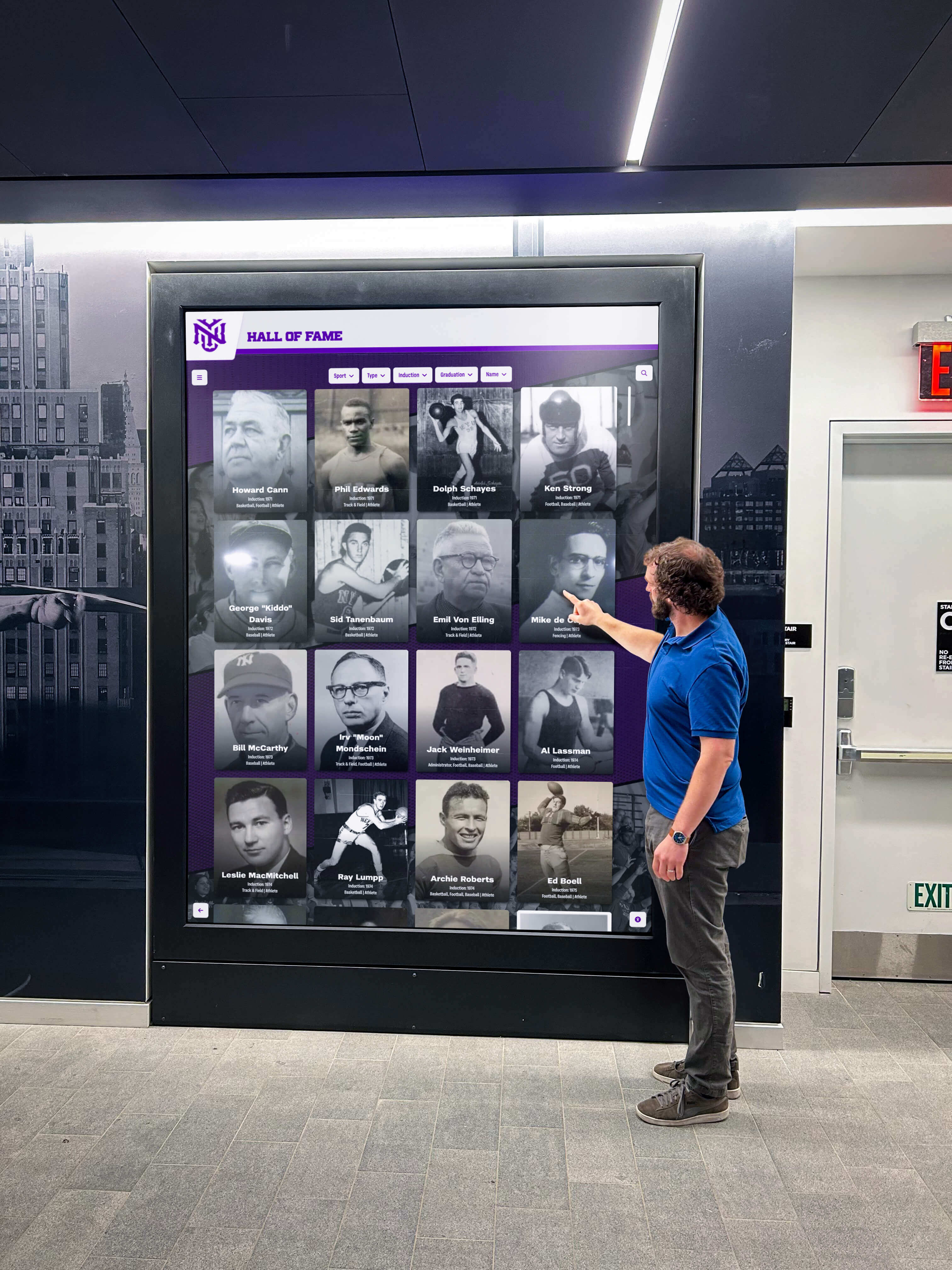
When school history displays are engaging and accessible, visitors naturally spend more time with them—deepening alumni connection and institutional pride with every interaction
Conclusion
A school’s history is one of its most underutilized assets. Decades of achievement, service, sacrifice, and excellence sit in archives, storage rooms, and community memories, waiting for a display system that can surface them in ways that matter. Whether you start with a chronological timeline wall in the main lobby, a dedicated heritage alcove in the library, or a fully interactive touchscreen installation in the athletics hallway, the fundamental goal is the same: making the school’s story visible, navigable, and relevant to everyone who walks through the door today.
The best school history displays don’t just document the past—they shape how current students understand their own potential and how alumni experience their ongoing connection to the institution. That’s worth investing in carefully.
Ready to transform your school’s legacy into a display that honors the past and engages every generation? Request a custom demo from Rocket Alumni Solutions to see how interactive touchscreen history displays work in real school environments.
Live Example: Rocket Alumni Solutions Touchscreen Display
Interact with a live example (16:9 scaled 1920x1080 display). All content is automatically responsive to all screen sizes and orientations.